 Bird Album
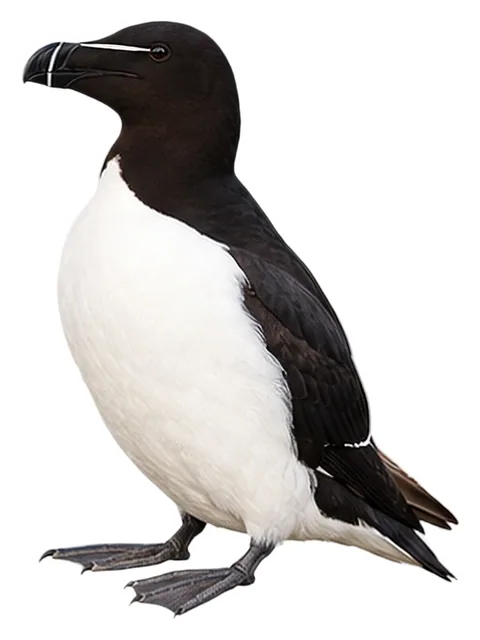
Razorbill
Alca torda Linnaeus, 1758
726 gWeight
The razorbill (Alca torda) is a North Atlantic colonial seabird and the only extant member of the genus Alca of the family Alcidae, the auks.
Busiest months: May and October · Most records: United Kingdom, United States, Canada
Where and when it's recorded

Razorbill has been recorded at 365 of the 8,171 birding hotspots we track, in 31 countries and regions.
Records by month Northern Hemisphere
Where it's recorded most
- Quai, Pointe-au-PèreCanada3,293 records
- Bempton Cliffs RSPB ReserveUnited Kingdom3,066 records
- Parker River NWRUnited States1,903 records
More places
- Whitburn Coastal ParkUnited Kingdom1,662 records
- Halibut Point SPUnited States1,466 records
- Rivière-OuelleCanada1,327 records
- PN Sintra-Cascais – Cabo RasoPortugal1,074 records
- GirdlenessUnited Kingdom1,009 records
- Ocean City InletUnited States997 records
- Portland BillUnited Kingdom973 records
Countries and regions with the most records
eBird records via GBIF up to 2024-12-31. A record means someone listed it; more records partly mean more birders, not more birds.
About
The razorbill (Alca torda) is a North Atlantic colonial seabird and the only extant member of the genus Alca of the family Alcidae, the auks. It is the closest living relative of the extinct great auk (Pinguinus impennis). Historically, it has also been known as "auk", "razor-billed auk" and "lesser auk".
Excerpt from Wikipedia, CC BY-SA 4.0 · authors · Read more on Wikipedia
Questions
How big is the Razorbill?
The Razorbill weighs around 726 g.
Where does the Razorbill live?
Its breeding range: North America, Palearctic: low Arctic to northern temperate North Atlantic coasts: Greenland, Iceland, British Isles to Scandinavia, northwestern France and the White Sea (northwestern Russia), northeastern Canada to Gulf of Maine. It is most often recorded in United Kingdom, United States and Canada.
When is the best time to see the Razorbill?
At the hotspots we track, it is recorded most in May and October (Northern Hemisphere).
Is the Razorbill endangered?
The IUCN Red List classifies the Razorbill as Least Concern.
What does the Razorbill eat?
Main food: Fish, shrimp & shellfish.
What family is the Razorbill in?
It belongs to the family Auks (Alcidae), order Charadriiformes.
At a glance
- Weight
- 726 g
- Habitat
- Ocean
- Diet
- Fish, shrimp & shellfish
- Lifestyle
- On the water surface
- Migration
- Migratory
- Conservation
- Least Concern
More measurements
- Wing
- 209 mm
- Tail
- 95 mm
- Bill
- 43 mm
- Tarsus
- 32 mm
Averages from the AVONET dataset; length from field guides where available.
Range
North America, Palearctic: low Arctic to northern temperate North Atlantic coasts: Greenland, Iceland, British Isles to Scandinavia, northwestern France and the White Sea (northwestern Russia), northeastern Canada to Gulf of Maine
Breeding range, IOC World Bird List 15.2
Classification
- Order
- Charadriiformes
- Family
- Auks Alcidae
- Genus
- Alca
More from the family Auks
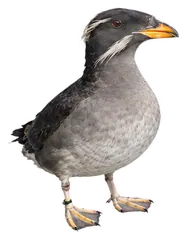 Rhinoceros AukletCerorhinca monocerata
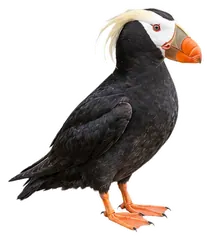 Tufted PuffinFratercula cirrhata
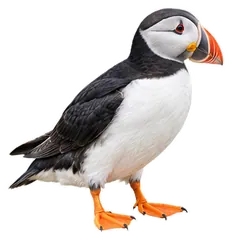 Atlantic PuffinFratercula arctica
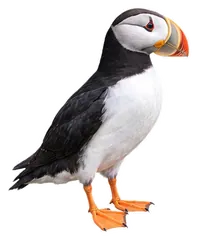 Horned PuffinFratercula corniculata
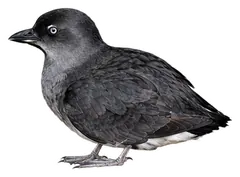 Cassin's AukletPtychoramphus aleuticus
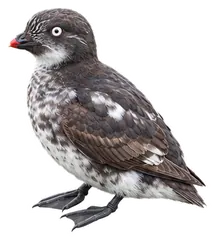 Least AukletAethia pusilla
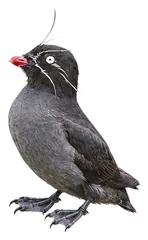 Whiskered AukletAethia pygmaea
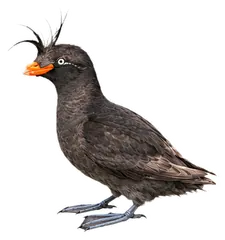 Crested AukletAethia cristatella
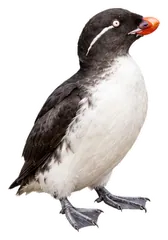 Parakeet AukletAethia psittacula
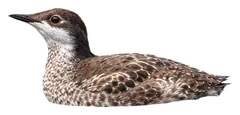 Long-billed MurreletBrachyramphus perdix
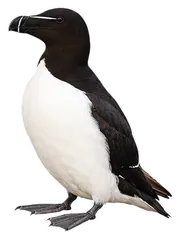
Download illustration
Free to use with credit: “Illustration: Bird Album (birdalbum.com)”. Drawn by AI from a reference photo by Mark Price. ↗
Heard it but can't see it? Mingji identifies birds by sound and photo, on your phone.