 Bird Album
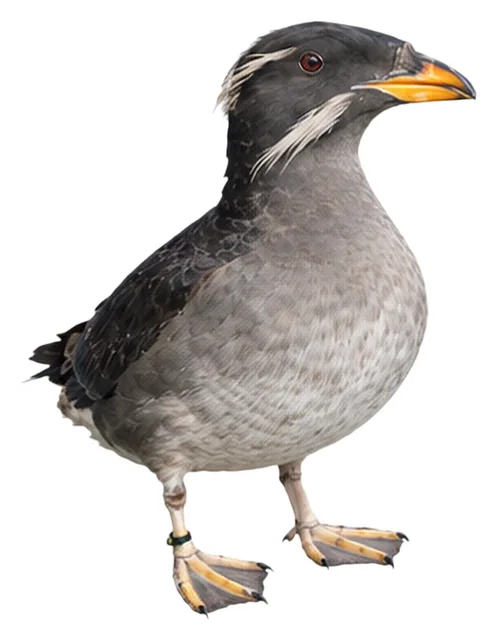
Rhinoceros Auklet
Cerorhinca monocerata (Pallas, 1811)
≈36 cmLength62 cmWingspan482 gWeight
Adults in the breeding season have a small horn on the bill and white facial plumes.
Busiest months: November · Most records: United States, Canada, Japan
How to identify
Field marks
- Adults in the breeding season have a horn-like structure on the bill
- Adults in the breeding season have white feathers above the eyes and behind the bill
- Dark upperparts and paler underparts
- Plump body and short wings
Male, female and young
The male is slightly larger, weighing about 10% more than the female; both adult sexes have white facial plumes in the breeding season.
Where and when it's recorded

Rhinoceros Auklet has been recorded at 61 of the 8,171 birding hotspots we track, in 4 countries and regions.
Records by month Northern Hemisphere
Where it's recorded most
- Pt. Pinos – seawatch onlyUnited States8,960 records
- Southeast Farallon IslandUnited States6,986 records
- Point No PointUnited States4,675 records
More places
- Rocky Point Bird ObservatoryCanada4,194 records
- Edmonds WaterfrontUnited States3,889 records
- Discovery ParkUnited States3,798 records
- Clover PointCanada3,115 records
- Gardiner BeachUnited States1,911 records
- Oak Bay – Cattle PointCanada1,354 records
- Esquimalt LagoonCanada1,278 records
Countries and regions with the most records
eBird records via GBIF up to 2024-12-31. A record means someone listed it; more records partly mean more birders, not more birds.
About
The rhinoceros auklet (Cerorhinca monocerata) is a seabird and a close relative of the puffins. It is the only extant species of the genus Cerorhinca. Given its close relationship with the puffins, the common name rhinoceros puffin has been proposed for the species.
Excerpt from Wikipedia, CC BY-SA 4.0 · authors · Read more on Wikipedia
Questions
How big is the Rhinoceros Auklet?
The Rhinoceros Auklet is about ≈36 cm long, with a wingspan of 62 cm and weighs around 482 g.
Where does the Rhinoceros Auklet live?
Its breeding range: Palearctic, North America: temperate North Pacific coasts: off Sakhalin and Kuril Islands (southeastern Russia), Hokkaido and northern Honshu (northern Japan), Aleutian Islands, southern, southeastern Alaska to southern California. It is most often recorded in United States, Canada and Japan.
When is the best time to see the Rhinoceros Auklet?
At the hotspots we track, it is recorded most in November (Northern Hemisphere).
Is the Rhinoceros Auklet endangered?
The IUCN Red List classifies the Rhinoceros Auklet as Least Concern.
What does the Rhinoceros Auklet eat?
Main food: Fish, shrimp & shellfish.
What family is the Rhinoceros Auklet in?
It belongs to the family Auks (Alcidae), order Charadriiformes.
At a glance
- Length
- ≈36 cm
- Wingspan
- 62 cm
- Weight
- 482 g
- Habitat
- Ocean
- Diet
- Fish, shrimp & shellfish
- Lifestyle
- On the water surface
- Migration
- Migratory
- Conservation
- Least Concern
More measurements
- Wing
- 179 mm
- Tail
- 51 mm
- Bill
- 48 mm
- Tarsus
- 29 mm
Averages from the AVONET dataset; length from field guides where available.
Range
Palearctic, North America: temperate North Pacific coasts: off Sakhalin and Kuril Islands (southeastern Russia), Hokkaido and northern Honshu (northern Japan), Aleutian Islands, southern, southeastern Alaska to southern California
Breeding range, IOC World Bird List 15.2
Classification
- Order
- Charadriiformes
- Family
- Auks Alcidae
- Genus
- Cerorhinca
More from the family Auks
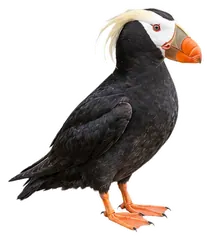 Tufted PuffinFratercula cirrhata
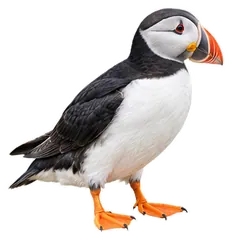 Atlantic PuffinFratercula arctica
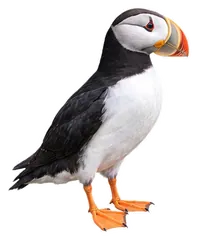 Horned PuffinFratercula corniculata
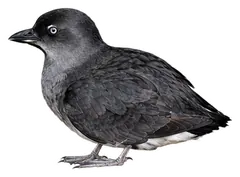 Cassin's AukletPtychoramphus aleuticus
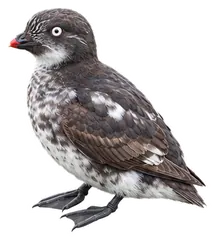 Least AukletAethia pusilla
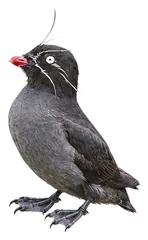 Whiskered AukletAethia pygmaea
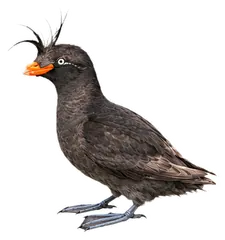 Crested AukletAethia cristatella
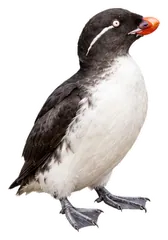 Parakeet AukletAethia psittacula
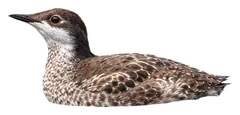 Long-billed MurreletBrachyramphus perdix
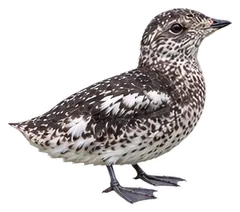 Kittlitz's MurreletBrachyramphus brevirostris
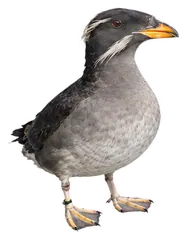
Download illustration
Free to use with credit: “Illustration: Bird Album (birdalbum.com)”. Drawn by AI from reference photos. ↗
Heard it but can't see it? Mingji identifies birds by sound and photo, on your phone.