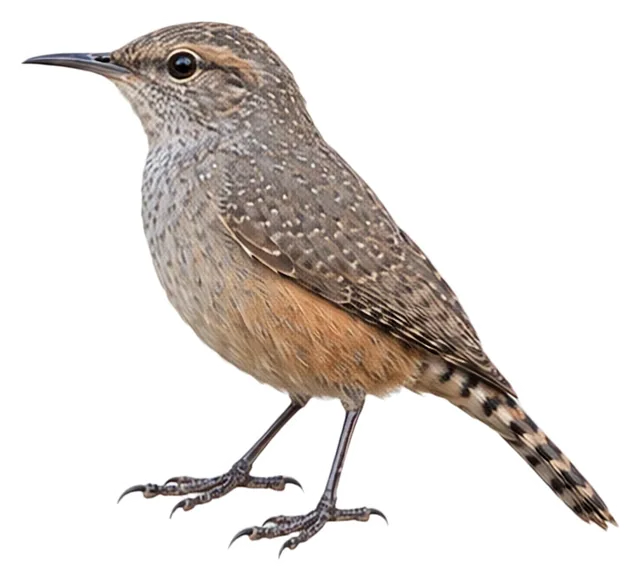
Rock Wren
Salpinctes obsoletus (Say, 1822)
16 gWeight
The rock wren (Salpinctes obsoletus) is a small songbird of the wren family native to the rocky areas of western North America.
Busiest months: October–November · Most records: United States, Mexico, Canada
Where and when it's recorded
Busiest months: October–November · Most records: United States, Mexico, Canada

Rock Wren has been recorded at 176 of the 8,276 birding hotspots we track, in 4 countries and regions.
Records by month Northern Hemisphere
Where it's recorded most
- Southeast Farallon IslandUnited States6,651 records
- Florida Canyon – lowerUnited States2,427 records
- Boyce Thompson ArboretumUnited States2,072 records
More places
- Sabino Dam and downstream riparianUnited States1,850 records
- Santa Margarita Ranch (LTC 079)United States1,326 records
- El Rio Open Space PreserveUnited States1,296 records
- Catalina SPUnited States1,222 records
- San Jacinto Wildlife AreaUnited States1,085 records
- Zona Arqueológica Monte AlbánMexico970 records
- Laguna LakeUnited States831 records
Countries and regions with the most records
eBird records via GBIF up to 2024-12-31. A record means someone listed it; more records partly mean more birders, not more birds.
About
The rock wren (Salpinctes obsoletus) is a small songbird of the wren family native to the rocky areas of western North America. There are 8 subspecies of the rock wren, one of which is extinct. They are similar in size to other wrens, with a grey-brown coat, a brown rump, and a speckled white throat.
Excerpt from Wikipedia, CC BY-SA 4.0 · authors · Read more on Wikipedia
Questions
How big is the Rock Wren?
The Rock Wren weighs around 16 g.
Where does the Rock Wren live?
Its breeding range: North America, Middle America: southwestern Canada to Costa Rica. It is most often recorded in United States, Mexico and Canada.
When is the best time to see the Rock Wren?
At the hotspots we track, it is recorded most in October and November (Northern Hemisphere).
Is the Rock Wren endangered?
The IUCN Red List classifies the Rock Wren as Least Concern.
What does the Rock Wren eat?
Main food: Insects & other invertebrates.
What family is the Rock Wren in?
It belongs to the family Wrens (Troglodytidae), order Passerines (Passeriformes).
At a glance
- Weight
- 16 g
- Habitat
- Rocky terrain
- Diet
- Insects & other invertebrates
- Lifestyle
- Active on the ground
- Migration
- Resident (barely migrates)
- Conservation
- Least Concern
More measurements
- Wing
- 69 mm
- Tail
- 56 mm
- Bill
- 20 mm
- Tarsus
- 20 mm
Averages from the AVONET dataset; length from field guides where available.
Range
North America, Middle America: southwestern Canada to Costa Rica
Breeding range, IOC World Bird List 15.2
Classification
- Order
- Passerines Passeriformes
- Family
- Wrens Troglodytidae
- Genus
- Salpinctes
More from the family Wrens
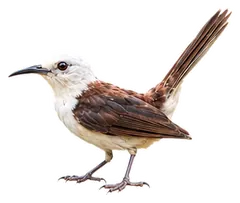 White-headed WrenCampylorhynchus albobrunneus
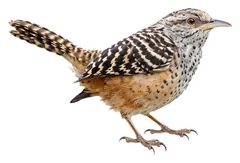 Band-backed WrenCampylorhynchus zonatus
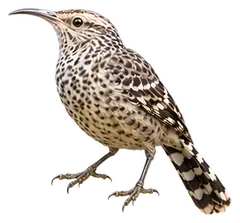 Grey-barred WrenCampylorhynchus megalopterus
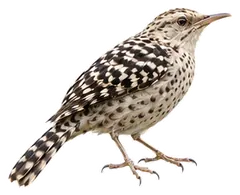 Stripe-backed WrenCampylorhynchus nuchalis
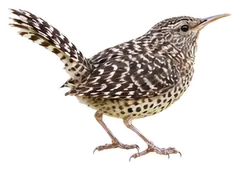 Fasciated WrenCampylorhynchus fasciatus
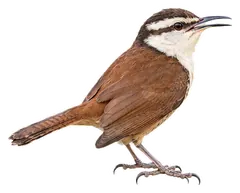 Giant WrenCampylorhynchus chiapensis
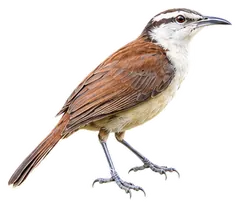 Bicolored WrenCampylorhynchus griseus
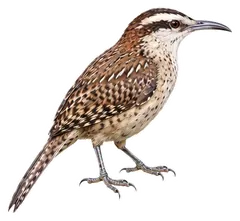 Veracruz WrenCampylorhynchus rufinucha
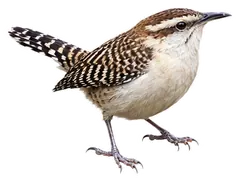 Russet-naped WrenCampylorhynchus humilis
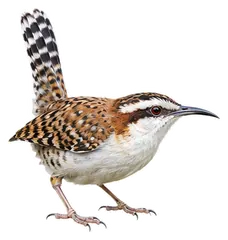 Rufous-backed WrenCampylorhynchus capistratus
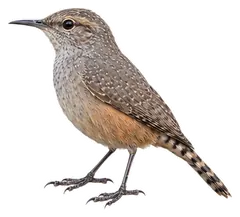
Download illustration
Free to use with credit: “Illustration: Bird Album (birdalbum.com)”. Drawn by AI from a reference photo by Jerry Oldenettel. ↗
Heard it but can't see it? Mingji identifies birds by sound and photo, on your phone.
In other languages
- EnglishRock Wren
- 简体中文岩鹪鹩
- 繁體中文普通岩鷦鷯
- 日本語イワミソサザイ
- DeutschFelsenzaunkönig
- FrançaisTroglodyte des rochers
- EspañolCucarachero roquero
- Portuguêscambaxirra-das-rochas
- ItalianoScricciolo di roccia
- NederlandsAmerikaanse Rotswinterkoning
- РусскийСкальный крапивник
- Svenskaklippgärdsmyg
- DanskBjergsmutte
- Polskiskalik złotorzytny