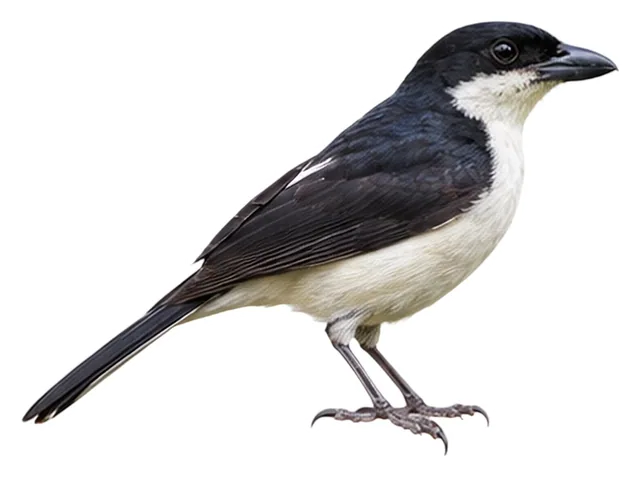
Sabine's Puffback
Dryoscopus sabini (Gray, JE, 1831)
37 gWeight
Sabine's puffback, also known as the large-billed puffback, is a species of bird in the family Malaconotidae.
Busiest months: February–March and November · Most records: Ghana, Equatorial Guinea, Côte d’Ivoire
Where and when it's recorded
Busiest months: February–March and November · Most records: Ghana, Equatorial Guinea, Côte d’Ivoire

Sabine's Puffback has been recorded at 43 of the 8,276 birding hotspots we track, in 12 countries and regions.
Records by month Northern Hemisphere
Where it's recorded most
- Kakum NP – CanopyGhana223 records
- Bobiri Butterfly SanctuaryGhana193 records
- Kakum NP – Canopy Walkway & vicinityGhana191 records
More places
- Kakum National ParkGhana128 records
- Atewa Range – upland forest & ridgeGhana81 records
- Bosque Científica – Selva PrimariaEquatorial Guinea77 records
- Ankasa NPGhana51 records
- American University of Central AfricaEquatorial Guinea37 records
- Taï National ParkCôte d’Ivoire34 records
- Ebekawopa (Abrafo) Forest ReserveGhana34 records
Countries and regions with the most records
eBird records via GBIF up to 2024-12-31. A record means someone listed it; more records partly mean more birders, not more birds.
About
Sabine's puffback, also known as the large-billed puffback, is a species of bird in the family Malaconotidae. It is native to the African tropical rainforest (western and sparsely throughout Central Africa). Its natural habitats are subtropical or tropical moist lowland forests and subtropical or tropical swamps.
Excerpt from Wikipedia, CC BY-SA 4.0 · authors · Read more on Wikipedia
Questions
How big is the Sabine's Puffback?
The Sabine's Puffback weighs around 37 g.
Where does the Sabine's Puffback live?
Its breeding range: Africa: western, central. It is most often recorded in Ghana, Equatorial Guinea and Côte d’Ivoire.
When is the best time to see the Sabine's Puffback?
At the hotspots we track, it is recorded most in February, March and November (Northern Hemisphere).
Is the Sabine's Puffback endangered?
The IUCN Red List classifies the Sabine's Puffback as Least Concern.
What does the Sabine's Puffback eat?
Main food: Insects & other invertebrates.
What family is the Sabine's Puffback in?
It belongs to the family Bushshrikes (Malaconotidae), order Passerines (Passeriformes).
At a glance
- Weight
- 37 g
- Habitat
- Forest
- Diet
- Insects & other invertebrates
- Lifestyle
- Perches in trees
- Migration
- Resident (barely migrates)
- Conservation
- Least Concern
More measurements
- Wing
- 84 mm
- Tail
- 68 mm
- Bill
- 26 mm
- Tarsus
- 25 mm
Averages from the AVONET dataset; length from field guides where available.
Range
Africa: western, central
Breeding range, IOC World Bird List 15.2
Classification
- Order
- Passerines Passeriformes
- Family
- Bushshrikes Malaconotidae
- Genus
- Dryoscopus
Other birds in the genus Dryoscopus
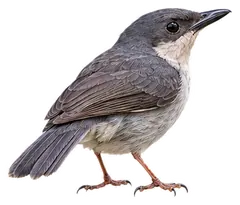 Pink-footed PuffbackDryoscopus angolensis
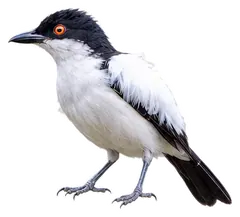 Red-eyed PuffbackDryoscopus senegalensis
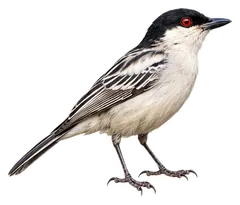 Black-backed PuffbackDryoscopus cubla
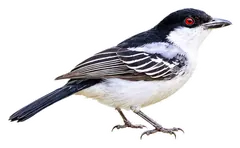 Northern PuffbackDryoscopus gambensis
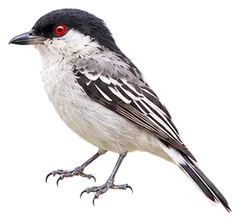 Pringle's PuffbackDryoscopus pringlii
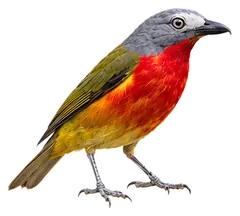 Fiery-breasted BushshrikeMalaconotus cruentus
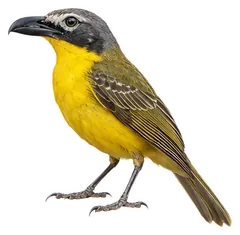 Monteiro's BushshrikeMalaconotus monteiri
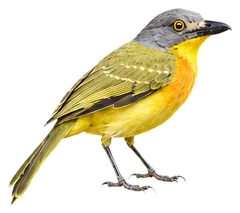 Grey-headed BushshrikeMalaconotus blanchoti
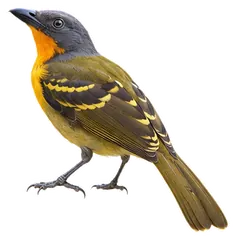 Lagden's BushshrikeMalaconotus lagdeni
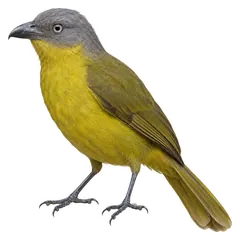 Green-breasted BushshrikeMalaconotus gladiator
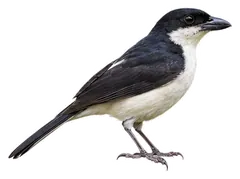
Download illustration
Free to use with credit: “Illustration: Bird Album (birdalbum.com)”. Drawn by AI from a reference photo by Nik Borrow. ↗
Heard it but can't see it? Mingji identifies birds by sound and photo, on your phone.
In other languages
- EnglishSabine's Puffback
- 简体中文大嘴蓬背鵙
- 繁體中文沙賓氏鬆背伯勞
- 日本語オグロフクレヤブモズ
- DeutschDickschnabel-Schneeballwürger
- FrançaisCubla à gros bec
- EspañolCubla de Sabine
- Portuguêspicanço-de-almofadinha-de-bico-grosso
- ItalianoPuffino beccogrosso
- NederlandsSabines Poederdonsklauwier
- РусскийТолстоклювая пухоспинка
- Svenskastornäbbad dunrygg
- DanskTyknæbbet Kvastryg
- Polskiturniurzyk grubodzioby