 Bird Album
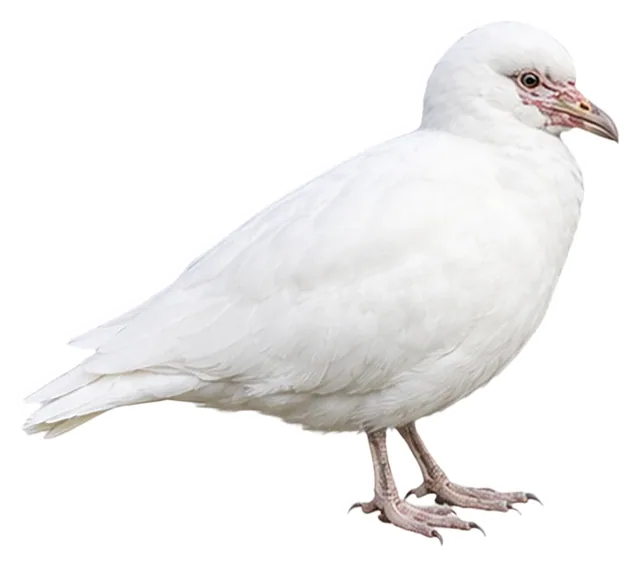
Snowy Sheathbill
Chionis albus (Gmelin, JF, 1789)
676 gWeight
The snowy sheathbill (Chionis albus), also known as the greater sheathbill, pale-faced sheathbill, and paddy, is one of two species of sheathbill.
Busiest months: November · Most records: Antarctica, South Georgia & South Sandwich Islands, Falkland Islands
Where and when it's recorded

Snowy Sheathbill has been recorded at 59 of the 8,171 birding hotspots we track, in 7 countries and regions.
Records by month Southern Hemisphere
Where it's recorded most
- Sea Lion IslandFalkland Islands662 records
- Punta LoyolaArgentina529 records
- Half Moon IslandAntarctica468 records
More places
- Gold HarbourSouth Georgia & South Sandwich Islands419 records
- St Andrew's BaySouth Georgia & South Sandwich Islands377 records
- Cape PembrokeFalkland Islands348 records
- Canal BeagleArgentina329 records
- Salisbury PlainSouth Georgia & South Sandwich Islands311 records
- Cooper BaySouth Georgia & South Sandwich Islands262 records
- Brown BluffAntarctica259 records
Countries and regions with the most records
eBird records via GBIF up to 2024-12-31. A record means someone listed it; more records partly mean more birders, not more birds.
About
The snowy sheathbill (Chionis albus), also known as the greater sheathbill, pale-faced sheathbill, and paddy, is one of two species of sheathbill. It is usually found on the ground. It is the only land bird native to the Antarctic continent.
Excerpt from Wikipedia, CC BY-SA 4.0 · authors · Read more on Wikipedia
Questions
How big is the Snowy Sheathbill?
The Snowy Sheathbill weighs around 676 g.
Where does the Snowy Sheathbill live?
Its breeding range: Antarctica: Antarctic Peninsula and satellites, South Shetland, South Orkney, and South Georgia islands. It is most often recorded in Antarctica, South Georgia & South Sandwich Islands and Falkland Islands.
When is the best time to see the Snowy Sheathbill?
At the hotspots we track, it is recorded most in November (Southern Hemisphere).
Is the Snowy Sheathbill endangered?
The IUCN Red List classifies the Snowy Sheathbill as Least Concern.
What does the Snowy Sheathbill eat?
Main food: Omnivore.
What family is the Snowy Sheathbill in?
It belongs to the family Sheathbills (Chionidae), order Charadriiformes.
At a glance
- Weight
- 676 g
- Habitat
- Ocean
- Diet
- Omnivore
- Lifestyle
- Active on the ground
- Migration
- Migratory
- Conservation
- Least Concern
More measurements
- Wing
- 246 mm
- Tail
- 103 mm
- Bill
- 33 mm
- Tarsus
- 46 mm
Averages from the AVONET dataset; length from field guides where available.
Range
Antarctica: Antarctic Peninsula and satellites, South Shetland, South Orkney, and South Georgia islands
Breeding range, IOC World Bird List 15.2
Classification
- Order
- Charadriiformes
- Family
- Sheathbills Chionidae
- Genus
- Chionis
Other birds in the genus Chionis
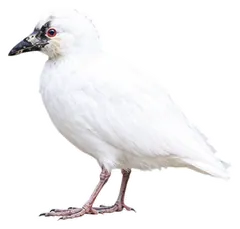 Black-faced SheathbillChionis minor
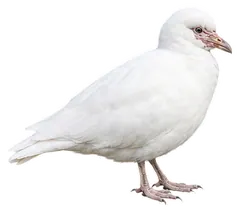
Download illustration
Free to use with credit: “Illustration: Bird Album (birdalbum.com)”. Drawn by AI from a reference photo by Guillermo Menéndez. ↗
Heard it but can't see it? Mingji identifies birds by sound and photo, on your phone.
In other languages
- EnglishSnowy Sheathbill
- 简体中文白鞘嘴鸥
- 繁體中文白鞘嘴鷗
- 日本語サヤハシチドリ
- DeutschWeißgesicht-Scheidenschnabel
- FrançaisChionis blanc
- EspañolPicovaina de las Malvinas
- Portuguêspomba-antártica-branca
- ItalianoChione niveo
- NederlandsZuidpoolkip
- РусскийБелая ржанка
- Svenskagulnäbbad slidnäbb
- DanskGulnæbbet Skedenæb
- Polskipochwodziób żółtodzioby