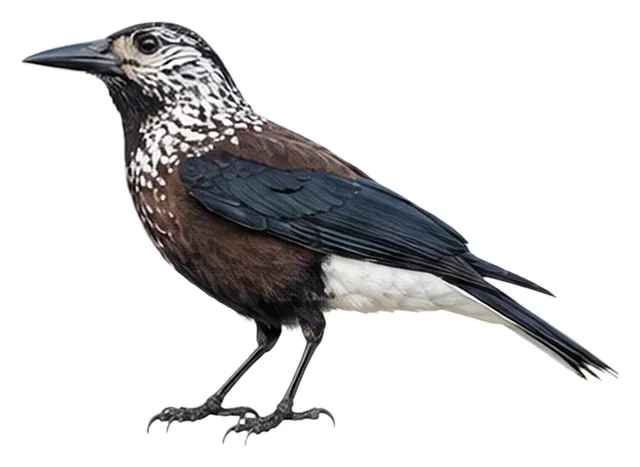
Southern Nutcracker
Nucifraga hemispila Vigors, 1831
33 cmLength182 gWeight
It is a mostly brown nutcracker with a few white spots on the face and upper breast, and white corners to its black tail.
Busiest months: April · Most records: China, Bhutan, Nepal
Looks like Northern Nutcracker, Kashmir Nutcracker
How to identify
Field marks
- A few white spots on the face and upper breast
- Lower breast and back plain brown
- Wings black and unmarked
- Tail black with two white outer corners
Similar species
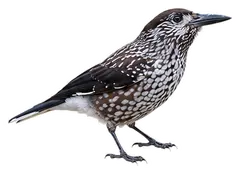
Northern Nutcracker has extensive, larger white patches across the entire breast and back; Southern Nutcracker has only a few on the face and upper breast.
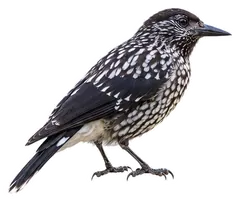
Kashmir Nutcracker has extensive, larger white patches across the entire breast and back; Southern Nutcracker has only a few on the face and upper breast.
Where and when it's recorded
Busiest months: April · Most records: China, Bhutan, Nepal

Southern Nutcracker has been recorded at 196 of the 8,276 birding hotspots we track, in 4 countries and regions.
Records by month Northern Hemisphere
Where it's recorded most
- Dasyueshan IBA – Xiaoxueshan Lodge (50K)Taiwan (China)1,316 records
- Yushan NP – TatakaTaiwan (China)792 records
- ChelelaBhutan452 records
More places
- PelelaBhutan390 records
- Hike to Tiger's Nest MonasteryBhutan235 records
- Dochula PassBhutan221 records
- Lingshan Scenic AreaChina143 records
- Tharpaling MonasteryBhutan132 records
- Labahe NNRChina129 records
- YotonglaBhutan127 records
Countries and regions with the most records
eBird records via GBIF up to 2024-12-31. A record means someone listed it; more records partly mean more birders, not more birds.
About
The southern nutcracker (Nucifraga hemispila) is a passerine bird in the crow family Corvidae. It was formerly considered to be conspecific with the northern nutcracker (Nucifraga caryocatactes) and the Kashmir nutcracker (Nucifraga multipunctata) under the English name "spotted nutcracker".
Excerpt from Wikipedia, CC BY-SA 4.0 · authors · Read more on Wikipedia
Questions
How big is the Southern Nutcracker?
The Southern Nutcracker is about 33 cm long and weighs around 182 g.
Where does the Southern Nutcracker live?
Its breeding range: Palearctic, Oriental: Himalayas to northern Myanmar, China and Taiwan (China). It is most often recorded in China, Bhutan and Nepal.
When is the best time to see the Southern Nutcracker?
At the hotspots we track, it is recorded most in April (Northern Hemisphere).
Is the Southern Nutcracker endangered?
The IUCN Red List classifies the Southern Nutcracker as Least Concern.
What does the Southern Nutcracker eat?
Main food: Seeds.
What family is the Southern Nutcracker in?
It belongs to the family Crows, Jays (Corvidae), order Passerines (Passeriformes).
At a glance
- Length
- 33 cm
- Weight
- 182 g
- Habitat
- Forest
- Diet
- Seeds
- Lifestyle
- Perches in trees
- Migration
- Partial migrant
- Conservation
- Least Concern
More measurements
- Wing
- 208 mm
- Tail
- 116 mm
- Bill
- 52 mm
- Tarsus
- 39 mm
Averages from the AVONET dataset; length from field guides where available.
Range
Palearctic, Oriental: Himalayas to northern Myanmar, China and Taiwan (China)
Breeding range, IOC World Bird List 15.2
Subspecies · 3
- Nucifraga hemispila macella e Himalayas to c, s China and n Myanmar
- Nucifraga hemispila interdicta n China
- Nucifraga hemispila owstoni Taiwan (China)
Classification
- Order
- Passerines Passeriformes
- Family
- Crows, Jays Corvidae
- Genus
- Nucifraga
Other birds in the genus Nucifraga
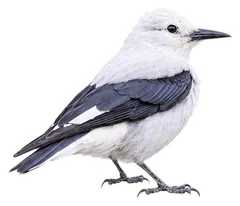 Clark's NutcrackerNucifraga columbianaNorthern NutcrackerNucifraga caryocatactesKashmir NutcrackerNucifraga multipunctata
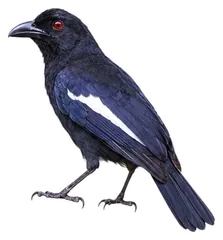 Malayan Black MagpiePlatysmurus leucopterus
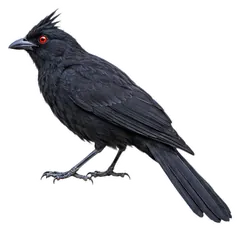 Bornean Black MagpiePlatysmurus aterrimus
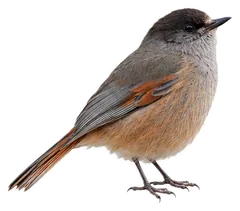 Siberian JayPerisoreus infaustus
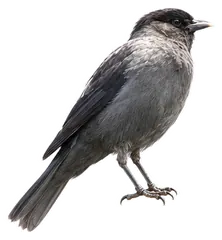 Sichuan JayPerisoreus internigrans
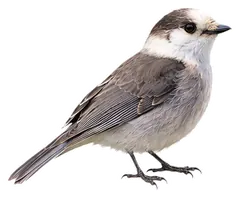 Canada JayPerisoreus canadensis
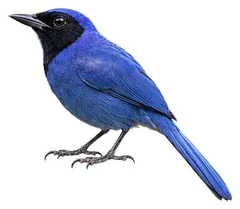 Black-collared JayCyanolyca armillata
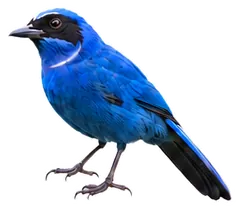 White-collared JayCyanolyca viridicyanus
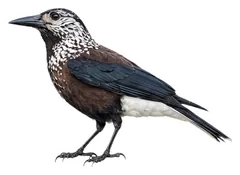
Download illustration
Free to use with credit: “Illustration: Bird Album (birdalbum.com)”. Drawn by AI from a reference photo by Original: Nrik kiran. ↗

Heard it but can't see it? Mingji identifies birds by sound and photo, on your phone.