 Bird Album
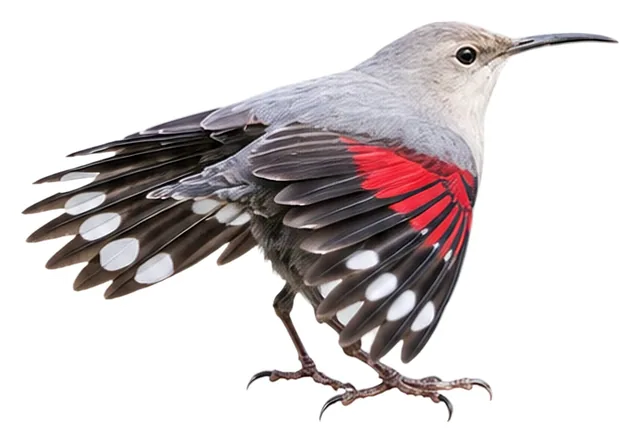
Wallcreeper
Tichodroma muraria (Linnaeus, 1766)
16–17 cmLength18 gWeight
This small blue-gray bird makes short flights and hops on rock faces, showing crimson wings with white spots.
Busiest months: February and November–December · Most records: China, India, Bhutan
How to identify
Field marks
- Plumage mainly blue-gray, with darker flight feathers and tail
- Crimson wings with white spots
- Most of the red is concealed when the wings are folded
- Short black tail with narrow white feather edges
Male, female and young
In summer, male has a black throat; female has a white throat or a small dark patch on it; both sexes have white throats in autumn and winter; juvenile resembles birds in winter plumage.
Voice
High-pitched, drawn-out whistles, with alternately rising and falling notes.
Where and when it's recorded

Wallcreeper has been recorded at 232 of the 8,171 birding hotspots we track, in 25 countries and regions.
Records by month Northern Hemisphere
Where it's recorded most
- Yolyn Am, Umnugobi, MNMongolia154 records
- Shidu, Juma River PNRChina149 records
- Forest Research Institute (FRI), New Forest CampusIndia146 records
More places
- Corbett NPIndia79 records
- Mt. Kuro slopesGeorgia56 records
- Paro to ThimphuBhutan54 records
- Ichangu NarayanNepal43 records
- [Dushanbe – Karamov Bridge over Varzob River]Tajikistan39 records
- Punakha DzongBhutan32 records
- SattalIndia29 records
Countries and regions with the most records
eBird records via GBIF up to 2024-12-31. A record means someone listed it; more records partly mean more birders, not more birds.
About
The wallcreeper (Tichodroma muraria) is a small passerine bird found throughout the high mountains of the Palearctic from southern Europe to central China. It is the only extant member of both the genus Tichodroma and the family Tichodromidae.
Excerpt from Wikipedia, CC BY-SA 4.0 · authors · Read more on Wikipedia
Questions
How big is the Wallcreeper?
The Wallcreeper is about 16–17 cm long and weighs around 18 g.
Where does the Wallcreeper live?
Its breeding range: Palearctic: southern Europe to central China. It is most often recorded in China, India and Bhutan.
When is the best time to see the Wallcreeper?
At the hotspots we track, it is recorded most in February, November and December (Northern Hemisphere).
Is the Wallcreeper endangered?
The IUCN Red List classifies the Wallcreeper as Least Concern.
What does the Wallcreeper eat?
Main food: Insects & other invertebrates.
What family is the Wallcreeper in?
It belongs to the family Wallcreeper (Tichodromidae), order Passerines (Passeriformes).
At a glance
- Length
- 16–17 cm
- Weight
- 18 g
- Habitat
- Rocky terrain
- Diet
- Insects & other invertebrates
- Lifestyle
- Perches in trees
- Migration
- Partial migrant
- Conservation
- Least Concern
More measurements
- Wing
- 100 mm
- Tail
- 60 mm
- Bill
- 31 mm
- Tarsus
- 22 mm
Averages from the AVONET dataset; length from field guides where available.
Range
Palearctic: southern Europe to central China
Breeding range, IOC World Bird List 15.2
Subspecies · 1
- Tichodroma muraria nepalensis Kazakhstan, Turkmenistan and e Iran to e China
Classification
- Order
- Passerines Passeriformes
- Family
- Wallcreeper Tichodromidae
- Genus
- Tichodroma
Download illustration
Free to use with credit: “Illustration: Bird Album (birdalbum.com)”. Drawn by AI from a reference photo by Imran Shah. ↗

Heard it but can't see it? Mingji identifies birds by sound and photo, on your phone.