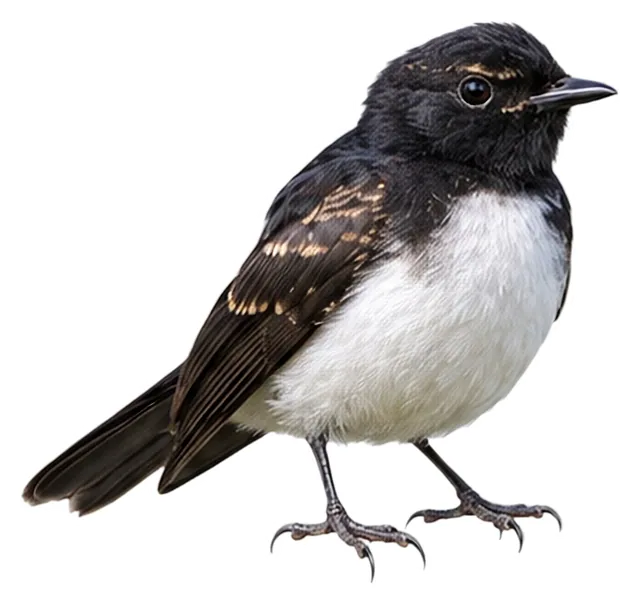
Willie Wagtail
Rhipidura leucophrys (Latham, 1801)
19–22 cmLength27 gWeight
The willie wagtail (Rhipidura leucophrys) (also spelt willy wagtail) is a passerine bird native to Australia, New Guinea, the Solomon Islands, the Bismarck Archipelago, and Eastern Indonesia.
Busiest months: January and September–October · Most records: Australia, Papua New Guinea, Indonesia
Where and when it's recorded
Busiest months: January and September–October · Most records: Australia, Papua New Guinea, Indonesia

Willie Wagtail has been recorded at 274 of the 8,276 birding hotspots we track, in 5 countries and regions.
Records by month Southern Hemisphere
Where it's recorded most
- Western Treatment PlantAustralia8,780 records
- Jerrabomberra Wetlands Nature ReserveAustralia7,829 records
- Oxley Creek CommonAustralia6,524 records
More places
- Sandy Camp Road WetlandsAustralia6,208 records
- Cairns EsplanadeAustralia4,754 records
- Herdsman LakeAustralia3,966 records
- Bowra Wildlife SanctuaryAustralia3,958 records
- Royal ParkAustralia3,955 records
- Centennial ParkAustralia3,447 records
- Cattana WetlandsAustralia2,984 records
Countries and regions with the most records
eBird records via GBIF up to 2024-12-31. A record means someone listed it; more records partly mean more birders, not more birds.
About
The willie wagtail (Rhipidura leucophrys) (also spelt willy wagtail) is a passerine bird native to Australia, New Guinea, the Solomon Islands, the Bismarck Archipelago, and Eastern Indonesia. It is a common and familiar bird throughout much of its range, living in most habitats apart from thick forest. Measuring 19–21.5 cm (7+1⁄2–8+1⁄2 in) in length, the willie wagtail is contrastingly coloured with almost entirely black upperparts and white underparts; the male and female have similar plumage.
Excerpt from Wikipedia, CC BY-SA 4.0 · authors · Read more on Wikipedia
Questions
How big is the Willie Wagtail?
The Willie Wagtail is about 19–22 cm long and weighs around 27 g.
Where does the Willie Wagtail live?
Its breeding range: Australasia: Moluccas, New Guinea area, Australia (except Tasmania), Bismarck Archipelago and Solomon Islands. It is most often recorded in Australia, Papua New Guinea and Indonesia.
When is the best time to see the Willie Wagtail?
At the hotspots we track, it is recorded most in January, September and October (Southern Hemisphere).
Is the Willie Wagtail endangered?
The IUCN Red List classifies the Willie Wagtail as Least Concern.
What does the Willie Wagtail eat?
Main food: Insects & other invertebrates.
What family is the Willie Wagtail in?
It belongs to the family Fantails (Rhipiduridae), order Passerines (Passeriformes).
At a glance
- Length
- 19–22 cm
- Weight
- 27 g
- Habitat
- Woodland
- Diet
- Insects & other invertebrates
- Lifestyle
- Perches in trees
- Migration
- Resident (barely migrates)
- Conservation
- Least Concern
More measurements
- Wing
- 99 mm
- Tail
- 102 mm
- Bill
- 18 mm
- Tarsus
- 26 mm
Averages from the AVONET dataset; length from field guides where available.
Range
Australasia: Moluccas, New Guinea area, Australia (except Tasmania), Bismarck Archipelago and Solomon Islands
Breeding range, IOC World Bird List 15.2
Classification
- Order
- Passerines Passeriformes
- Family
- Fantails Rhipiduridae
- Genus
- Rhipidura
Other birds in the genus Rhipidura
 Mindanao Blue FantailRhipidura superciliaris
 Visayan Blue FantailRhipidura samarensis
 Blue-headed FantailRhipidura cyaniceps
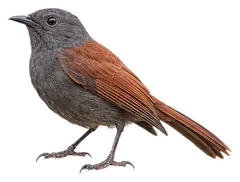 Tablas FantailRhipidura sauli
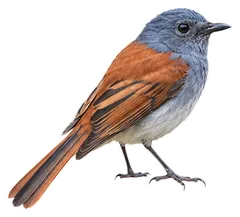 Visayan FantailRhipidura albiventris
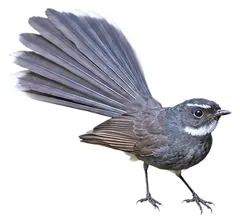 White-throated FantailRhipidura albicollis
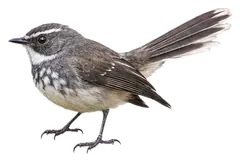 White-spotted FantailRhipidura albogularis
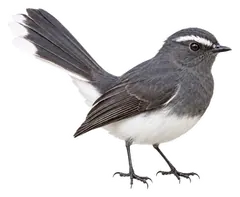 White-bellied FantailRhipidura euryura
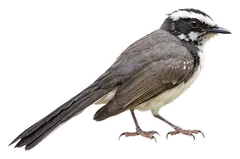 White-browed FantailRhipidura aureola
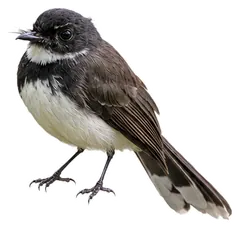 Sunda Pied FantailRhipidura javanica
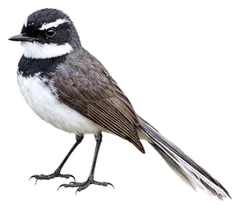 Philippine Pied FantailRhipidura nigritorquis
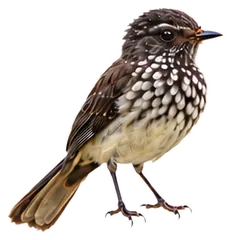 Spotted FantailRhipidura perlata
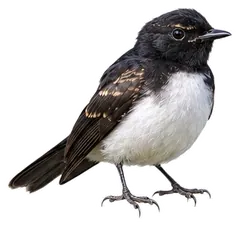
Download illustration
Free to use with credit: “Illustration: Bird Album (birdalbum.com)”. Drawn by AI from a reference photo by Lip Kee. ↗
Heard it but can't see it? Mingji identifies birds by sound and photo, on your phone.
In other languages
- EnglishWillie Wagtail
- 简体中文黑白扇尾鹟
- 繁體中文鶺鴒扇尾鶲
- 日本語ヨコフリオウギビタキ
- DeutschGartenfächerschwanz
- FrançaisRhipidure hochequeue
- EspañolAbanico lavandera
- Portuguêsrabo-de-leque-de-garganta-preta
- ItalianoWilli batticoda
- NederlandsTuinwaaierstaart
- РусскийЧёрно-белая веерохвостка
- Svenskaärlesolfjäderstjärt
- DanskSorthvid Viftehale
- Polskiwachlarzówka smolista