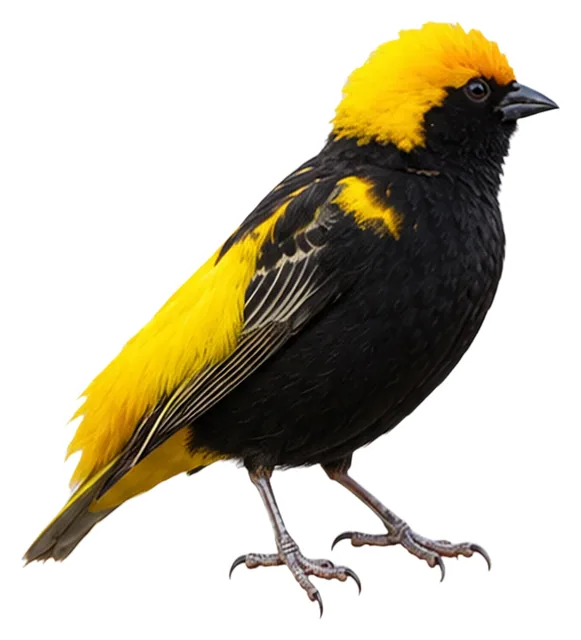
Yellow-crowned Bishop
Euplectes afer (Gmelin, JF, 1789)
≈11 cmLength14 gWeight
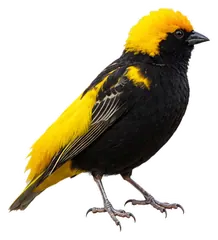
In the breeding season, the male has a yellow head and back, with a black lower face, throat, breast and belly.
Busiest months: August–September · Most records: Portugal, South Africa, Spain
Looks like Southern Red Bishop
How to identify
Field marks
- Male in breeding season has bright yellow crown and forehead
- Breeding male has black lower face, throat, breast and belly
- Breeding male has yellow back and rump, with yellow patches on the scapulars
- Bill short and conical
Male, female and young
The male is golden-yellow and black in the breeding season, while the female is mainly brown; outside the breeding season, the male resembles the female.
Voice
An insect-like, high-pitched hissing: “zzzzzzz, zzit, zzit, zzzz”.
Similar species
Where and when it's recorded
Busiest months: August–September · Most records: Portugal, South Africa, Spain

Yellow-crowned Bishop has been recorded at 264 of the 8,276 birding hotspots we track, in 41 countries and regions.
Records by month Northern Hemisphere
Where it's recorded most
- Lezíria Grande de Vila Franca de Xira – área geralPortugal3,101 records
- Paul da BarrocaPortugal1,578 records
- Ria de Aveiro – SalreuPortugal865 records
More places
- Barrinha de EsmorizPortugal828 records
- Brazo del Este PjeNat – ÁreaSpain759 records
- RN Estuário do Tejo – EVOA – área geralPortugal360 records
- Marievale Bird SanctuarySouth Africa350 records
- Quinta da AtalayaPortugal333 records
- RN Estuário do Sado – ZambujalPortugal333 records
- Nairobi NPKenya261 records
Countries and regions with the most records
eBird records via GBIF up to 2024-12-31. A record means someone listed it; more records partly mean more birders, not more birds.
About
The yellow-crowned bishop (Euplectes afer) is a species of passerine bird in the family Ploceidae native to Africa south of the Sahara. It is highly sexually dimorphic in its breeding season, during which the male adopts a distinctive yellow and black plumage, contrasting with the female's predominantly brown coloration. Four subspecies are recognised.
Excerpt from Wikipedia, CC BY-SA 4.0 · authors · Read more on Wikipedia
Questions
How big is the Yellow-crowned Bishop?
The Yellow-crowned Bishop is about ≈11 cm long and weighs around 14 g.
Where does the Yellow-crowned Bishop live?
Its breeding range: Africa: western, central, eastern, southern. It is most often recorded in Portugal, South Africa and Spain.
When is the best time to see the Yellow-crowned Bishop?
At the hotspots we track, it is recorded most in August and September (Northern Hemisphere).
Is the Yellow-crowned Bishop endangered?
The IUCN Red List classifies the Yellow-crowned Bishop as Least Concern.
What does the Yellow-crowned Bishop eat?
Main food: Seeds.
What family is the Yellow-crowned Bishop in?
It belongs to the family Weavers, Widowbirds (Ploceidae), order Passerines (Passeriformes).
At a glance
- Length
- ≈11 cm
- Weight
- 14 g
- Habitat
- Wetland
- Diet
- Seeds
- Lifestyle
- Active on the ground
- Migration
- Resident (barely migrates)
- Conservation
- Least Concern
More measurements
- Wing
- 55 mm
- Tail
- 32 mm
- Bill
- 14 mm
- Tarsus
- 16 mm
Averages from the AVONET dataset; length from field guides where available.
Range
Africa: western, central, eastern, southern
Breeding range, IOC World Bird List 15.2
Classification
- Order
- Passerines Passeriformes
- Family
- Weavers, Widowbirds Ploceidae
- Genus
- Euplectes
Other birds in the genus Euplectes
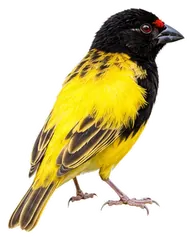 Fire-fronted BishopEuplectes diadematus
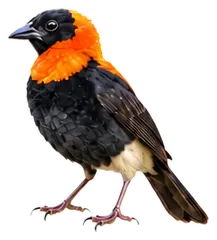 Black BishopEuplectes gierowii
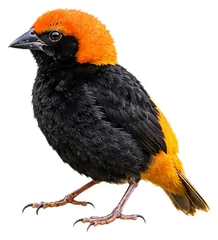 Zanzibar Red BishopEuplectes nigroventris
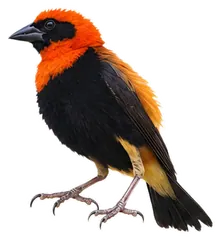 Black-winged Red BishopEuplectes hordeaceus
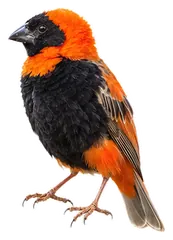 Southern Red BishopEuplectes orix
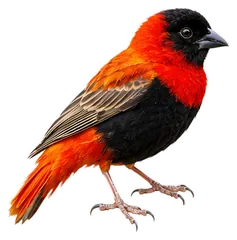 Northern Red BishopEuplectes franciscanus
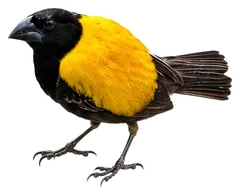 Golden-backed BishopEuplectes aureus
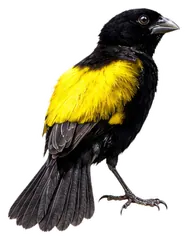 Yellow BishopEuplectes capensis
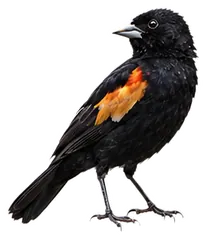 Fan-tailed WidowbirdEuplectes axillaris
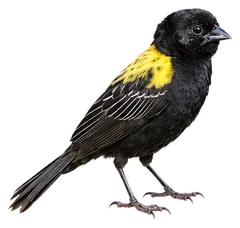 Yellow-mantled WidowbirdEuplectes macroura
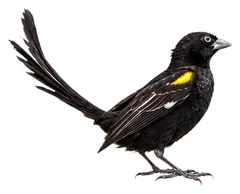 Marsh WidowbirdEuplectes hartlaubi
 Montane WidowbirdEuplectes psammacromius
Download illustration
Free to use with credit: “Illustration: Bird Album (birdalbum.com)”. Drawn by AI from a reference photo by Pieter Kotze. ↗
Heard it but can't see it? Mingji identifies birds by sound and photo, on your phone.