 Bird Album
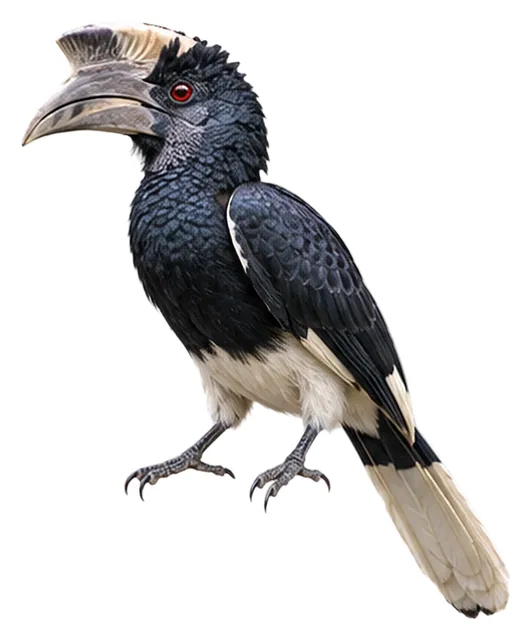
Black-and-white-casqued Hornbill
Bycanistes subcylindricus (Sclater, PL, 1871)
1.2 kgWeight
The black-and-white-casqued hornbill (Bycanistes subcylindricus), also known as the grey-cheeked hornbill, is a large black and white hornbill.
Busiest months: July · Most records: Uganda, Kenya, Congo - Kinshasa
Where and when it's recorded
Busiest months: July · Most records: Uganda, Kenya, Congo - Kinshasa

Black-and-white-casqued Hornbill has been recorded at 86 of the 8,276 birding hotspots we track, in 15 countries and regions.
Records by month Northern Hemisphere
Where it's recorded most
- Entebbe Botanical GardenUganda1,755 records
- Kakamega Forest NR – Rondo Retreat CentreKenya915 records
- Kibale NPUganda644 records
More places
- Bigodi SwampUganda565 records
- Kakamega Forest NRKenya558 records
- Budongo Forest Reserve – Royal MileUganda408 records
- Mabira ForestUganda325 records
- Mabamba SwampUganda320 records
- Kakamega Forest NR – Zimmerman Plot/Isecheno Forest StationKenya282 records
- Uganda Wildlife Education CentreUganda239 records
Countries and regions with the most records
eBird records via GBIF up to 2024-12-31. A record means someone listed it; more records partly mean more birders, not more birds.
About
The black-and-white-casqued hornbill (Bycanistes subcylindricus), also known as the grey-cheeked hornbill, is a large black and white hornbill. It has an oversized blackish bill with a large casque on top. The female is slightly smaller than the male and has a significantly smaller casque.
Excerpt from Wikipedia, CC BY-SA 4.0 · authors · Read more on Wikipedia
Questions
How big is the Black-and-white-casqued Hornbill?
The Black-and-white-casqued Hornbill weighs around 1.2 kg.
Where does the Black-and-white-casqued Hornbill live?
Its breeding range: Africa: central, western. It is most often recorded in Uganda, Kenya and Congo - Kinshasa.
When is the best time to see the Black-and-white-casqued Hornbill?
At the hotspots we track, it is recorded most in July (Northern Hemisphere).
Is the Black-and-white-casqued Hornbill endangered?
The IUCN Red List classifies the Black-and-white-casqued Hornbill as Least Concern.
What does the Black-and-white-casqued Hornbill eat?
Main food: Fruit.
What family is the Black-and-white-casqued Hornbill in?
It belongs to the family Hornbills (Bucerotidae), order Bucerotiformes.
At a glance
- Weight
- 1.2 kg
- Habitat
- Forest
- Diet
- Fruit
- Lifestyle
- Perches in trees
- Migration
- Resident (barely migrates)
- Conservation
- Least Concern
More measurements
- Wing
- 328 mm
- Tail
- 253 mm
- Bill
- 133 mm
- Tarsus
- 49 mm
Averages from the AVONET dataset; length from field guides where available.
Range
Africa: central, western
Breeding range, IOC World Bird List 15.2
Classification
- Order
- Bucerotiformes
- Family
- Hornbills Bucerotidae
- Genus
- Bycanistes
Other birds in the genus Bycanistes
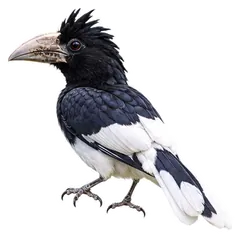 Piping HornbillBycanistes fistulator
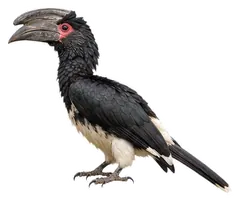 Trumpeter HornbillBycanistes bucinator
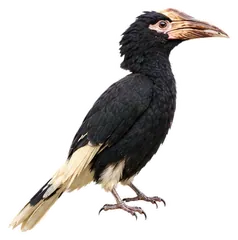 Brown-cheeked HornbillBycanistes cylindricus
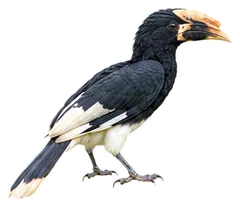 White-thighed HornbillBycanistes albotibialis
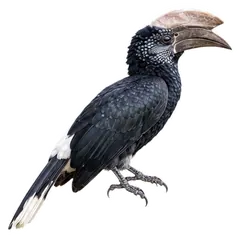 Silvery-cheeked HornbillBycanistes brevis
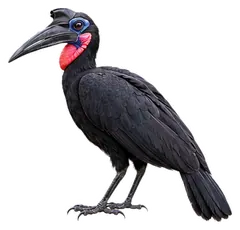 Abyssinian Ground HornbillBucorvus abyssinicus
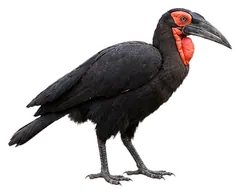 Southern Ground HornbillBucorvus leadbeateri
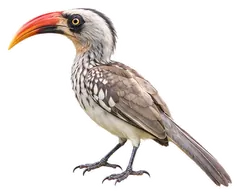 Tanzanian Red-billed HornbillTockus ruahae
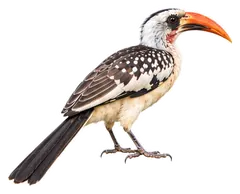 Western Red-billed HornbillTockus kempi
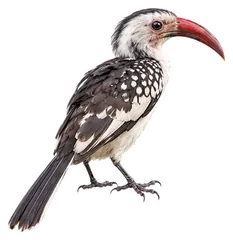 Damara Red-billed HornbillTockus damarensis
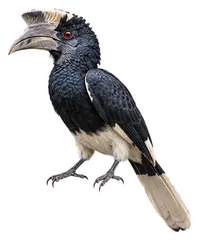
Download illustration
Free to use with credit: “Illustration: Bird Album (birdalbum.com)”. Drawn by AI from a reference photo by David Beadle. ↗
Heard it but can't see it? Mingji identifies birds by sound and photo, on your phone.
In other languages
- EnglishBlack-and-white-casqued Hornbill
- 简体中文黑白噪犀鸟
- 繁體中文黑白噪犀鳥
- 日本語ハシダカサイチョウ
- DeutschGrauwangen-Hornvogel
- FrançaisCalao à joues grises
- EspañolCálao carigrís
- Portuguêscalau-de-casquete-preto-e-branco
- ItalianoBucero cascobianconero
- NederlandsGrijsoorneushoornvogel
- РусскийСерощёкий шлеморог
- Svenskasvartvit näshornsfågel
- DanskGråkindet Hornfugl
- Polskidzioborożec baniastoczoły