 Bird Album
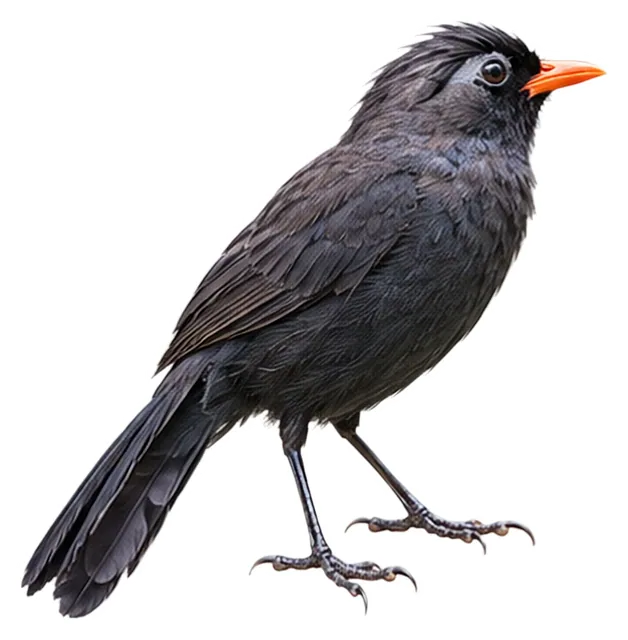
Black Laughingthrush
Melanocichla lugubris (Müller, S, 1836)
79 gWeight
The black laughingthrush (Melanocichla lugubris) is a species of bird in the family Timaliidae.
Busiest months: March and June–August · Most records: Malaysia
Where and when it's recorded

Black Laughingthrush has been recorded at 18 of the 8,171 birding hotspots we track, in 1 country or region.
Records by month Northern Hemisphere
Where it's recorded most
- Bukit FraserMalaysia356 records
- Bukit Fraser – The GapMalaysia96 records
- Bukit Fraser – The GapMalaysia85 records
More places
- Bukit Fraser – Telekom LoopMalaysia81 records
- Bukit Fraser – Road from Gap to Bukit FraserMalaysia64 records
- Bukit TinggiMalaysia54 records
- Bukit Fraser – Bishop TrailMalaysia36 records
- Bukit Fraser – Jalan Lady GuillemardMalaysia25 records
- Genting Highlands – Awana Pumphouse RoadMalaysia18 records
- Fraser's HillMalaysia15 records
Countries and regions with the most records
eBird records via GBIF up to 2024-12-31. A record means someone listed it; more records partly mean more birders, not more birds.
About
The black laughingthrush (Melanocichla lugubris) is a species of bird in the family Timaliidae. It is found in highland forests in the Thai-Malay Peninsula and on the Indonesian island of Sumatra. Until recently, it usually included the bare-headed laughingthrush as a subspecies.
Excerpt from Wikipedia, CC BY-SA 4.0 · authors · Read more on Wikipedia
Questions
How big is the Black Laughingthrush?
The Black Laughingthrush weighs around 79 g.
Where does the Black Laughingthrush live?
Its breeding range: Oriental: montane Malay Peninsula and Sumatra. It is most often recorded in Malaysia.
When is the best time to see the Black Laughingthrush?
At the hotspots we track, it is recorded most in March, June, July and August (Northern Hemisphere).
Is the Black Laughingthrush endangered?
The IUCN Red List classifies the Black Laughingthrush as Least Concern.
What does the Black Laughingthrush eat?
Main food: Insects & other invertebrates.
What family is the Black Laughingthrush in?
It belongs to the family Babblers, Scimitar Babblers (Timaliidae), order Passerines (Passeriformes).
At a glance
- Weight
- 79 g
- Habitat
- Forest
- Diet
- Insects & other invertebrates
- Lifestyle
- Active on the ground
- Migration
- Resident (barely migrates)
- Conservation
- Least Concern
More measurements
- Wing
- 122 mm
- Tail
- 121 mm
- Bill
- 29 mm
- Tarsus
- 36 mm
Averages from the AVONET dataset; length from field guides where available.
Range
Oriental: montane Malay Peninsula and Sumatra
Breeding range, IOC World Bird List 15.2
Classification
- Order
- Passerines Passeriformes
- Family
- Babblers, Scimitar Babblers Timaliidae
- Genus
- Melanocichla
Other birds in the genus Melanocichla
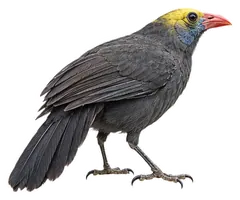 Bare-headed LaughingthrushMelanocichla calva
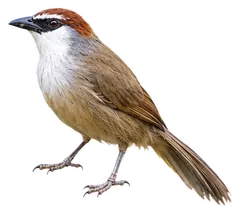 Chestnut-capped BabblerTimalia pileata
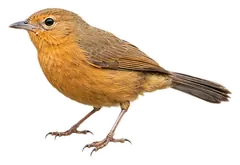 Tawny-bellied BabblerDumetia hyperythra
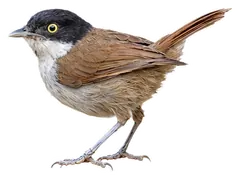 Dark-fronted BabblerDumetia atriceps
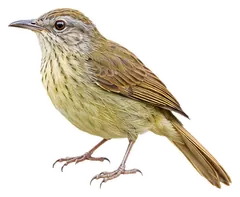 Grey-faced Tit-BabblerMixornis kelleyi
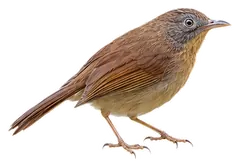 Grey-cheeked Tit-BabblerMixornis flavicollis
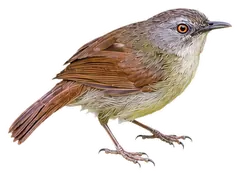 Kangean Tit-BabblerMixornis prillwitzi
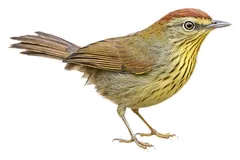 Pin-striped Tit-BabblerMixornis gularis
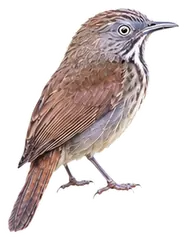 Bold-striped Tit-BabblerMixornis bornensis
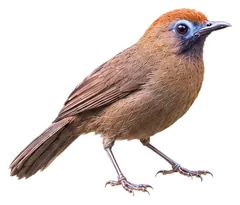 Fluffy-backed Tit-BabblerMacronus ptilosus
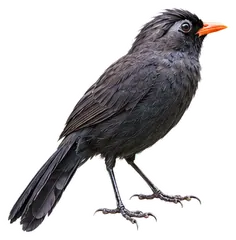
Download illustration
Free to use with credit: “Illustration: Bird Album (birdalbum.com)”. Drawn by AI from a reference photo by Chan Chee Keong. ↗
Heard it but can't see it? Mingji identifies birds by sound and photo, on your phone.