 Bird Album
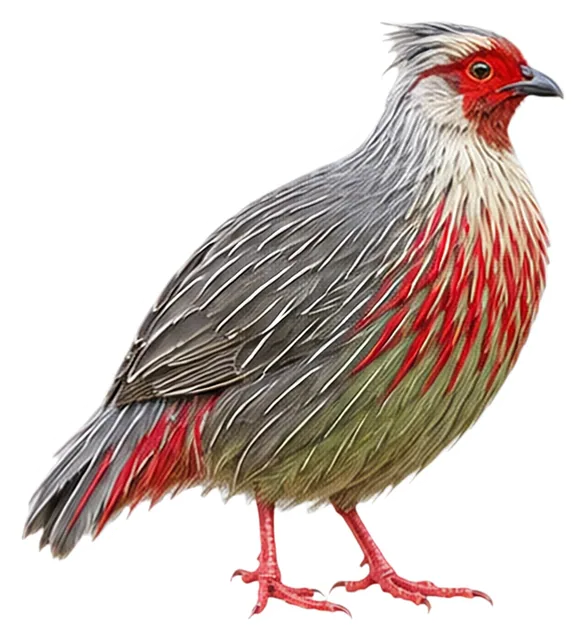
Blood Pheasant
Ithaginis cruentus (Hardwicke, 1821)
≈40 cmLength531 gWeight
The male has bright red feathers on the breast, neck and face, red legs and feet, and red bare skin around the eye.
Busiest months: April–May · Most records: China, Bhutan, Nepal
How to identify
Field marks
- A ring of bare skin around the eye, usually crimson
- Legs and feet red
- Male has bright red feathers on the breast, neck and face
- Bill short, stout and black; small crest on the head
Male, female and young
The male has bright red feathers on the breast, neck and face; the female is dark brown overall and more uniform in color.
Where and when it's recorded

Blood Pheasant has been recorded at 88 of the 8,171 birding hotspots we track, in 3 countries and regions.
Records by month Northern Hemisphere
Where it's recorded most
- ChelelaBhutan352 records
- MengbishanChina117 records
- ThrumsinglaBhutan113 records
More places
- Balang Shan [General Area]China83 records
- Balang Shan – Tunnel AreaChina75 records
- Baxi ForestChina72 records
- Tharpaling MonasteryBhutan60 records
- PelelaBhutan47 records
- Baizha ForestChina42 records
- Sengor – camp and upper Lingmethan RdBhutan41 records
Countries and regions with the most records
eBird records via GBIF up to 2024-12-31. A record means someone listed it; more records partly mean more birders, not more birds.
About
The blood pheasant (Ithaginis cruentus) or blood partridge is a galliforme bird in the pheasant family Phasianidae and the only species in the genus Ithaginis. It is a relatively small, short-tailed pheasant that is widespread in the lower Himalayas ranging across North and East India, Nepal, Bhutan, South China and northern Myanmar. It has been classified as Least Concern on the IUCN Red List since 2009, and the global blood pheasant population is thought to be stable.
Excerpt from Wikipedia, CC BY-SA 4.0 · authors · Read more on Wikipedia
Questions
How big is the Blood Pheasant?
The Blood Pheasant is about ≈40 cm long and weighs around 531 g.
Where does the Blood Pheasant live?
Its breeding range: Oriental: Himalayas. It is most often recorded in China, Bhutan and Nepal.
When is the best time to see the Blood Pheasant?
At the hotspots we track, it is recorded most in April and May (Northern Hemisphere).
Is the Blood Pheasant endangered?
The IUCN Red List classifies the Blood Pheasant as Least Concern.
What does the Blood Pheasant eat?
Main food: Omnivore.
What family is the Blood Pheasant in?
It belongs to the family Pheasants & Allies (Phasianidae), order Galliformes.
At a glance
- Length
- ≈40 cm
- Weight
- 531 g
- Habitat
- Shrubland
- Diet
- Omnivore
- Lifestyle
- Active on the ground
- Migration
- Resident (barely migrates)
- Conservation
- Least Concern
More measurements
- Wing
- 196 mm
- Tail
- 142 mm
- Bill
- 24 mm
- Tarsus
- 61 mm
Averages from the AVONET dataset; length from field guides where available.
Range
Oriental: Himalayas
Breeding range, IOC World Bird List 15.2
Subspecies · 12
- Ithaginis cruentus cruentus n Nepal and sc Tibet
- Ithaginis cruentus affinis Sikkim (ne India), w Bhutan and sse Tibet
- Ithaginis cruentus tibetanus e Bhutan and se Tibet
- Ithaginis cruentus kuseri n Assam and e Arunachal Pradesh (ne India), ese Tibet and nw Yunnan (sw China)
- Ithaginis cruentus marionae w Yunnan (sw China) and ne Myanmar
- Ithaginis cruentus rocki nw Yunnan (sw China)
- Ithaginis cruentus clarkei Lichiang Mts. (nw Yunnan, sw China)
- Ithaginis cruentus geoffroyi e Tibet and sw Sichuan (w China)
- Ithaginis cruentus berezowskii nw Sichuan to s Gansu (c China)
- Ithaginis cruentus beicki ne Qinghai (nc China)
- Ithaginis cruentus michaelis n Qinghai and nw Gansu (nc China)
- Ithaginis cruentus sinensis Shensi (c China)
Classification
- Order
- Galliformes
- Family
- Pheasants & Allies Phasianidae
- Genus
- Ithaginis
More from the family Pheasants & Allies
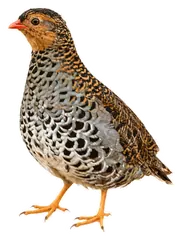 Udzungwa Forest PartridgeXenoperdix udzungwensis
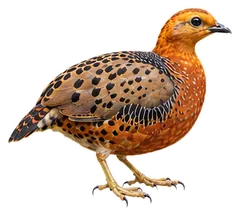 Ferruginous PartridgeCaloperdix oculeus
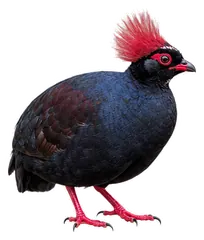 Crested PartridgeRollulus rouloul
 Black PartridgeMelanoperdix niger
 Hill PartridgeArborophila torqueola
 Sichuan PartridgeArborophila rufipectus
 Chestnut-breasted PartridgeArborophila mandellii
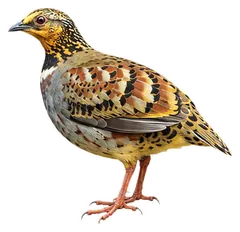 White-necklaced PartridgeArborophila gingica
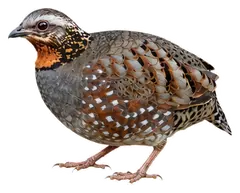 Rufous-throated PartridgeArborophila rufogularis
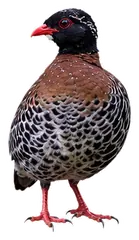 Red-billed PartridgeArborophila rubrirostris
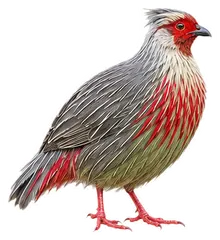
Download illustration
Free to use with credit: “Illustration: Bird Album (birdalbum.com)”. Drawn by AI from a reference photo by Dibyendu Ash. ↗

Heard it but can't see it? Mingji identifies birds by sound and photo, on your phone.