 Bird Album
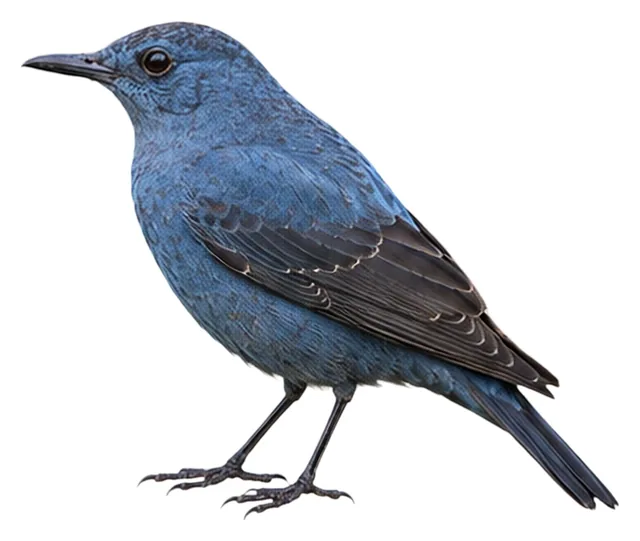
Blue Rock Thrush
Monticola solitarius (Linnaeus, 1758)
21–23 cmLength54 gWeight
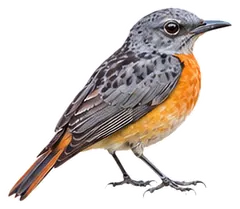
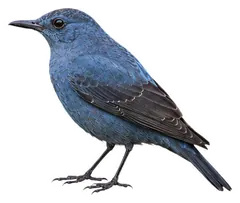
The male of this starling-sized rock thrush is blue-gray, with rufous from the mid-breast down in the northern Chinese subspecies.
Busiest months: October · Most records: China, Spain, Thailand
Looks like Common Rock Thrush, White-throated Rock Thrush
How to identify
Field marks
- Male of the nominate subspecies is blue-gray during the breeding season, with darker wings
- Slender bill
- Female has dark brown upperparts and pale rufous scaling on the underparts
- Male of the northern Chinese subspecies is rufous from the mid-breast to beneath the tail
Male, female and young
Female and immature have dark brown upperparts and paler rufous scaling on the underparts, and are less conspicuous than the male.
Voice
Male's song is clear and melodious, like that of Common Rock Thrush but louder.
Similar species
Where and when it's recorded

Blue Rock Thrush has been recorded at 1,231 of the 8,171 birding hotspots we track, in 70 countries and regions.
Records by month Northern Hemisphere
Where it's recorded most
- Yeliu IBATaiwan (China)3,877 records
- Monfragüe PN – Peña Falcón/Salto del GitanoSpain2,455 records
- Casares – CastilloSpain1,493 records
More places
- Monfragüe PN – Portilla del TiétarSpain1,485 records
- Kenting NP – Sheding Lingxiao Pavilion (Raptors Observation Spot)Taiwan (China)1,289 records
- Po ToiHong Kong (China)1,015 records
- Taipei – Tianliaoyang WetlandTaiwan (China)930 records
- Kaohsiung – Qijin VTC TowerTaiwan (China)840 records
- Monfragüe PNSpain768 records
- Green MubazzarahUnited Arab Emirates743 records
Countries and regions with the most records
eBird records via GBIF up to 2024-12-31. A record means someone listed it; more records partly mean more birders, not more birds.
About
The blue rock thrush (Monticola solitarius) is a species of chat. This thrush-like Old World flycatcher was formerly placed in the family Turdidae. It breeds in southern Europe, northwest Africa, and from Central Asia to northern China and Malaysia.
Excerpt from Wikipedia, CC BY-SA 4.0 · authors · Read more on Wikipedia
Questions
How big is the Blue Rock Thrush?
The Blue Rock Thrush is about 21–23 cm long and weighs around 54 g.
Where does the Blue Rock Thrush live?
Its breeding range: Palearctic, Oriental: widespread, also northwestern Africa. It is most often recorded in China, Spain and Thailand.
When is the best time to see the Blue Rock Thrush?
At the hotspots we track, it is recorded most in October (Northern Hemisphere).
Is the Blue Rock Thrush endangered?
The IUCN Red List classifies the Blue Rock Thrush as Least Concern.
What does the Blue Rock Thrush eat?
Main food: Omnivore.
What family is the Blue Rock Thrush in?
It belongs to the family Chats, Old World Flycatchers (Muscicapidae), order Passerines (Passeriformes).
At a glance
- Length
- 21–23 cm
- Weight
- 54 g
- Habitat
- Rocky terrain
- Diet
- Omnivore
- Lifestyle
- Perches in trees
- Migration
- Partial migrant
- Conservation
- Least Concern
More measurements
- Wing
- 121 mm
- Tail
- 85 mm
- Bill
- 28 mm
- Tarsus
- 28 mm
Averages from the AVONET dataset; length from field guides where available.
Range
Palearctic, Oriental: widespread, also northwestern Africa
Breeding range, IOC World Bird List 15.2
Subspecies · 2
- Monticola solitarius pandoo c Himalayas to e China and nw Vietnam | non-breeding: to Greater Sundas
- Monticola solitarius philippensis e Mongolia to Sakhalin s to Japan, extreme n Philippines and ne China | non-breeding: to Indonesian Arch. and Philippines
Classification
- Order
- Passerines Passeriformes
- Family
- Chats, Old World Flycatchers Muscicapidae
- Genus
- Monticola
Other birds in the genus Monticola
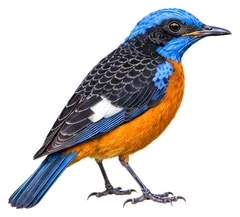 Blue-capped Rock ThrushMonticola cinclorhyncha
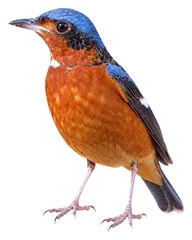 White-throated Rock ThrushMonticola gularis
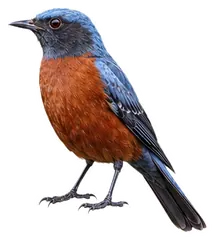 Chestnut-bellied Rock ThrushMonticola rufiventris
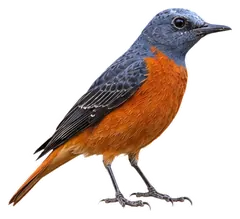 Short-toed Rock ThrushMonticola brevipes
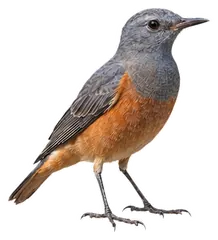 Sentinel Rock ThrushMonticola explorator
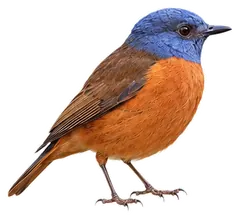 Amber Mountain Rock ThrushMonticola erythronotus
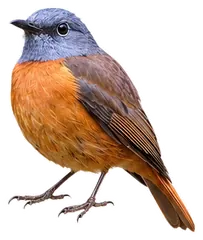 Forest Rock ThrushMonticola sharpei
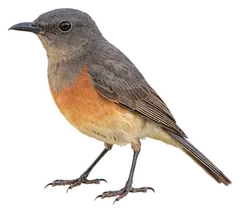 Littoral Rock ThrushMonticola imerina
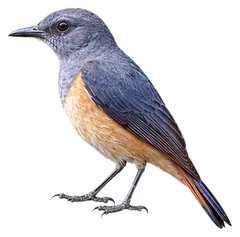 Little Rock ThrushMonticola rufocinereus
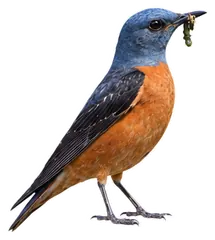 Common Rock ThrushMonticola saxatilis
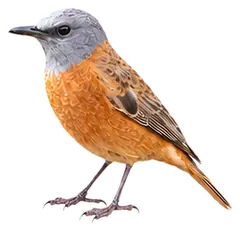 Cape Rock ThrushMonticola rupestris
 Miombo Rock ThrushMonticola angolensis
Download illustration
Free to use with credit: “Illustration: Bird Album (birdalbum.com)”. Drawn by AI from a reference photo by jose maria carretero palacios. ↗

Heard it but can't see it? Mingji identifies birds by sound and photo, on your phone.