 Bird Album
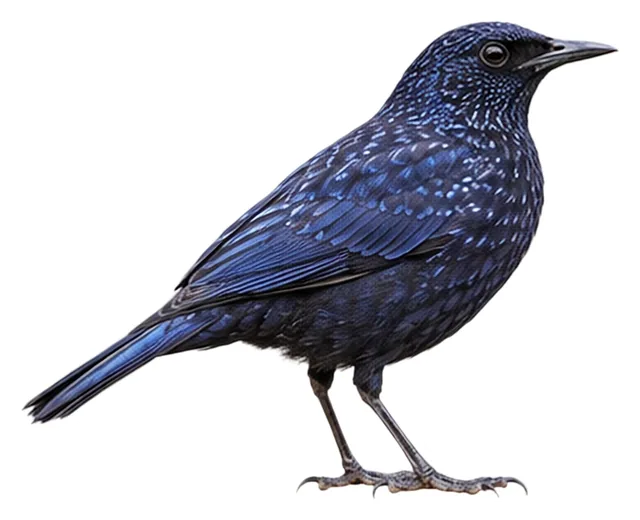
Blue Whistling Thrush
Myophonus caeruleus (Scopoli, 1786)
31–35 cmLength158 gWeight
This deep purple-blue thrush often gives human-like whistling calls at dawn and dusk.
Busiest months: February · Most records: China, India, Thailand
How to identify
Field marks
- Deep purple-blue overall
- Feather tips with sparkling pale blue or white spots
- Median coverts with white spots at the tips in most subspecies
- Bill usually yellow, but black in central and eastern China; legs and feet black
Male, female and young
Sexes similar in plumage.
Voice
Loud, human-like whistles at dawn and dusk; a grating “kree” in alarm.
Where and when it's recorded

Blue Whistling Thrush has been recorded at 814 of the 8,171 birding hotspots we track, in 18 countries and regions.
Records by month Northern Hemisphere
Where it's recorded most
- SattalIndia1,675 records
- Munsyari – Bheema WodeyarIndia1,661 records
- Po ToiHong Kong (China)1,537 records
More places
- Kinmen – Botanical GardenChina1,465 records
- Doi Inthanon NP – summitThailand1,399 records
- Wildlife Institute of IndiaIndia1,267 records
- Tai Po Kau Nature ReserveHong Kong (China)984 records
- Forest Research Institute (FRI), New Forest CampusIndia958 records
- Doi Inthanon NPThailand908 records
- Kaeng Krachan NP – Baan Maka Nature LodgeThailand793 records
Countries and regions with the most records
eBird records via GBIF up to 2024-12-31. A record means someone listed it; more records partly mean more birders, not more birds.
About
The Chinese whistling thrush or blue whistling thrush (Myophonus caeruleus) is a bird in the Old World flycatchers family Muscicapidae that is found in the mountains of Central Asia, South Asia, China and Southeast Asia. It is known for its loud human-like whistling song at dawn and dusk. Like others in the genus, they feed on the ground, often along streams and in damp places, foraging for snails, crabs, insects, and fruit.
Excerpt from Wikipedia, CC BY-SA 4.0 · authors · Read more on Wikipedia
Questions
How big is the Blue Whistling Thrush?
The Blue Whistling Thrush is about 31–35 cm long and weighs around 158 g.
Where does the Blue Whistling Thrush live?
Its breeding range: Oriental: widespread, also central, south-central Asia. It is most often recorded in China, India and Thailand.
When is the best time to see the Blue Whistling Thrush?
At the hotspots we track, it is recorded most in February (Northern Hemisphere).
Is the Blue Whistling Thrush endangered?
The IUCN Red List classifies the Blue Whistling Thrush as Least Concern.
What does the Blue Whistling Thrush eat?
Main food: Omnivore.
What family is the Blue Whistling Thrush in?
It belongs to the family Chats, Old World Flycatchers (Muscicapidae), order Passerines (Passeriformes).
At a glance
- Length
- 31–35 cm
- Weight
- 158 g
- Habitat
- Forest
- Diet
- Omnivore
- Lifestyle
- Active on the ground
- Migration
- Resident (barely migrates)
- Conservation
- Least Concern
More measurements
- Wing
- 169 mm
- Tail
- 119 mm
- Bill
- 33 mm
- Tarsus
- 50 mm
Averages from the AVONET dataset; length from field guides where available.
Range
Oriental: widespread, also central, south-central Asia
Breeding range, IOC World Bird List 15.2
Subspecies · 3
- Myophonus caeruleus temminckii mountains of c Asia to wc China and ne Myanmar
- Myophonus caeruleus caeruleus c, e China
- Myophonus caeruleus eugenei c Myanmar to e Thailand, s China and n, c Indochina
Classification
- Order
- Passerines Passeriformes
- Family
- Chats, Old World Flycatchers Muscicapidae
- Genus
- Myophonus
Other birds in the genus Myophonus
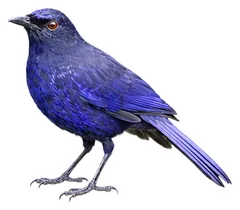 Taiwan Whistling ThrushMyophonus insularis
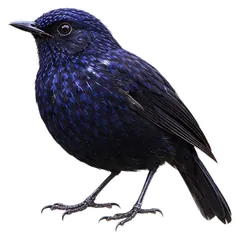 Shiny Whistling ThrushMyophonus melanurus
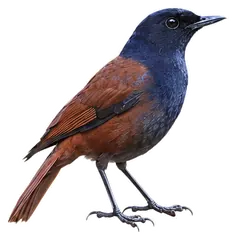 Brown-winged Whistling ThrushMyophonus castaneus
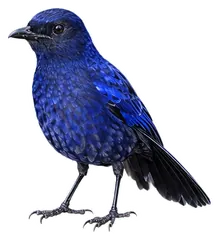 Javan Whistling ThrushMyophonus glaucinus
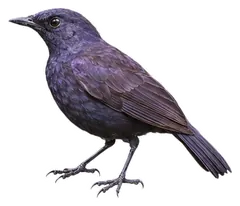 Bornean Whistling ThrushMyophonus borneensis
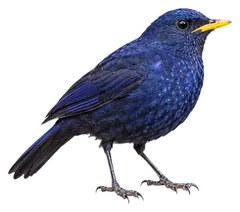 Malayan Whistling ThrushMyophonus robinsoni
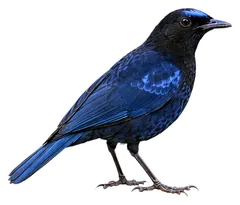 Malabar Whistling ThrushMyophonus horsfieldii
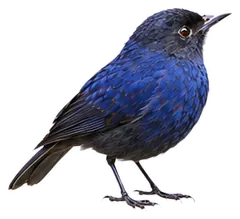 Sri Lanka Whistling ThrushMyophonus blighi
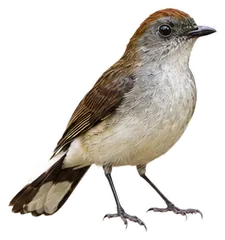 White-tailed AletheAlethe diademata
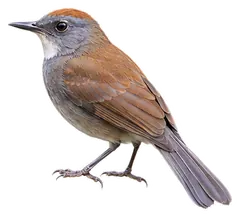 Fire-crested AletheAlethe castanea
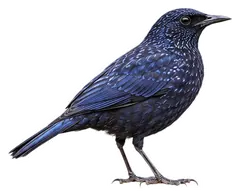
Download illustration
Free to use with credit: “Illustration: Bird Album (birdalbum.com)”. Drawn by AI from a reference photo by 孫鋒 林. ↗

Heard it but can't see it? Mingji identifies birds by sound and photo, on your phone.