 Bird Album
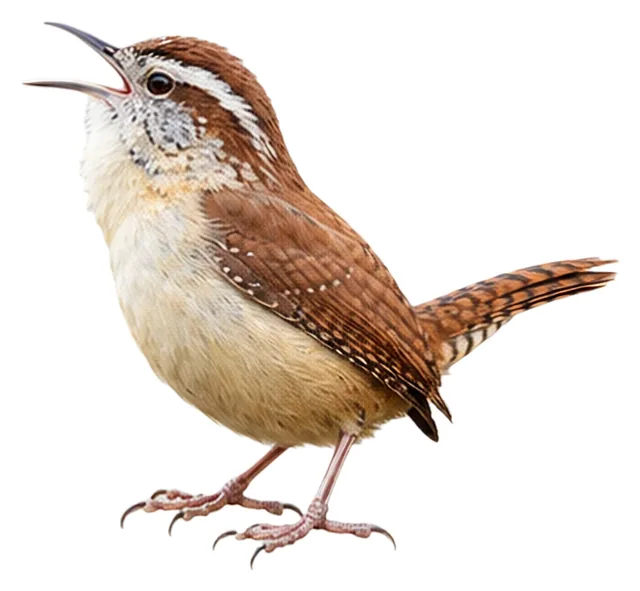
Carolina Wren
Thryothorus ludovicianus (Latham, 1790)
19 gWeight
The Carolina wren (Thryothorus ludovicianus) is a species of wren common in the eastern United States, the extreme south of Ontario, Canada, the northeast and southeast of Mexico, and into northern Central America.
Busiest months: April–May · Most records: United States, Canada, Mexico
Where and when it's recorded

Carolina Wren has been recorded at 516 of the 8,171 birding hotspots we track, in 5 countries and regions.
Records by month Northern Hemisphere
Where it's recorded most
- John Heinz NWR – impoundmentUnited States20,362 records
- Cape Island – Cape May Point SPUnited States19,575 records
- Cape Island – Higbee Beach WMAUnited States17,135 records
More places
- HUNTLEY MEADOWS PARKUnited States16,851 records
- Cape Island – South Cape May MeadowsUnited States16,659 records
- Audubon Corkscrew Swamp SanctuaryUnited States16,169 records
- Point Pelee National ParkCanada15,233 records
- Prospect ParkUnited States14,942 records
- Estero Llano Grande SP WBCUnited States13,921 records
- Bombay Hook National Wildlife RefugeUnited States12,937 records
Countries and regions with the most records
eBird records via GBIF up to 2024-12-31. A record means someone listed it; more records partly mean more birders, not more birds.
About
The Carolina wren (Thryothorus ludovicianus) is a species of wren common in the eastern United States, the extreme south of Ontario, Canada, the northeast and southeast of Mexico, and into northern Central America. Severe winters restrict the northern limits of their range, while favorable weather conditions lead to a northward extension of their breeding range. Their preferred habitat is in dense cover in forest, farm edges, and suburban areas.
Excerpt from Wikipedia, CC BY-SA 4.0 · authors · Read more on Wikipedia
Questions
How big is the Carolina Wren?
The Carolina Wren weighs around 19 g.
Where does the Carolina Wren live?
Its breeding range: North America, Middle America: southeastern Canada and eastern USA to Guatemala and Nicaragua. It is most often recorded in United States, Canada and Mexico.
When is the best time to see the Carolina Wren?
At the hotspots we track, it is recorded most in April and May (Northern Hemisphere).
Is the Carolina Wren endangered?
The IUCN Red List classifies the Carolina Wren as Least Concern.
What does the Carolina Wren eat?
Main food: Insects & other invertebrates.
What family is the Carolina Wren in?
It belongs to the family Wrens (Troglodytidae), order Passerines (Passeriformes).
At a glance
- Weight
- 19 g
- Habitat
- Woodland
- Diet
- Insects & other invertebrates
- Lifestyle
- Perches in trees
- Migration
- Resident (barely migrates)
- Conservation
- Least Concern
More measurements
- Wing
- 59 mm
- Tail
- 51 mm
- Bill
- 17 mm
- Tarsus
- 21 mm
Averages from the AVONET dataset; length from field guides where available.
Range
North America, Middle America: southeastern Canada and eastern USA to Guatemala and Nicaragua
Breeding range, IOC World Bird List 15.2
Classification
- Order
- Passerines Passeriformes
- Family
- Wrens Troglodytidae
- Genus
- Thryothorus
More from the family Wrens
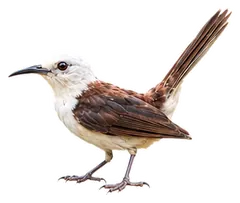 White-headed WrenCampylorhynchus albobrunneus
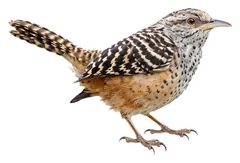 Band-backed WrenCampylorhynchus zonatus
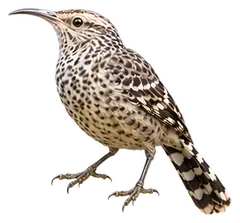 Grey-barred WrenCampylorhynchus megalopterus
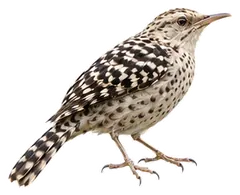 Stripe-backed WrenCampylorhynchus nuchalis
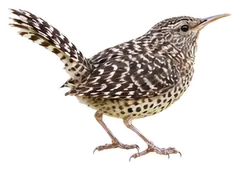 Fasciated WrenCampylorhynchus fasciatus
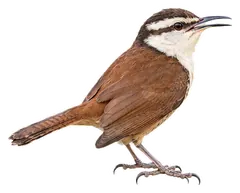 Giant WrenCampylorhynchus chiapensis
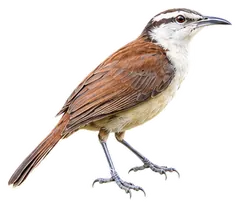 Bicolored WrenCampylorhynchus griseus
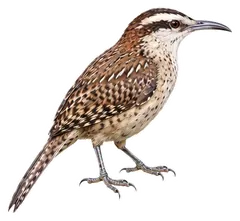 Veracruz WrenCampylorhynchus rufinucha
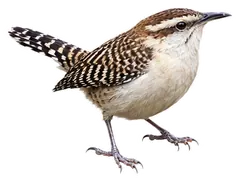 Russet-naped WrenCampylorhynchus humilis
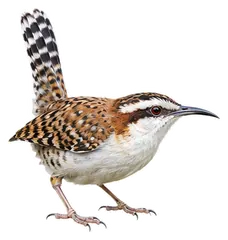 Rufous-backed WrenCampylorhynchus capistratus
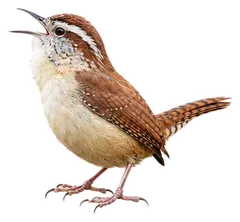
Download illustration
Free to use with credit: “Illustration: Bird Album (birdalbum.com)”. Drawn by AI from a reference photo by Tom Murray. ↗
Heard it but can't see it? Mingji identifies birds by sound and photo, on your phone.
In other languages
- EnglishCarolina Wren
- 简体中文卡罗苇鹪鹩
- 繁體中文皇葦鷦鷯
- 日本語チャバラマユミソサザイ
- DeutschCarolinazaunkönig
- FrançaisTroglodyte de Caroline
- EspañolCucarachero de Carolina
- Portuguêscarriça-carolina
- ItalianoScricciolo della Carolina
- NederlandsCarolinawinterkoning
- РусскийКаролинский крапивник
- Svenskakarolinagärdsmyg
- DanskCarolinasmutte
- Polskistrzyżyk karoliński