 Bird Album
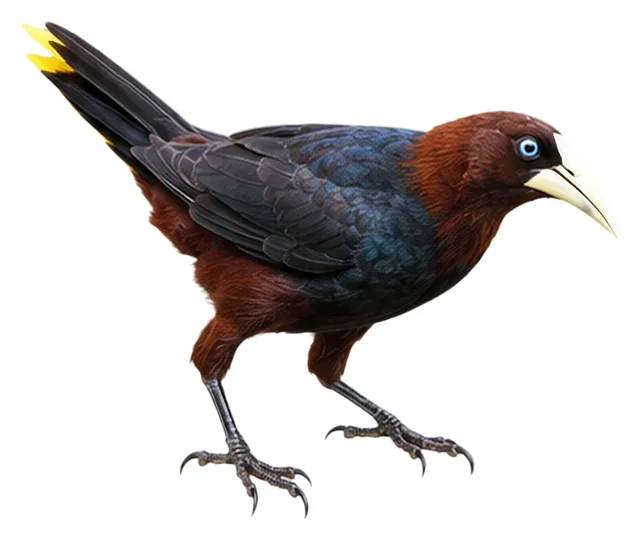
Chestnut-headed Oropendola
Psarocolius wagleri (Gray, GR, 1844)
35 cmLength156 gWeight
The chestnut-headed oropendola (Psarocolius wagleri) is a species of bird in the family Icteridae, the oropendolas, New World orioles, and New World blackbirds.
Busiest months: January–March · Most records: Costa Rica, Panama, Colombia
Where and when it's recorded

Chestnut-headed Oropendola has been recorded at 212 of the 8,171 birding hotspots we track, in 9 countries and regions.
Records by month Northern Hemisphere
Where it's recorded most
- Rancho NaturalistaCosta Rica4,451 records
- Estación Biológica La Selva-OTSCosta Rica4,345 records
- RNP ChajbaocGuatemala2,191 records
More places
- Canopy LodgePanama2,162 records
- RN San Cipriano-EscalereteColombia1,917 records
- Canopy CampPanama1,915 records
- Arenal Observatory LodgeCosta Rica1,759 records
- Hotel QuelitalesCosta Rica1,569 records
- Donde Cope- La Unión de GuápilesCosta Rica1,497 records
- Finca Rubel ChaimGuatemala1,451 records
Countries and regions with the most records
eBird records via GBIF up to 2024-12-31. A record means someone listed it; more records partly mean more birders, not more birds.
About
The chestnut-headed oropendola (Psarocolius wagleri) is a species of bird in the family Icteridae, the oropendolas, New World orioles, and New World blackbirds. It is found in Mexico, in every Central American country except El Salvador, and in Colombia and Ecuador.
Excerpt from Wikipedia, CC BY-SA 4.0 · authors · Read more on Wikipedia
Questions
How big is the Chestnut-headed Oropendola?
The Chestnut-headed Oropendola is about 35 cm long and weighs around 156 g.
Where does the Chestnut-headed Oropendola live?
Its breeding range: Middle America, South America: east-central Mexico to east-central Colombia and southwestern Ecuador. It is most often recorded in Costa Rica, Panama and Colombia.
When is the best time to see the Chestnut-headed Oropendola?
At the hotspots we track, it is recorded most in January, February and March (Northern Hemisphere).
Is the Chestnut-headed Oropendola endangered?
The IUCN Red List classifies the Chestnut-headed Oropendola as Least Concern.
What does the Chestnut-headed Oropendola eat?
Main food: Omnivore.
What family is the Chestnut-headed Oropendola in?
It belongs to the family Oropendolas, New World Orioles, Blackbirds (Icteridae), order Passerines (Passeriformes).
At a glance
- Length
- 35 cm
- Weight
- 156 g
- Habitat
- Forest
- Diet
- Omnivore
- Lifestyle
- Perches in trees
- Migration
- Partial migrant
- Conservation
- Least Concern
More measurements
- Wing
- 182 mm
- Tail
- 119 mm
- Bill
- 58 mm
- Tarsus
- 36 mm
Averages from the AVONET dataset; length from field guides where available.
Range
Middle America, South America: east-central Mexico to east-central Colombia and southwestern Ecuador
Breeding range, IOC World Bird List 15.2
Classification
- Order
- Passerines Passeriformes
- Family
- Oropendolas, New World Orioles, Blackbirds Icteridae
- Genus
- Psarocolius
Other birds in the genus Psarocolius
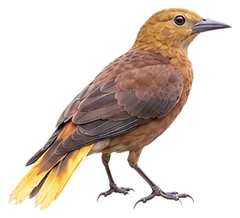 Russet-backed OropendolaPsarocolius angustifrons
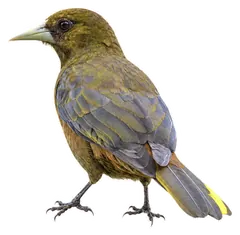 Dusky-green OropendolaPsarocolius atrovirens
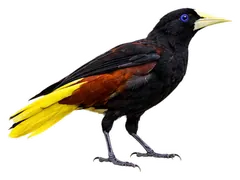 Crested OropendolaPsarocolius decumanus
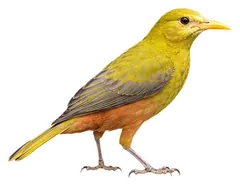 Green OropendolaPsarocolius viridis
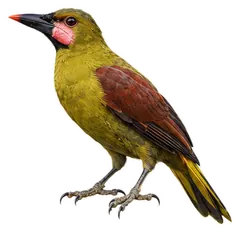 Olive OropendolaPsarocolius bifasciatus
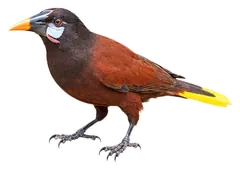 Montezuma OropendolaPsarocolius montezuma
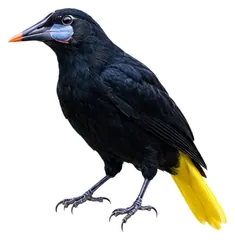 Black OropendolaPsarocolius guatimozinus
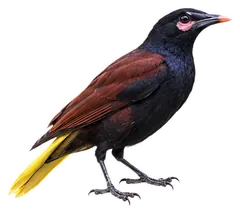 Baudo OropendolaPsarocolius cassini
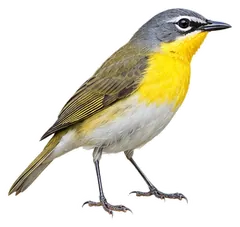 Yellow-breasted ChatIcteria virens
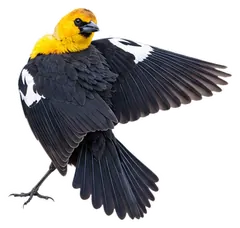 Yellow-headed BlackbirdXanthocephalus xanthocephalus
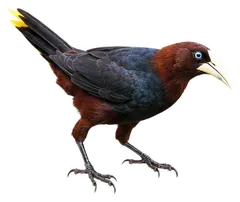
Download illustration
Free to use with credit: “Illustration: Bird Album (birdalbum.com)”. Drawn by AI from a reference photo by Francesco Veronesi. ↗
Heard it but can't see it? Mingji identifies birds by sound and photo, on your phone.
In other languages
- EnglishChestnut-headed Oropendola
- 简体中文栗头拟椋鸟
- 繁體中文栗頭擬椋鳥
- 日本語クリガシラオオツリスドリ
- DeutschRotkopf-Stirnvogel
- FrançaisCassique à tête brune
- EspañolCacique cabecicastaño
- Portuguêsjapu-de-cabeça-castanha
- ItalianoOropendola testacastana
- NederlandsWaglers Oropendola
- РусскийКаштановоголовая оропендола
- Svenskabrunhuvad oropendola
- DanskStornæbbet Hjelmoropendola
- Polskikacykowiec grubodzioby