 Bird Album
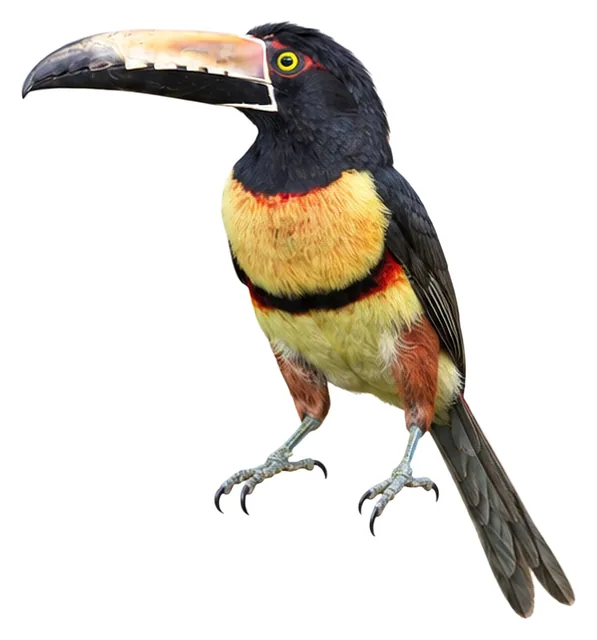
Collared Aracari
Pteroglossus torquatus (Gmelin, JF, 1788)
38–41 cmLength219 gWeight
The adult has a white line at the base of its large bill, and the nominate subspecies has red and black bands across the upper part of its yellow belly.
Busiest months: January–March · Most records: Costa Rica, Belize, Panama
How to identify
Field marks
- Adult has a narrow vertical white line at the base of the bill
- Adult of the nominate subspecies has a cinnamon-red collar on the nape
- Adult of the nominate subspecies has a bright red rump
- Adult of the nominate subspecies has red and black bands across the upper part of the yellow belly
Male, female and young
Sexes alike in plumage and bill color; female has a shorter bill. Juvenile duller, with less distinct markings.
Voice
Often gives high, sharp “seek” and “pseek” notes, as well as purring sounds.
Where and when it's recorded
Busiest months: January–March · Most records: Costa Rica, Belize, Panama

Collared Aracari has been recorded at 309 of the 8,276 birding hotspots we track, in 11 countries and regions.
Records by month Northern Hemisphere
Where it's recorded most
- Estación Biológica La Selva-OTSCosta Rica9,608 records
- Arenal Observatory LodgeCosta Rica8,715 records
- Black Rock LodgeBelize5,422 records
More places
- Rancho NaturalistaCosta Rica4,627 records
- Selva Verde LodgeCosta Rica2,904 records
- Rio Silanche Bird SanctuaryEcuador2,119 records
- RN San Cipriano-EscalereteColombia2,093 records
- Milpe Bird SanctuaryEcuador2,011 records
- PN Tikal – sitio arqueológicoGuatemala1,715 records
- Canopy TowerPanama1,602 records
Countries and regions with the most records
eBird records via GBIF up to 2024-12-31. A record means someone listed it; more records partly mean more birders, not more birds.
About
The collared aracari or collared araçari (Pteroglossus torquatus) is a bird in the toucan family Ramphastidae. It is found from Mexico to Colombia and Venezuela.
Excerpt from Wikipedia, CC BY-SA 4.0 · authors · Read more on Wikipedia
Questions
How big is the Collared Aracari?
The Collared Aracari is about 38–41 cm long and weighs around 219 g.
Where does the Collared Aracari live?
Its breeding range: Middle America, South America: Mexico to Venezuela. It is most often recorded in Costa Rica, Belize and Panama.
When is the best time to see the Collared Aracari?
At the hotspots we track, it is recorded most in January, February and March (Northern Hemisphere).
Is the Collared Aracari endangered?
The IUCN Red List classifies the Collared Aracari as Least Concern.
What does the Collared Aracari eat?
Main food: Fruit.
What family is the Collared Aracari in?
It belongs to the family Toucans (Ramphastidae), order Piciformes.
At a glance
- Length
- 38–41 cm
- Weight
- 219 g
- Habitat
- Forest
- Diet
- Fruit
- Lifestyle
- Perches in trees
- Migration
- Resident (barely migrates)
- Conservation
- Least Concern
More measurements
- Wing
- 147 mm
- Tail
- 154 mm
- Bill
- 104 mm
- Tarsus
- 35 mm
Averages from the AVONET dataset; length from field guides where available.
Range
Middle America, South America: Mexico to Venezuela
Breeding range, IOC World Bird List 15.2
Classification
- Order
- Piciformes
- Family
- Toucans Ramphastidae
- Genus
- Pteroglossus
Other birds in the genus Pteroglossus
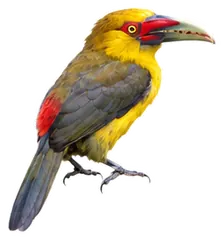 Saffron ToucanetPteroglossus bailloni
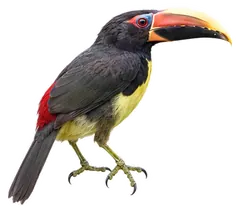 Green AracariPteroglossus viridis
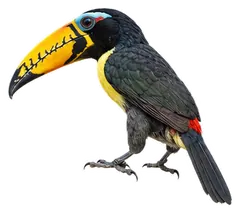 Lettered AracariPteroglossus inscriptus
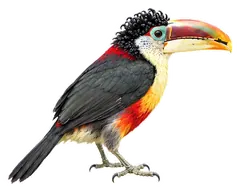 Curl-crested AracariPteroglossus beauharnaisii
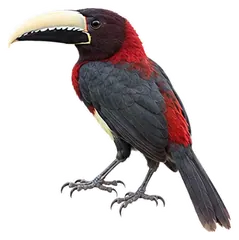 Red-necked AracariPteroglossus bitorquatus
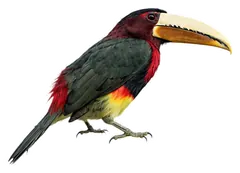 Ivory-billed AracariPteroglossus azara
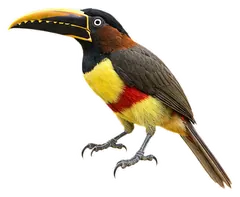 Chestnut-eared AracariPteroglossus castanotis
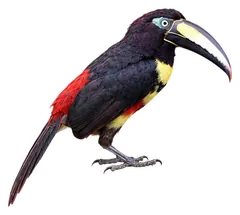 Many-banded AracariPteroglossus pluricinctus
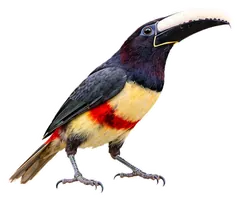 Black-necked AracariPteroglossus aracari
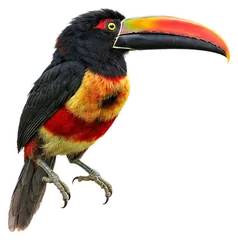 Fiery-billed AracariPteroglossus frantzii
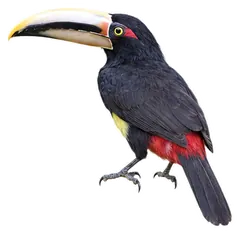 Pale-mandibled AracariPteroglossus erythropygius
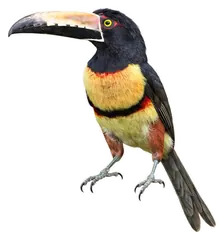
Download illustration
Free to use with credit: “Illustration: Bird Album (birdalbum.com)”. Drawn by AI from a reference photo by Greg Lasley. ↗
Heard it but can't see it? Mingji identifies birds by sound and photo, on your phone.