 Bird Album
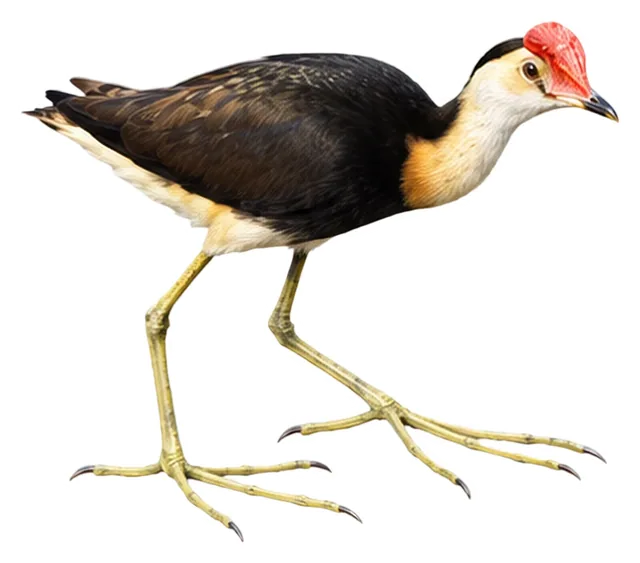
Comb-crested Jacana
Irediparra gallinacea (Temminck, 1828)
20–22 cmLength99 gWeight
The comb-crested jacana (Irediparra gallinacea), also known as the lotusbird or lilytrotter (though these names are sometimes used to describe Jacanidae as a whole), is the only species of jacana in the genus Irediparra.
Busiest months: July–November · Most records: Australia, Papua New Guinea, Timor-Leste
Where and when it's recorded

Comb-crested Jacana has been recorded at 74 of the 8,171 birding hotspots we track, in 3 countries and regions.
Records by month Southern Hemisphere
Where it's recorded most
- Sandy Camp Road WetlandsAustralia5,541 records
- Cattana WetlandsAustralia3,345 records
- Dowse LagoonAustralia2,338 records
More places
- Townsville Town Common Conservation ParkAustralia1,862 records
- Tyto WetlandsAustralia1,821 records
- Fogg Dam Conservation ReserveAustralia1,620 records
- Keatings Lagoon Conservation ParkAustralia1,543 records
- Minnippi ParklandsAustralia1,267 records
- Kakadu National Park – Yellow WaterAustralia1,244 records
- Lake Samsonvale – Golds Scrub LaneAustralia1,070 records
Countries and regions with the most records
eBird records via GBIF up to 2024-12-31. A record means someone listed it; more records partly mean more birders, not more birds.
About
The comb-crested jacana (Irediparra gallinacea), also known as the lotusbird or lilytrotter (though these names are sometimes used to describe Jacanidae as a whole), is the only species of jacana in the genus Irediparra. Like other jacana species, it is adapted to the floating vegetation of tropical freshwater wetlands.
Excerpt from Wikipedia, CC BY-SA 4.0 · authors · Read more on Wikipedia
Questions
How big is the Comb-crested Jacana?
The Comb-crested Jacana is about 20–22 cm long and weighs around 99 g.
Where does the Comb-crested Jacana live?
Its breeding range: Australasia: inland southeastern Borneo, Sulawesi, Lesser Sundas and Mindanao (southern Philippines) to New Guinea and some satellites, and northeastern Western Australia to south-central New South Wales (northern, eastern Australia). It is most often recorded in Australia, Papua New Guinea and Timor-Leste.
When is the best time to see the Comb-crested Jacana?
At the hotspots we track, it is recorded most in July, August, September, October and November (Southern Hemisphere).
Is the Comb-crested Jacana endangered?
The IUCN Red List classifies the Comb-crested Jacana as Least Concern.
What does the Comb-crested Jacana eat?
Main food: Fish, shrimp & shellfish.
What family is the Comb-crested Jacana in?
It belongs to the family Jacanas (Jacanidae), order Charadriiformes.
At a glance
- Length
- 20–22 cm
- Weight
- 99 g
- Habitat
- Wetland
- Diet
- Fish, shrimp & shellfish
- Lifestyle
- Active on the ground
- Migration
- Resident (barely migrates)
- Conservation
- Least Concern
More measurements
- Wing
- 135 mm
- Tail
- 41 mm
- Bill
- 28 mm
- Tarsus
- 59 mm
Averages from the AVONET dataset; length from field guides where available.
Range
Australasia: inland southeastern Borneo, Sulawesi, Lesser Sundas and Mindanao (southern Philippines) to New Guinea and some satellites, and northeastern Western Australia to south-central New South Wales (northern, eastern Australia)
Breeding range, IOC World Bird List 15.2
Classification
- Order
- Charadriiformes
- Family
- Jacanas Jacanidae
- Genus
- Irediparra
More from the family Jacanas
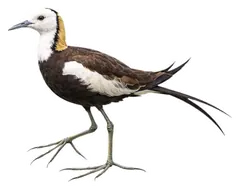 Pheasant-tailed JacanaHydrophasianus chirurgus
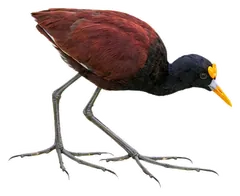 Northern JacanaJacana spinosa
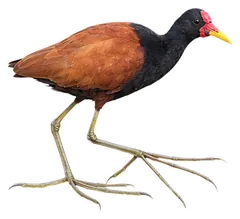 Wattled JacanaJacana jacana
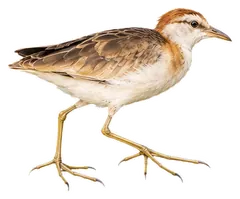 Lesser JacanaMicroparra capensis
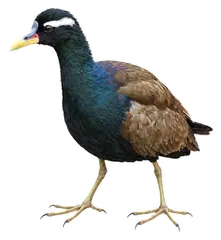 Bronze-winged JacanaMetopidius indicus
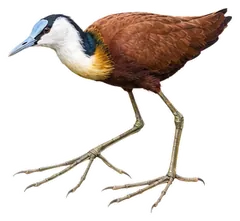 African JacanaActophilornis africanus
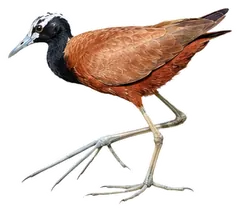 Madagascar JacanaActophilornis albinucha
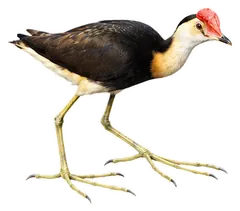
Download illustration
Free to use with credit: “Illustration: Bird Album (birdalbum.com)”. Drawn by AI from a reference photo by Nik Borrow. ↗
Heard it but can't see it? Mingji identifies birds by sound and photo, on your phone.