 Bird Album
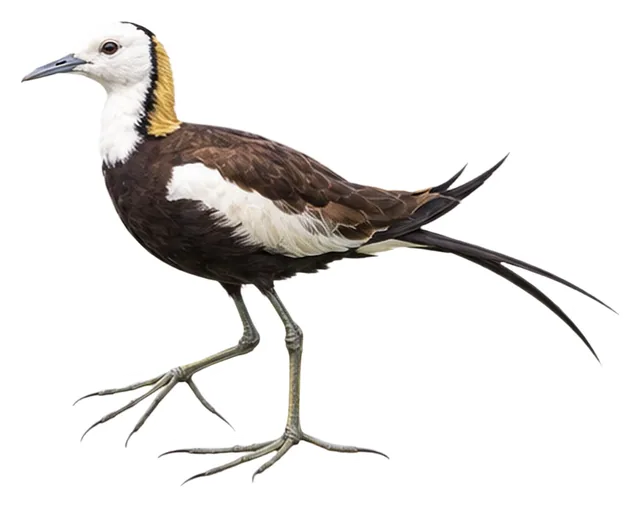
Pheasant-tailed Jacana
Hydrophasianus chirurgus (Scopoli, 1786)
≈30 cmLength160 gWeight
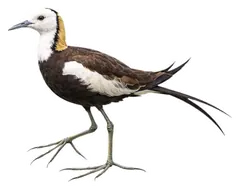
It is a waterbird that walks on floating leaves, trailing long central tail feathers in the breeding season.
Busiest months: December–February · Most records: India, China, Sri Lanka
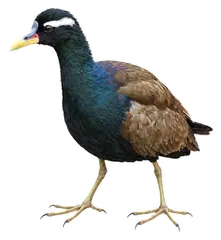
Looks like Bronze-winged Jacana
How to identify
Field marks
- Central tail feathers greatly elongated in the breeding season
- Face white and nape golden yellow in the breeding season
- Body chocolate-rufous and wings mostly white in the breeding season
- Wings white with black edges in flight
Male, female and young
Female larger than male; juvenile has rufous upperparts and an incomplete dark collar.
Voice
A cat-like “me-onp”; winter flocks give a nasal “teeun”.
Similar species
Where and when it's recorded
Busiest months: December–February · Most records: India, China, Sri Lanka

Pheasant-tailed Jacana has been recorded at 652 of the 8,276 birding hotspots we track, in 22 countries and regions.
Records by month Northern Hemisphere
Where it's recorded most
- Changaram Wetlands – EzhupunnaIndia2,112 records
- Bharatpur – Keoladeo Ghana NPIndia1,876 records
- Saul Kere / Sowl KereIndia1,441 records
More places
- Tainan – Guantian Pheasant-tailed Jacana Ecological Education ParkTaiwan (China)1,380 records
- Kaohsiung – Meinong Zhongzheng Lake Pheasant-tailed Jacana HabitatTaiwan (China)1,115 records
- Baruipur MarshesIndia1,107 records
- Sholinganallur/Perumbakkam MarshlandsIndia874 records
- Khon Kaen University – WTPThailand872 records
- Haiderpur Wetlands and Bijnor BarrageIndia841 records
- Pavalathanoor Lake, TharamangalamIndia803 records
Countries and regions with the most records
eBird records via GBIF up to 2024-12-31. A record means someone listed it; more records partly mean more birders, not more birds.
About
The pheasant-tailed jacana (Hydrophasianus chirurgus) is a jacana in the monotypic genus Hydrophasianus. Like all other jacanas, they have elongated toes and nails that enable them to walk on floating vegetation in shallow lakes, their preferred habitat. They may also swim or wade in water reaching their body while foraging mainly for invertebrate prey.
Excerpt from Wikipedia, CC BY-SA 4.0 · authors · Read more on Wikipedia
Questions
How big is the Pheasant-tailed Jacana?
The Pheasant-tailed Jacana is about ≈30 cm long and weighs around 160 g.
Where does the Pheasant-tailed Jacana live?
Its breeding range: Oriental: widespread inland Pakistan to Luzon, Mindanao (northern, southern Philippines), Java and Bali. It is most often recorded in India, China and Sri Lanka.
When is the best time to see the Pheasant-tailed Jacana?
At the hotspots we track, it is recorded most in January, February and December (Northern Hemisphere).
Is the Pheasant-tailed Jacana endangered?
The IUCN Red List classifies the Pheasant-tailed Jacana as Least Concern.
What does the Pheasant-tailed Jacana eat?
Main food: Fish, shrimp & shellfish.
What family is the Pheasant-tailed Jacana in?
It belongs to the family Jacanas (Jacanidae), order Charadriiformes.
At a glance
- Length
- ≈30 cm
- Weight
- 160 g
- Habitat
- Wetland
- Diet
- Fish, shrimp & shellfish
- Lifestyle
- Active on the ground
- Migration
- Partial migrant
- Conservation
- Least Concern
More measurements
- Wing
- 194 mm
- Tail
- 70 mm
- Bill
- 33 mm
- Tarsus
- 53 mm
Averages from the AVONET dataset; length from field guides where available.
Range
Oriental: widespread inland Pakistan to Luzon, Mindanao (northern, southern Philippines), Java and Bali
Breeding range, IOC World Bird List 15.2
Classification
- Order
- Charadriiformes
- Family
- Jacanas Jacanidae
- Genus
- Hydrophasianus
More from the family Jacanas
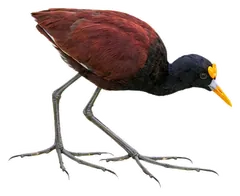 Northern JacanaJacana spinosa
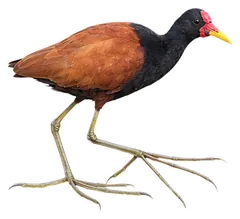 Wattled JacanaJacana jacana
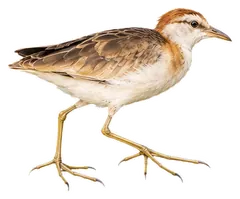 Lesser JacanaMicroparra capensis
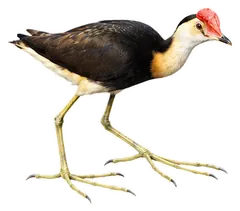 Comb-crested JacanaIrediparra gallinacea
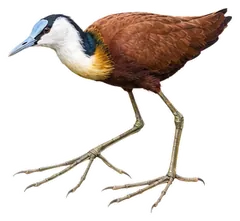 African JacanaActophilornis africanus
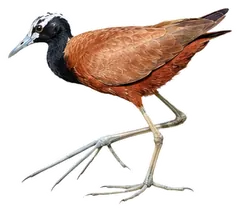 Madagascar JacanaActophilornis albinucha
Download illustration
Free to use with credit: “Illustration: Bird Album (birdalbum.com)”. Drawn by AI from a reference photo by Charles J. Sharp. ↗

Heard it but can't see it? Mingji identifies birds by sound and photo, on your phone.