 Bird Album
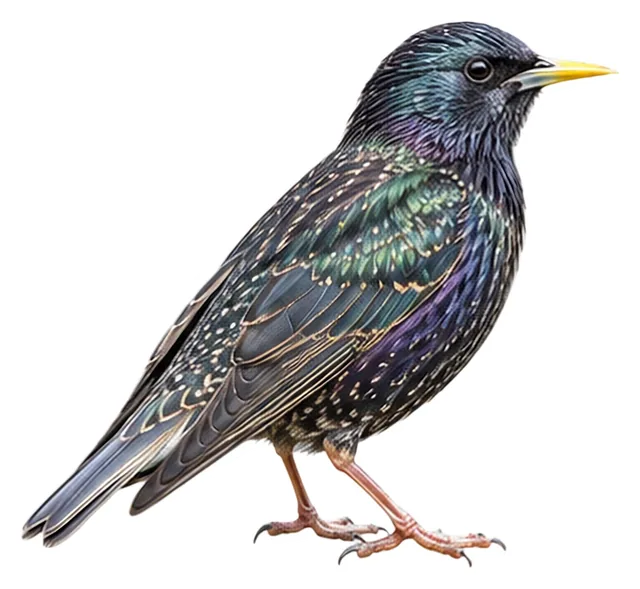
Common Starling
Sturnus vulgaris Linnaeus, 1758
20 cmLength38 cmWingspan77 gWeight
It has black feathers with a metallic gloss and seasonal white spots, walks with a slight waddle and often gathers in large flocks.
Busiest months: May · Most records: United States, Canada, United Kingdom
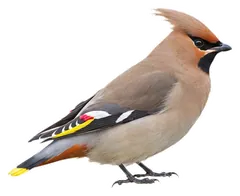
Looks like Bohemian Waxwing
How to identify
Field marks
- Black feathers with a purple-green metallic gloss and many white spots in winter
- Bill yellow in summer, black in winter
- Relatively short tail, pointed, knife-like bill and rounded belly
- Stout pink legs and feet
Male, female and young
The sexes can usually be distinguished by the iris: dark brown in males, gray-brown or gray in females. Males have fewer spots on the underparts; juveniles are gray-brown.
Voice
The song is highly varied, with whistles, mimicry and series of clicks.
Similar species
Where and when it's recorded
Busiest months: May · Most records: United States, Canada, United Kingdom

Common Starling has been recorded at 3,109 of the 8,276 birding hotspots we track, in 116 countries and regions.
Records by month Northern Hemisphere
Where it's recorded most
- Central ParkUnited States34,597 records
- Prospect ParkUnited States32,310 records
- Montrose Point Bird Sanctuary, Lincoln Park, ChicagoUnited States30,880 records
More places
- Magee Marsh – BoardwalkUnited States18,392 records
- Billy Frank Jr. Nisqually NWRUnited States18,247 records
- Parker River NWRUnited States17,746 records
- Riparian Preserve at Gilbert Water RanchUnited States16,855 records
- Point Pelee National ParkCanada16,256 records
- Fort De Soto ParkUnited States15,485 records
- Central Park – The RambleUnited States15,182 records
Countries and regions with the most records
eBird records via GBIF up to 2024-12-31. A record means someone listed it; more records partly mean more birders, not more birds.
About
The common starling (Sturnus vulgaris), also known simply as the starling in Great Britain and Ireland, and as the European starling in North America, is a medium-sized passerine bird in the starling family, Sturnidae. It is about 20 cm (8 in) long and has glossy black plumage with a metallic sheen, which is speckled with white at some times of the year. The legs are pink and the bill is black in winter and yellow in summer; young birds have browner plumage than the adults.
Excerpt from Wikipedia, CC BY-SA 4.0 · authors · Read more on Wikipedia
Questions
How big is the Common Starling?
The Common Starling is about 20 cm long, with a wingspan of 38 cm and weighs around 77 g.
Where does the Common Starling live?
Its breeding range: Palearctic: western, central, introduced worldwide. It is most often recorded in United States, Canada and United Kingdom.
When is the best time to see the Common Starling?
At the hotspots we track, it is recorded most in May (Northern Hemisphere).
Is the Common Starling endangered?
The IUCN Red List classifies the Common Starling as Least Concern.
What does the Common Starling eat?
Main food: Omnivore.
What family is the Common Starling in?
It belongs to the family Starlings, Rhabdornises (Sturnidae), order Passerines (Passeriformes).
At a glance
- Length
- 20 cm
- Wingspan
- 38 cm
- Weight
- 77 g
- Habitat
- Towns & farmland
- Diet
- Omnivore
- Lifestyle
- Perches in trees
- Migration
- Partial migrant
- Conservation
- Least Concern
More measurements
- Wing
- 128 mm
- Tail
- 66 mm
- Bill
- 30 mm
- Tarsus
- 29 mm
Averages from the AVONET dataset; length from field guides where available.
Range
Palearctic: western, central, introduced worldwide
Breeding range, IOC World Bird List 15.2
Subspecies · 1
- Sturnus vulgaris porphyronotus e Kazakhstan and nw China to Uzbekistan and Tajikistan
Classification
- Order
- Passerines Passeriformes
- Family
- Starlings, Rhabdornises Sturnidae
- Genus
- Sturnus
Other birds in the genus Sturnus
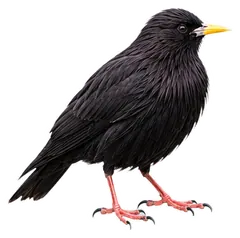 Spotless StarlingSturnus unicolor
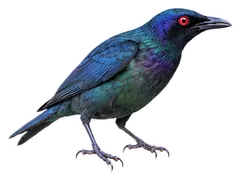 Metallic StarlingAplonis metallica
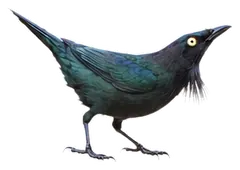 Yellow-eyed StarlingAplonis mystacea
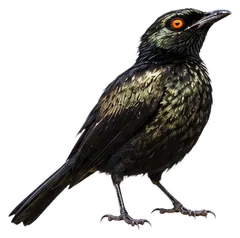 Singing StarlingAplonis cantoroides
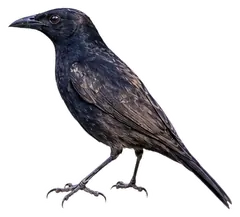 Tanimbar StarlingAplonis crassa
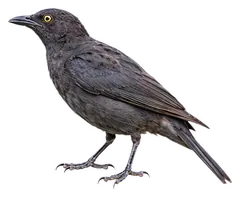 Atoll StarlingAplonis feadensis
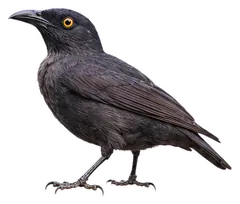 Rennell StarlingAplonis insularis
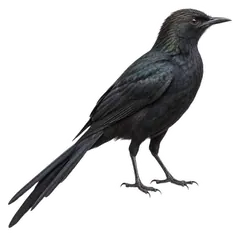 Long-tailed StarlingAplonis magna
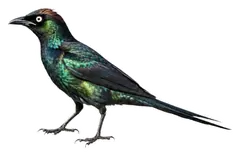 White-eyed StarlingAplonis brunneicapillus
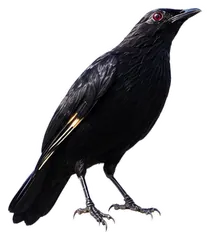 Brown-winged StarlingAplonis grandis
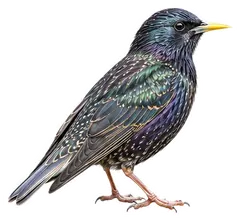
Download illustration
Free to use with credit: “Illustration: Bird Album (birdalbum.com)”. Drawn by AI from a reference photo by Charles J. Sharp. ↗

Heard it but can't see it? Mingji identifies birds by sound and photo, on your phone.