 Bird Album
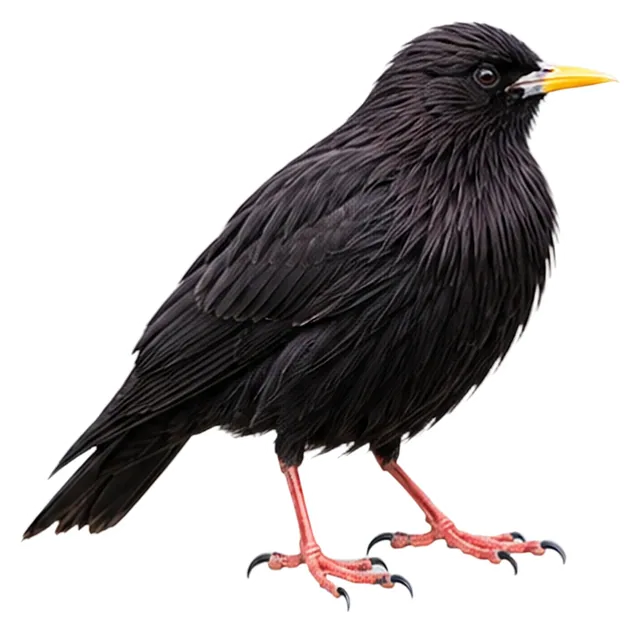
Spotless Starling
Sturnus unicolor Temminck, 1820
21–23 cmLength84 gWeight
The spotless starling (Sturnus unicolor) is a passerine bird in the starling family, Sturnidae.
Busiest months: April–May and September–October · Most records: Spain, Portugal, Morocco
Where and when it's recorded

Spotless Starling has been recorded at 236 of the 8,171 birding hotspots we track, in 10 countries and regions.
Records by month Northern Hemisphere
Where it's recorded most
- Desembocadura del Guadalhorce – ÁreaSpain5,324 records
- Lezíria Grande de Vila Franca de Xira – área geralPortugal3,483 records
- Parque El Retiro-MadridSpain3,135 records
More places
- El Oso – Laguna y entornoSpain2,985 records
- Costa da Caparica – área nortePortugal2,919 records
- Zamora – Río DueroSpain2,765 records
- Azud de RiolobosSpain2,242 records
- Sureste PNat – Ruta del Soto GutiérrezSpain2,105 records
- Doñana PN – Marisma de El RocíoSpain1,788 records
- Marjal dels Moros – ÁreaSpain1,779 records
Countries and regions with the most records
eBird records via GBIF up to 2024-12-31. A record means someone listed it; more records partly mean more birders, not more birds.
About
The spotless starling (Sturnus unicolor) is a passerine bird in the starling family, Sturnidae. It is closely related to the common starling (S. vulgaris), but has a much more restricted range, confined to the Iberian Peninsula, Northwest Africa, southernmost France, and the islands of Sicily, Corsica and Sardinia. It is largely non-migratory.
Excerpt from Wikipedia, CC BY-SA 4.0 · authors · Read more on Wikipedia
Questions
How big is the Spotless Starling?
The Spotless Starling is about 21–23 cm long and weighs around 84 g.
Where does the Spotless Starling live?
Its breeding range: Palearctic: southwestern Europe and northern Africa: Iberian Peninsula, far southwestern France, Balearic Islands, Corsica, Sardinia and Sicily; southwestern Morocco to northern Tunisia. It is most often recorded in Spain, Portugal and Morocco.
When is the best time to see the Spotless Starling?
At the hotspots we track, it is recorded most in April, May, September and October (Northern Hemisphere).
Is the Spotless Starling endangered?
The IUCN Red List classifies the Spotless Starling as Least Concern.
What does the Spotless Starling eat?
Main food: Omnivore.
What family is the Spotless Starling in?
It belongs to the family Starlings, Rhabdornises (Sturnidae), order Passerines (Passeriformes).
At a glance
- Length
- 21–23 cm
- Weight
- 84 g
- Habitat
- Forest
- Diet
- Omnivore
- Lifestyle
- Varied
- Migration
- Resident (barely migrates)
- Conservation
- Least Concern
More measurements
- Wing
- 128 mm
- Tail
- 62 mm
- Bill
- 29 mm
- Tarsus
- 29 mm
Averages from the AVONET dataset; length from field guides where available.
Range
Palearctic: southwestern Europe and northern Africa: Iberian Peninsula, far southwestern France, Balearic Islands, Corsica, Sardinia and Sicily; southwestern Morocco to northern Tunisia
Breeding range, IOC World Bird List 15.2
Classification
- Order
- Passerines Passeriformes
- Family
- Starlings, Rhabdornises Sturnidae
- Genus
- Sturnus
Other birds in the genus Sturnus
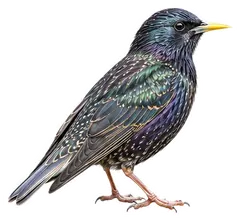 Common StarlingSturnus vulgaris
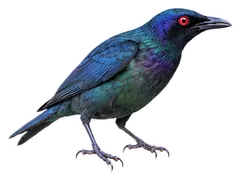 Metallic StarlingAplonis metallica
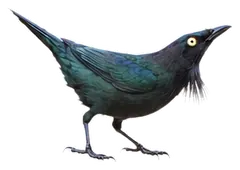 Yellow-eyed StarlingAplonis mystacea
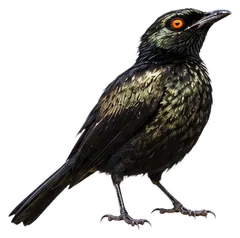 Singing StarlingAplonis cantoroides
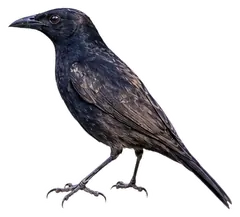 Tanimbar StarlingAplonis crassa
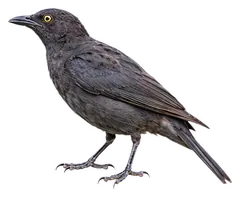 Atoll StarlingAplonis feadensis
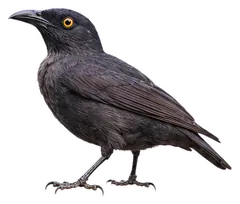 Rennell StarlingAplonis insularis
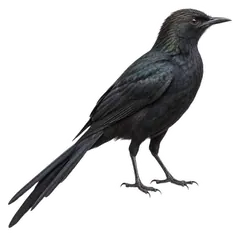 Long-tailed StarlingAplonis magna
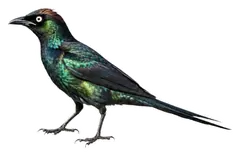 White-eyed StarlingAplonis brunneicapillus
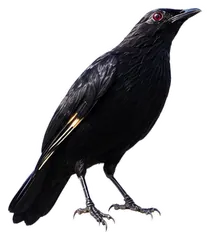 Brown-winged StarlingAplonis grandis
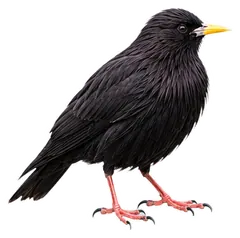
Download illustration
Free to use with credit: “Illustration: Bird Album (birdalbum.com)”. Drawn by AI from a reference photo by Luca Ghiraldi. ↗
Heard it but can't see it? Mingji identifies birds by sound and photo, on your phone.