 Bird Album
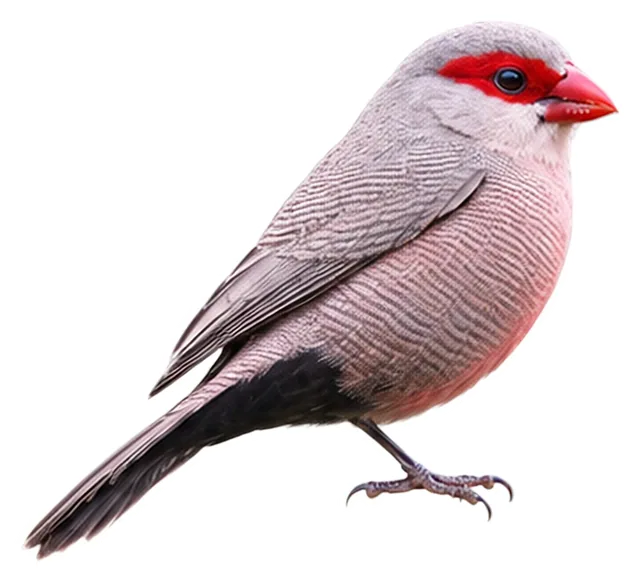
Common Waxbill
Estrilda astrild (Linnaeus, 1758)
9.5–13 cmLength8.3 gWeight
The adult has a sealing-wax-red bill and a red stripe through the eye.
Most records: Portugal, Spain, South Africa
How to identify
Field marks
- Adult: red bill like sealing wax
- A red stripe through the eye
- Gray-rufous feathers with fine dark brown barring
- Cheeks and throat whitish
Male, female and young
The female is paler, with less red on the belly; the juvenile has a black bill, almost no red on the belly and fainter barring.
Voice
Calls include trills and buzzing notes, with a distinctive high-pitched note in flight.
Where and when it's recorded

Common Waxbill has been recorded at 790 of the 8,276 birding hotspots we track, in 50 countries and regions.
Records by month Northern Hemisphere
Where it's recorded most
- Lezíria Grande de Vila Franca de Xira – área geralPortugal3,299 records
- Paul do Cabo da PraiaPortugal1,757 records
- Paul da BarrocaPortugal1,684 records
More places
- Barrinha de EsmorizPortugal1,426 records
- Strandfontein WTPSouth Africa1,344 records
- Nairobi NPKenya1,290 records
- Ria de Aveiro – SalreuPortugal1,069 records
- Sant Feliu de Llobregat – Riu LlobregatSpain1,045 records
- Kirstenbosch Botanical GardenSouth Africa983 records
- PN Ria Formosa – Quinta do Lago – área geralPortugal958 records
Countries and regions with the most records
eBird records via GBIF up to 2024-12-31. A record means someone listed it; more records partly mean more birders, not more birds.
About
The common waxbill (Estrilda astrild), also known as the St Helena waxbill, is a small passerine bird belonging to the estrildid finch family. It is native to sub-Saharan Africa but has been introduced to many other regions of the world and now has an estimated global extent of occurrence of 10,000,000 km2. It is popular and easy to keep in captivity.
Excerpt from Wikipedia, CC BY-SA 4.0 · authors · Read more on Wikipedia
Questions
How big is the Common Waxbill?
The Common Waxbill is about 9.5–13 cm long and weighs around 8.3 g.
Where does the Common Waxbill live?
Its breeding range: Africa: western, central, eastern, southern. It is most often recorded in Portugal, Spain and South Africa.
Is the Common Waxbill endangered?
The IUCN Red List classifies the Common Waxbill as Least Concern.
What does the Common Waxbill eat?
Main food: Seeds.
What family is the Common Waxbill in?
It belongs to the family Waxbills, Munias & Allies (Estrildidae), order Passerines (Passeriformes).
At a glance
- Length
- 9.5–13 cm
- Weight
- 8.3 g
- Habitat
- Grassland
- Diet
- Seeds
- Lifestyle
- Varied
- Migration
- Resident (barely migrates)
- Conservation
- Least Concern
More measurements
- Wing
- 47 mm
- Tail
- 49 mm
- Bill
- 10 mm
- Tarsus
- 14 mm
Averages from the AVONET dataset; length from field guides where available.
Range
Africa: western, central, eastern, southern
Breeding range, IOC World Bird List 15.2
Classification
- Order
- Passerines Passeriformes
- Family
- Waxbills, Munias & Allies Estrildidae
- Genus
- Estrilda
Other birds in the genus Estrilda
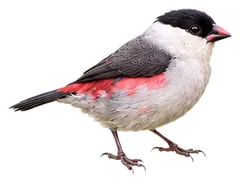 Black-crowned WaxbillEstrilda nonnula
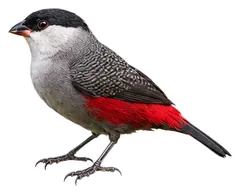 Black-headed WaxbillEstrilda atricapilla
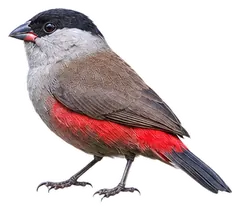 Kandt's WaxbillEstrilda kandti
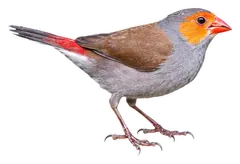 Orange-cheeked WaxbillEstrilda melpoda
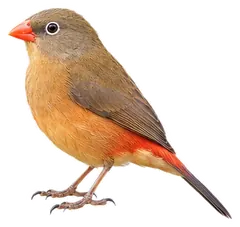 Anambra WaxbillEstrilda poliopareia
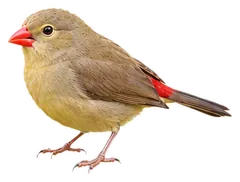 Fawn-breasted WaxbillEstrilda paludicola
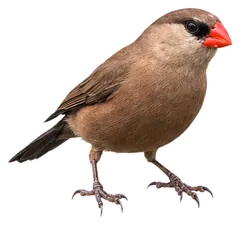 Black-lored WaxbillEstrilda nigriloris
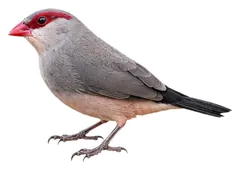 Black-rumped WaxbillEstrilda troglodytes
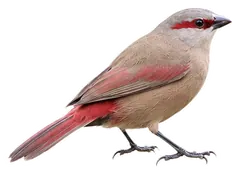 Crimson-rumped WaxbillEstrilda rhodopyga
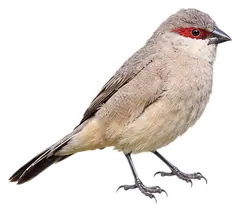 Arabian WaxbillEstrilda rufibarba
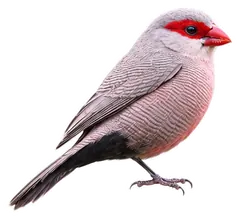
Download illustration
Free to use with credit: “Illustration: Bird Album (birdalbum.com)”. Drawn by AI from a reference photo by guyincognito. ↗
Heard it but can't see it? Mingji identifies birds by sound and photo, on your phone.