 Bird Album
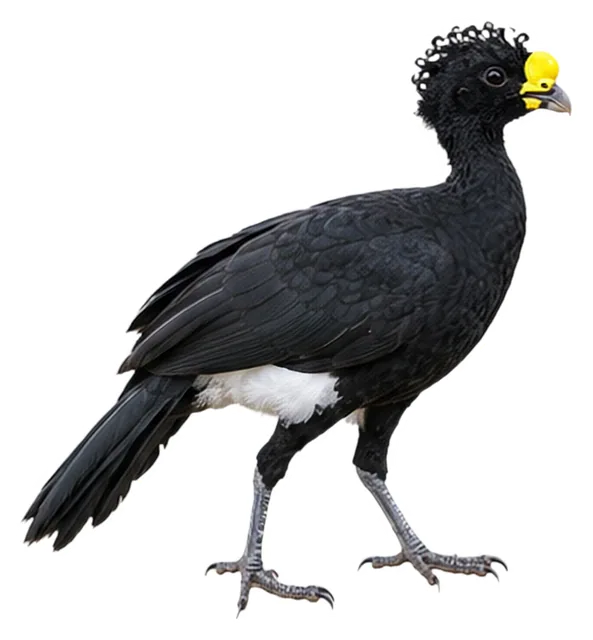
Great Curassow
Crax rubra Linnaeus, 1758
78–100 cmLength4.1 kgWeight
The great curassow (Crax rubra) is a large, pheasant-like bird from the Neotropical rainforests, its range extending from eastern Mexico, through Central America to western Colombia and northwestern Ecuador.
Busiest months: February–March · Most records: Costa Rica, Belize, Guatemala
Where and when it's recorded

Great Curassow has been recorded at 147 of the 8,171 birding hotspots we track, in 10 countries and regions.
Records by month Northern Hemisphere
Where it's recorded most
- Arenal Observatory LodgeCosta Rica12,137 records
- Estación Biológica La Selva-OTSCosta Rica4,561 records
- Esquinas Rainforest LodgeCosta Rica1,952 records
More places
- PN Corcovado – Sector SirenaCosta Rica1,593 records
- La Milpa Field StationBelize1,479 records
- Laguna Lagarto LodgeCosta Rica1,435 records
- Chan Chich LodgeBelize955 records
- Bijagua – Tapir ValleyCosta Rica730 records
- PN Tikal – sitio arqueológicoGuatemala554 records
- Arenal – Peninsula roadCosta Rica505 records
Countries and regions with the most records
eBird records via GBIF up to 2024-12-31. A record means someone listed it; more records partly mean more birders, not more birds.
About
The great curassow (Crax rubra) is a large, pheasant-like bird from the Neotropical rainforests, its range extending from eastern Mexico, through Central America to western Colombia and northwestern Ecuador. Male birds are black with curly crests and yellow beaks; females come in three colour morphs, barred, rufous and black. These birds form small groups, foraging mainly on the ground for fruits and arthropods, and the occasional small vertebrate, but they roost and nest in trees.
Excerpt from Wikipedia, CC BY-SA 4.0 · authors · Read more on Wikipedia
Questions
How big is the Great Curassow?
The Great Curassow is about 78–100 cm long and weighs around 4.1 kg.
Where does the Great Curassow live?
Its breeding range: Middle America, South America: Mexico to Peru. It is most often recorded in Costa Rica, Belize and Guatemala.
When is the best time to see the Great Curassow?
At the hotspots we track, it is recorded most in February and March (Northern Hemisphere).
Is the Great Curassow endangered?
The IUCN Red List classifies the Great Curassow as Vulnerable.
What does the Great Curassow eat?
Main food: Fruit.
What family is the Great Curassow in?
It belongs to the family Chachalacas, Curassows, Guans (Cracidae), order Galliformes.
At a glance
- Length
- 78–100 cm
- Weight
- 4.1 kg
- Habitat
- Forest
- Diet
- Fruit
- Lifestyle
- Active on the ground
- Migration
- Resident (barely migrates)
- Conservation
- Vulnerable
More measurements
- Wing
- 381 mm
- Tail
- 340 mm
- Bill
- 53 mm
- Tarsus
- 107 mm
Averages from the AVONET dataset; length from field guides where available.
Range
Middle America, South America: Mexico to Peru
Breeding range, IOC World Bird List 15.2
Classification
- Order
- Galliformes
- Family
- Chachalacas, Curassows, Guans Cracidae
- Genus
- Crax
Other birds in the genus Crax
 Blue-billed CurassowCrax alberti
 Yellow-knobbed CurassowCrax daubentoni
 Black CurassowCrax alector
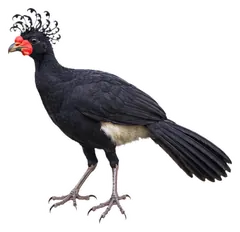 Wattled CurassowCrax globulosa
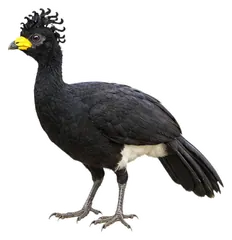 Bare-faced CurassowCrax fasciolata
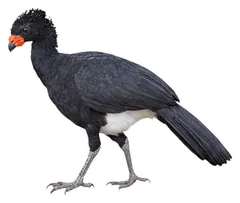 Red-billed CurassowCrax blumenbachii
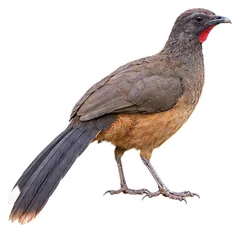 Plain ChachalacaOrtalis vetula
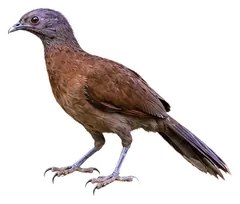 Grey-headed ChachalacaOrtalis cinereiceps
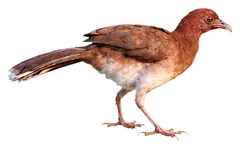 Chestnut-winged ChachalacaOrtalis garrula
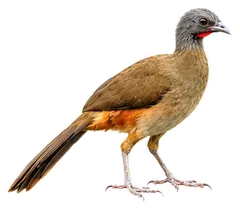 Rufous-vented ChachalacaOrtalis ruficauda
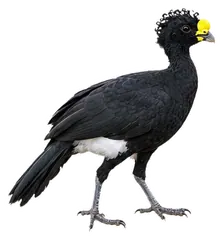
Download illustration
Free to use with credit: “Illustration: Bird Album (birdalbum.com)”. Drawn by AI from a reference photo by mattag2002. ↗
Heard it but can't see it? Mingji identifies birds by sound and photo, on your phone.