 Bird Album
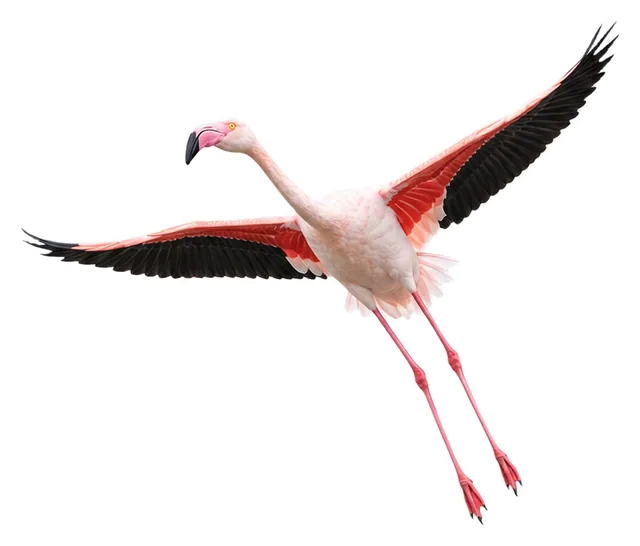
Greater Flamingo
Phoenicopterus roseus Pallas, 1811
130 cmLength160 cmWingspan3 kgWeight
The largest flamingo has mainly pinkish-white feathers, red wing coverts and black flight feathers.
Busiest months: March–April · Most records: Spain, Portugal, Israel
How to identify
Field marks
- Mainly pinkish-white feathers
- Red wing coverts and black primaries and secondaries
- Pink bill with a black tip
- Legs and feet entirely pink
Male, female and young
Chicks have gray down; immatures are paler, with dark legs and feet.
Voice
Goose-like quacking.
Where and when it's recorded

Greater Flamingo has been recorded at 752 of the 8,171 birding hotspots we track, in 79 countries and regions.
Records by month Northern Hemisphere
Where it's recorded most
- Desembocadura del Guadalhorce – ÁreaSpain5,094 records
- International Birding and Research Center Eilat (IBRCE)Israel4,351 records
- Eilat – KM20 Flamingo Pools 20Israel3,900 records
More places
- Private estate near Green MubazzarahUnited Arab Emirates3,222 records
- Strandfontein WTPSouth Africa2,958 records
- L'Albufera PNat – El Raco de l'OllaSpain2,790 records
- Doñana PN – Marisma de El RocíoSpain2,323 records
- Laguna de la VeguillaSpain2,166 records
- Fuente de Piedra – Centro de VisitantesSpain1,940 records
- Laguna de NavasecaSpain1,827 records
Countries and regions with the most records
eBird records via GBIF up to 2024-12-31. A record means someone listed it; more records partly mean more birders, not more birds.
About
The greater flamingo (Phoenicopterus roseus) is the largest and most widespread species of the flamingo family. Common in the Old World, they are found in Northern (coastal) and Sub-Saharan Africa, the Indian subcontinent (south of the Himalayas), Central Asia, the Middle East, the Levant, the Persian Gulf, the Gulf of Aden, the Red Sea, and the Mediterranean countries of Southern Europe.
Excerpt from Wikipedia, CC BY-SA 4.0 · authors · Read more on Wikipedia
Questions
How big is the Greater Flamingo?
The Greater Flamingo is about 130 cm long, with a wingspan of 160 cm and weighs around 3 kg.
Where does the Greater Flamingo live?
Its breeding range: Palearctic, Africa: widespread in Africa and southwestern, south-central Eurasia. It is most often recorded in Spain, Portugal and Israel.
When is the best time to see the Greater Flamingo?
At the hotspots we track, it is recorded most in March and April (Northern Hemisphere).
Is the Greater Flamingo endangered?
The IUCN Red List classifies the Greater Flamingo as Least Concern.
What does the Greater Flamingo eat?
Main food: Fish, shrimp & shellfish.
What family is the Greater Flamingo in?
It belongs to the family Flamingos (Phoenicopteridae), order Phoenicopteriformes.
At a glance
- Length
- 130 cm
- Wingspan
- 160 cm
- Weight
- 3 kg
- Habitat
- Wetland
- Diet
- Fish, shrimp & shellfish
- Lifestyle
- Active on the ground
- Migration
- Partial migrant
- Conservation
- Least Concern
More measurements
- Wing
- 399 mm
- Tail
- 138 mm
- Bill
- 125 mm
- Tarsus
- 294 mm
Averages from the AVONET dataset; length from field guides where available.
Range
Palearctic, Africa: widespread in Africa and southwestern, south-central Eurasia
Breeding range, IOC World Bird List 15.2
Classification
- Order
- Phoenicopteriformes
- Family
- Flamingos Phoenicopteridae
- Genus
- Phoenicopterus
Other birds in the genus Phoenicopterus
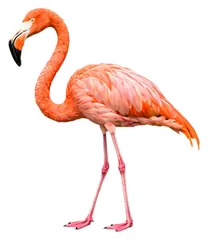 American FlamingoPhoenicopterus ruber
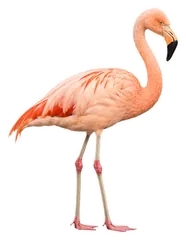 Chilean FlamingoPhoenicopterus chilensis
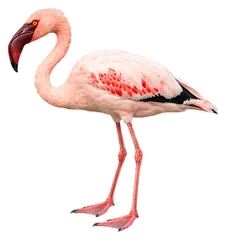 Lesser FlamingoPhoeniconaias minor
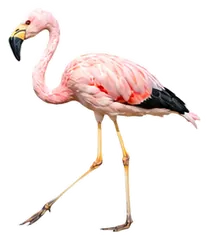 Andean FlamingoPhoenicoparrus andinus
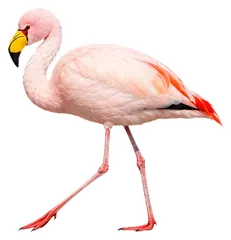 James's FlamingoPhoenicoparrus jamesi
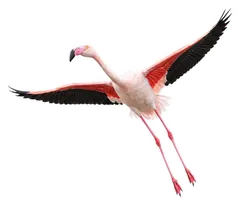
Download illustration
Free to use with credit: “Illustration: Bird Album (birdalbum.com)”. Drawn by AI from a reference photo by Giles Laurent. ↗
Heard it but can't see it? Mingji identifies birds by sound and photo, on your phone.