 Bird Album
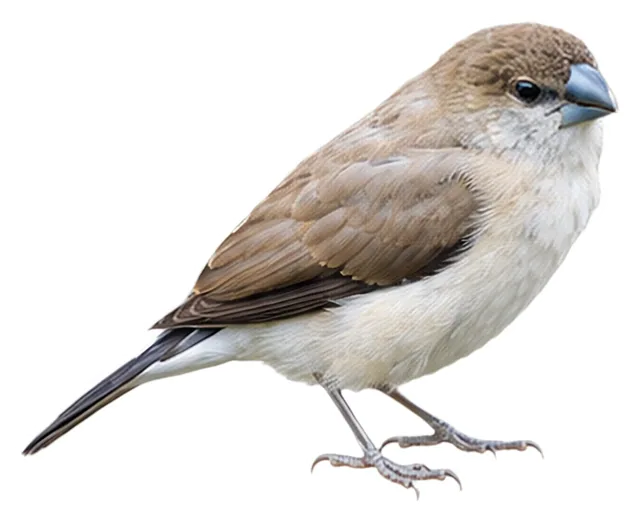
Indian Silverbill
Euodice malabarica (Linnaeus, 1758)
≈12 cmLength12 gWeight
This small bird has a silver-gray conical bill, yellowish-brown upperparts and white underparts, and forages in flocks in grassland.
Busiest months: October–January · Most records: India, United Arab Emirates, Israel
How to identify
Field marks
- Bill conical and silver-gray
- Upperparts yellowish-brown, underparts white
- Black tail contrasts strongly with white uppertail-coverts
- Tail pointed, central tail feathers longer
Male, female and young
Sexes similar in appearance; the juvenile has brown underparts and a shorter tail.
Voice
It gives continuous low chirps while foraging to maintain contact.
Where and when it's recorded
Busiest months: October–January · Most records: India, United Arab Emirates, Israel

Indian Silverbill has been recorded at 327 of the 8,276 birding hotspots we track, in 23 countries and regions.
Records by month Northern Hemisphere
Where it's recorded most
- International Birding and Research Center Eilat (IBRCE)Israel3,114 records
- Private estate near Green MubazzarahUnited Arab Emirates3,104 records
- Hessaraghatta KereIndia1,800 records
More places
- Hoskote / Hosakote KereIndia1,764 records
- Bharatpur – Keoladeo Ghana NPIndia1,720 records
- Wamm FarmsUnited Arab Emirates1,171 records
- Manjeera Wildlife SanctuaryIndia990 records
- Saul Kere / Sowl KereIndia923 records
- LIG 1219 Sector-8 Saddu, Raipur ChhattisgarhIndia904 records
- Ameenpur Lake, HyderabadIndia895 records
Countries and regions with the most records
eBird records via GBIF up to 2024-12-31. A record means someone listed it; more records partly mean more birders, not more birds.
About
The Indian silverbill or white-throated munia (Euodice malabarica) is a small passerine bird found in the Indian subcontinent and adjoining regions that was formerly considered to include the closely related African silverbill (Euodice cantans). This estrildid finch is a common resident breeding bird in the drier regions of the Middle East and the Indian subcontinent. It has also been introduced into many other parts of the world and has become established in some areas.
Excerpt from Wikipedia, CC BY-SA 4.0 · authors · Read more on Wikipedia
Questions
How big is the Indian Silverbill?
The Indian Silverbill is about ≈12 cm long and weighs around 12 g.
Where does the Indian Silverbill live?
Its breeding range: Oriental: India, Sri Lanka, also south-central Asia. It is most often recorded in India, United Arab Emirates and Israel.
When is the best time to see the Indian Silverbill?
At the hotspots we track, it is recorded most in January, October, November and December (Northern Hemisphere).
Is the Indian Silverbill endangered?
The IUCN Red List classifies the Indian Silverbill as Least Concern.
What does the Indian Silverbill eat?
Main food: Seeds.
What family is the Indian Silverbill in?
It belongs to the family Waxbills, Munias & Allies (Estrildidae), order Passerines (Passeriformes).
At a glance
- Length
- ≈12 cm
- Weight
- 12 g
- Habitat
- Grassland
- Diet
- Seeds
- Lifestyle
- Active on the ground
- Migration
- Resident (barely migrates)
- Conservation
- Least Concern
More measurements
- Wing
- 54 mm
- Tail
- 52 mm
- Bill
- 10 mm
- Tarsus
- 14 mm
Averages from the AVONET dataset; length from field guides where available.
Range
Oriental: India, Sri Lanka, also south-central Asia
Breeding range, IOC World Bird List 15.2
Classification
- Order
- Passerines Passeriformes
- Family
- Waxbills, Munias & Allies Estrildidae
- Genus
- Euodice
Other birds in the genus Euodice
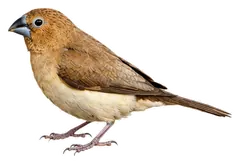 African SilverbillEuodice cantans
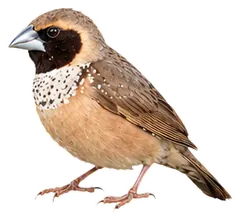 Pictorella MannikinHeteromunia pectoralis
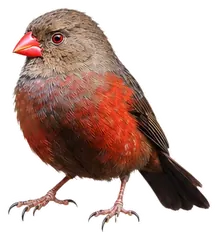 Mountain FiretailOreostruthus fuliginosus
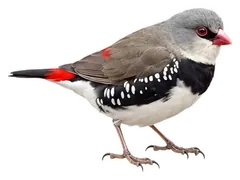 Diamond FiretailStagonopleura guttata
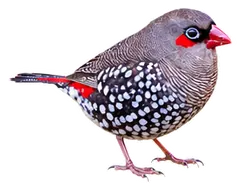 Red-eared FiretailStagonopleura oculata
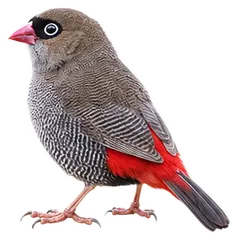 Beautiful FiretailStagonopleura bella
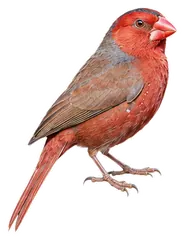 Crimson FinchNeochmia phaeton
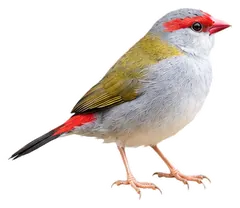 Red-browed FinchNeochmia temporalis
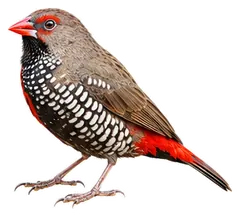 Painted FinchEmblema pictum
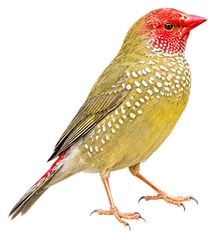 Star FinchEmblema ruficauda
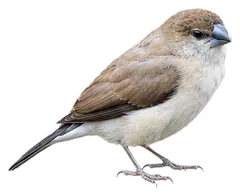
Download illustration
Free to use with credit: “Illustration: Bird Album (birdalbum.com)”. Drawn by AI from a reference photo by vineetkathuria24. ↗
Heard it but can't see it? Mingji identifies birds by sound and photo, on your phone.
In other languages
- EnglishIndian Silverbill
- 简体中文白喉文鸟
- 繁體中文白喉文鳥
- 日本語ギンバシ
- DeutschIndiensilberschnabel
- FrançaisCapucin bec-de-plomb
- EspañolCapuchino picoplata indio
- Portuguêsbico-de-chumbo-indiano
- ItalianoBecco di piombo
- NederlandsLoodbekje
- РусскийМалабарская амадина
- Svenskaindisk silvernäbb
- DanskIndisk Sølvnæb
- Polskisrebrnodziobek indyjski