 Bird Album
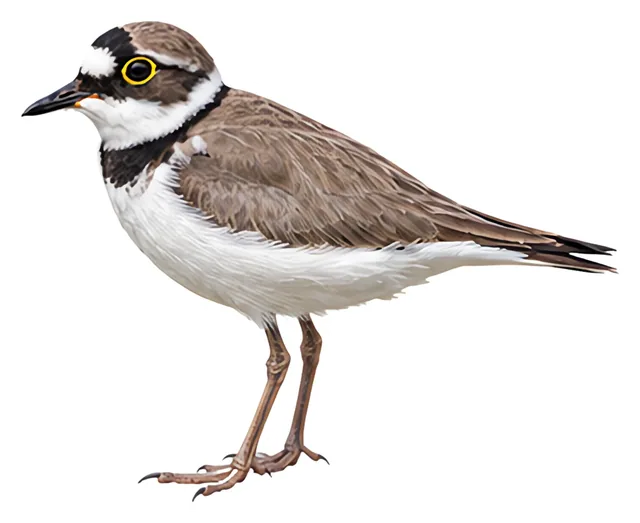
Little Ringed Plover
Thinornis dubius (Scopoli, 1786)
14–18 cmLength32–48 cmWingspan
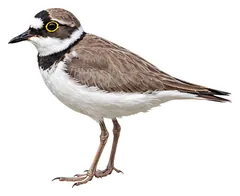
It has a golden-yellow eye-ring and a single black ring around the lower neck in summer plumage, and is usually solitary.
Busiest months: April · Most records: China, Spain, United Kingdom
Looks like Common Ringed Plover, Long-billed Plover, Kentish Plover
How to identify
Field marks
- Very conspicuous golden-yellow eye-ring
- Summer plumage has a black eyestripe across the face and a black ring around the lower neck
- Short, entirely black bill with a slight yellow tinge at the base of the lower mandible
- Wing stripes almost invisible
Male, female and young
In summer, the male's ear-coverts are entirely black, while the female's are partly brown; black areas turn brown in winter; juveniles resemble adults in winter plumage.
Voice
Often gives short, sharp “piu” or “pew” calls in flight.
Similar species
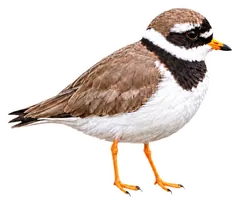
Slightly smaller than Common Ringed Plover, with a longer, more slender bill, a more slender tail and more agile movements.
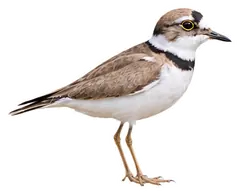
Bill shorter than Long-billed Plover's, with a more conspicuous golden ring around the eye.
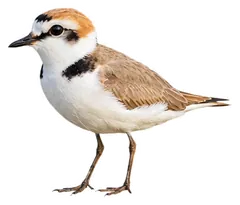
May resemble Kentish Plover when the breast-band is indistinct in winter plumage; Little Ringed Plover usually retains a visible golden eye-ring in winter and has almost no wing-bar.
Where and when it's recorded

Little Ringed Plover has been recorded at 2,542 of the 8,171 birding hotspots we track, in 124 countries and regions.
Records by month Northern Hemisphere
Where it's recorded most
- Taipei – Tianliaoyang WetlandTaiwan (China)3,517 records
- Huajiang IBA – Huajiang Wild Duck Nature Park (Huajiang to Zhongxing Bridge)Taiwan (China)2,748 records
- Desembocadura del Guadalhorce – ÁreaSpain2,679 records
More places
- Private estate near Green MubazzarahUnited Arab Emirates2,060 records
- Amwell HMWT NRUnited Kingdom2,021 records
- Mai Po Nature ReserveHong Kong (China)1,823 records
- Titchwell Marsh RSPB ReserveUnited Kingdom1,788 records
- Frampton Marsh RSPB ReserveUnited Kingdom1,687 records
- Cley & Salthouse Marshes NWT NR – Cley Marshes including Hides and Visitor CentreUnited Kingdom1,645 records
- Lizejian IBA – 52-Jia WetlandTaiwan (China)1,631 records
Countries and regions with the most records
eBird records via GBIF up to 2024-12-31. A record means someone listed it; more records partly mean more birders, not more birds.
About
The little ringed plover (Thinornis dubius) is a small plover native to the Old World. A migratory species, it breeds in open gravel areas near freshwater, including gravel pits, islands and river edges. Its diet consists mainly of insects and worms, which it forages for in muddy areas.
Excerpt from Wikipedia, CC BY-SA 4.0 · authors · Read more on Wikipedia
Questions
How big is the Little Ringed Plover?
The Little Ringed Plover is about 14–18 cm long, with a wingspan of 32–48 cm.
Where does the Little Ringed Plover live?
Its breeding range: Palearctic, Oriental: widespread inland subarctic to tropical zones: Eurasia, Indian subcontinent, Southeast Asia, Philippines, New Guinea and Bismarck Archipelago. It is most often recorded in China, Spain and United Kingdom.
When is the best time to see the Little Ringed Plover?
At the hotspots we track, it is recorded most in April (Northern Hemisphere).
What family is the Little Ringed Plover in?
It belongs to the family Plovers (Charadriidae), order Charadriiformes.
At a glance
- Length
- 14–18 cm
- Wingspan
- 32–48 cm
Range
Palearctic, Oriental: widespread inland subarctic to tropical zones: Eurasia, Indian subcontinent, Southeast Asia, Philippines, New Guinea and Bismarck Archipelago
Breeding range, IOC World Bird List 15.2
Subspecies · 2
- Thinornis dubius curonicus British Isles, s, c Scandinavia, Iberian Pen. and n Africa, across Russia to Sea of Okhotsk and Ussuriland, s through Turkey, Middle East to Iran, n Mongolia to ec China, Korean Pen., Taiwan (China) and Hokkaido to Kyushu (n to s Japan) | non-breeding: Africa and s Asia
- Thinornis dubius jerdoni India to s China, n, c Thailand, e Cambodia and nc, se Vietnam
Classification
- Order
- Charadriiformes
- Family
- Plovers Charadriidae
- Genus
- Thinornis
Other birds in the genus Thinornis
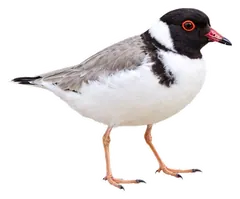 Hooded PloverThinornis cucullatus
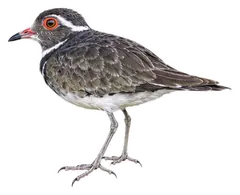 Forbes's PloverThinornis forbesi
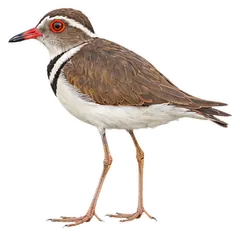 Three-banded PloverThinornis tricollaris
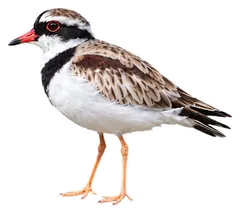 Black-fronted DotterelThinornis melanops
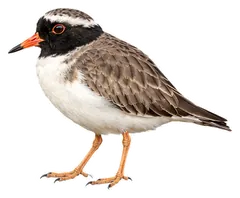 Shore PloverThinornis novaeseelandiaeLong-billed PloverThinornis placidus
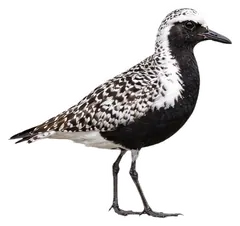 Grey PloverPluvialis squatarola
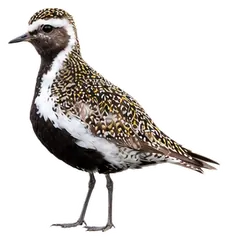 European Golden PloverPluvialis apricaria
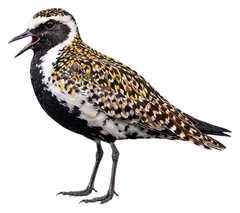 Pacific Golden PloverPluvialis fulva
 American Golden PloverPluvialis dominica
Download illustration
Free to use with credit: “Illustration: Bird Album (birdalbum.com)”. Drawn by AI from a reference photo by Zeynel Cebeci. ↗

Heard it but can't see it? Mingji identifies birds by sound and photo, on your phone.
In other languages
- EnglishLittle Ringed Plover
- 简体中文金眶鸻
- 繁體中文小環頸鴴
- 日本語コチドリ
- 한국어꼬마물떼새
- DeutschFlussregenpfeifer
- FrançaisPluvier petit-gravelot
- EspañolChorlitejo chico
- Portuguêsborrelho-pequeno-de-coleira
- ItalianoCorriere piccolo
- NederlandsKleine Plevier
- РусскийМалый зуёк
- Svenskamindre strandpipare
- DanskLille Præstekrave
- Polskisieweczka rzeczna