 Bird Album
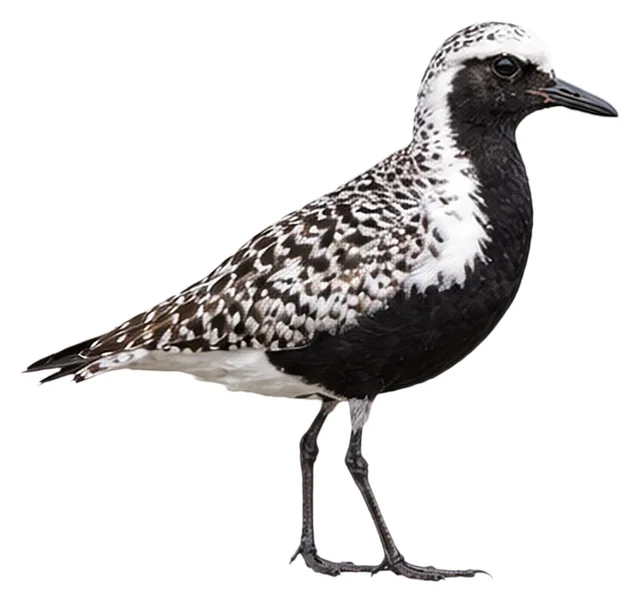
Grey Plover
Pluvialis squatarola (Linnaeus, 1758)
27–30 cmLength77 cmWingspan250 gWeight
In summer, its face, breast and belly are entirely black, its back and wings have black-and-white spots, and black armpits show in flight.
Busiest months: May and September–October · Most records: United States, Canada, United Kingdom
How to identify
Field marks
- Inner sides of the body and bases of the underwings black in flight
- Summer plumage has a black face, neck, breast and belly bordered with white
- Summer plumage has black-and-white spots on the back and wings
- Winter plumage plain gray with a white belly
Male, female and young
Juvenile and first-winter plumages resemble adult winter plumage, but the back feathers are blacker with creamy-white edges.
Where and when it's recorded
Busiest months: May and September–October · Most records: United States, Canada, United Kingdom

Grey Plover has been recorded at 2,660 of the 8,276 birding hotspots we track, in 184 countries and regions.
Records by month Northern Hemisphere
To protect this bird from disturbance, we don't list exact sites.
Countries and regions with the most records
eBird records via GBIF up to 2024-12-31. A record means someone listed it; more records partly mean more birders, not more birds.
About
The grey plover or black-bellied plover (Pluvialis squatarola) is a large plover breeding in Arctic regions. It is a long-distance migrant, with a nearly worldwide coastal distribution when not breeding.
Excerpt from Wikipedia, CC BY-SA 4.0 · authors · Read more on Wikipedia
Questions
How big is the Grey Plover?
The Grey Plover is about 27–30 cm long, with a wingspan of 77 cm and weighs around 250 g.
Where does the Grey Plover live?
Its breeding range: North America, Palearctic: high (locally low) Arctic coasts and islands (except Ellesmere Island, Greenland, Scandinavia and islands from Svalbard to Severnaya Zemlya). It is most often recorded in United States, Canada and United Kingdom.
When is the best time to see the Grey Plover?
At the hotspots we track, it is recorded most in May, September and October (Northern Hemisphere).
Is the Grey Plover endangered?
The IUCN Red List classifies the Grey Plover as Vulnerable.
What does the Grey Plover eat?
Main food: Fish, shrimp & shellfish.
What family is the Grey Plover in?
It belongs to the family Plovers (Charadriidae), order Charadriiformes.
At a glance
- Length
- 27–30 cm
- Wingspan
- 77 cm
- Weight
- 250 g
- Habitat
- Grassland
- Diet
- Fish, shrimp & shellfish
- Lifestyle
- Active on the ground
- Migration
- Migratory
- Conservation
- Vulnerable
More measurements
- Wing
- 184 mm
- Tail
- 71 mm
- Bill
- 32 mm
- Tarsus
- 44 mm
Averages from the AVONET dataset; length from field guides where available.
Range
North America, Palearctic: high (locally low) Arctic coasts and islands (except Ellesmere Island, Greenland, Scandinavia and islands from Svalbard to Severnaya Zemlya)
Breeding range, IOC World Bird List 15.2
Classification
- Order
- Charadriiformes
- Family
- Plovers Charadriidae
- Genus
- Pluvialis
Other birds in the genus Pluvialis
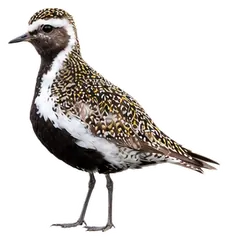 European Golden PloverPluvialis apricaria
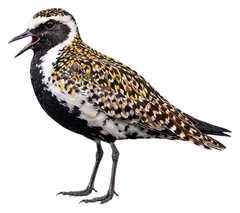 Pacific Golden PloverPluvialis fulva
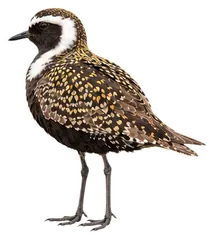 American Golden PloverPluvialis dominica
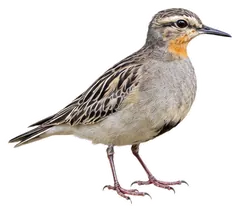 Tawny-throated DotterelOreopholus ruficollis
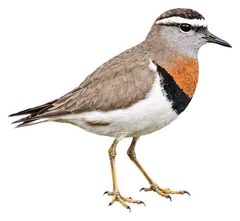 Rufous-chested DotterelZonibyx modestus
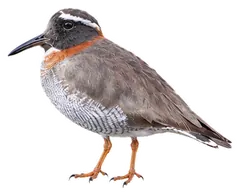 Diademed Sandpiper-PloverPhegornis mitchellii
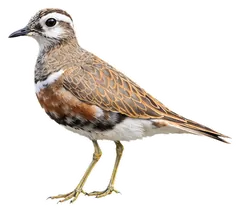 Eurasian DotterelEudromias morinellus
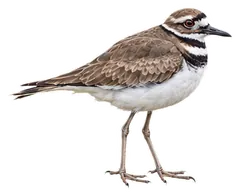 KilldeerCharadrius vociferus
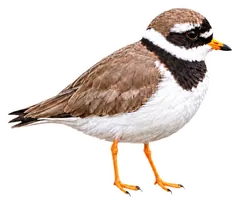 Common Ringed PloverCharadrius hiaticula
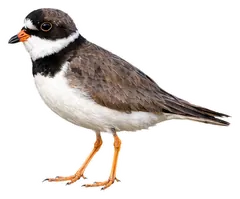 Semipalmated PloverCharadrius semipalmatus
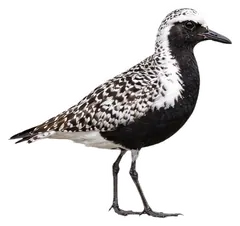
Download illustration
Free to use with credit: “Illustration: Bird Album (birdalbum.com)”. Drawn by AI from a reference photo by Chuck Homler, Focus On Wildlife. ↗

Heard it but can't see it? Mingji identifies birds by sound and photo, on your phone.