 Bird Album
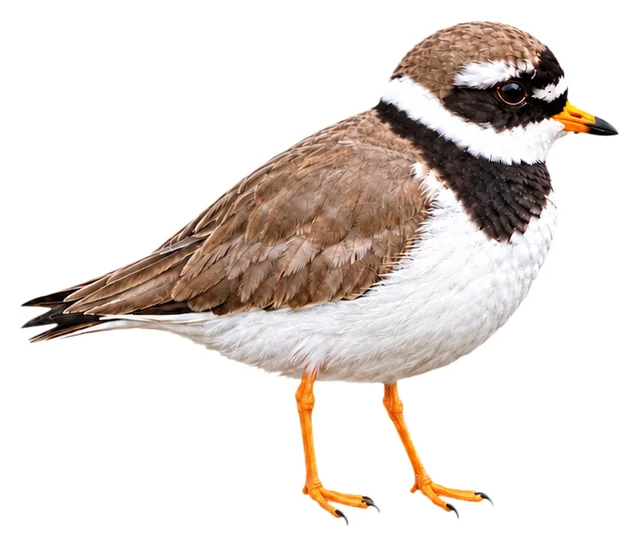
Common Ringed Plover
Charadrius hiaticula Linnaeus, 1758
17–20 cmLength41 cmWingspan64 gWeight
Adults in breeding plumage have orange legs and feet, a black mask and a single black band across the white breast.
Busiest months: September · Most records: United Kingdom, Spain, Portugal
How to identify
Field marks
- Adults in breeding plumage have a black neckband across the white breast
- Adults in breeding plumage have a white forehead and black mask
- Adults in breeding plumage have a short orange-and-black bill
- Adults in breeding plumage have orange legs and feet
Male, female and young
Juveniles are duller, with an often incomplete gray-rufous breast-band, a dark bill and dark yellowish-gray legs and feet.
Where and when it's recorded

Common Ringed Plover has been recorded at 1,636 of the 8,171 birding hotspots we track, in 140 countries and regions.
Records by month Northern Hemisphere
Where it's recorded most
- International Birding and Research Center Eilat (IBRCE)Israel4,671 records
- Titchwell Marsh RSPB ReserveUnited Kingdom4,640 records
- Txingudi – PlaiaundiSpain3,718 records
More places
- Desembocadura del Guadalhorce – ÁreaSpain3,692 records
- Eilat – KM20 Flamingo Pools 20Israel3,331 records
- Minsmere RSPB ReserveUnited Kingdom3,297 records
- Spurn Bird Observatory Recording AreaUnited Kingdom2,735 records
- Frampton Marsh RSPB ReserveUnited Kingdom2,406 records
- Gozón – Playa de BañuguesSpain2,346 records
- Cley & Salthouse Marshes NWT NR – Cley Marshes including Hides and Visitor CentreUnited Kingdom2,203 records
Countries and regions with the most records
eBird records via GBIF up to 2024-12-31. A record means someone listed it; more records partly mean more birders, not more birds.
About
The common ringed plover, great ringed plover or ringed plover (Charadrius hiaticula) is a species of bird in the family Charadriidae. It breeds across much of northern Eurasia, as well as Greenland.
Excerpt from Wikipedia, CC BY-SA 4.0 · authors · Read more on Wikipedia
Questions
How big is the Common Ringed Plover?
The Common Ringed Plover is about 17–20 cm long, with a wingspan of 41 cm and weighs around 64 g.
Where does the Common Ringed Plover live?
Its breeding range: Palearctic: inland high Arctic Palearctic from Greenland to northeastern Siberia; to temperate Europe. It is most often recorded in United Kingdom, Spain and Portugal.
When is the best time to see the Common Ringed Plover?
At the hotspots we track, it is recorded most in September (Northern Hemisphere).
Is the Common Ringed Plover endangered?
The IUCN Red List classifies the Common Ringed Plover as Least Concern.
What does the Common Ringed Plover eat?
Main food: Fish, shrimp & shellfish.
What family is the Common Ringed Plover in?
It belongs to the family Plovers (Charadriidae), order Charadriiformes.
At a glance
- Length
- 17–20 cm
- Wingspan
- 41 cm
- Weight
- 64 g
- Habitat
- Coast & tidal flats
- Diet
- Fish, shrimp & shellfish
- Lifestyle
- Active on the ground
- Migration
- Partial migrant
- Conservation
- Least Concern
More measurements
- Wing
- 126 mm
- Tail
- 60 mm
- Bill
- 16 mm
- Tarsus
- 25 mm
Averages from the AVONET dataset; length from field guides where available.
Range
Palearctic: inland high Arctic Palearctic from Greenland to northeastern Siberia; to temperate Europe
Breeding range, IOC World Bird List 15.2
Classification
- Order
- Charadriiformes
- Family
- Plovers Charadriidae
- Genus
- Charadrius
Other birds in the genus Charadrius
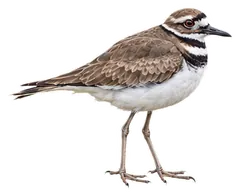 KilldeerCharadrius vociferus
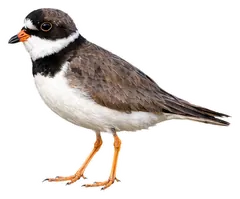 Semipalmated PloverCharadrius semipalmatus
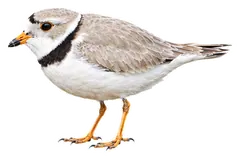 Piping PloverCharadrius melodus
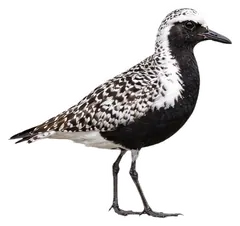 Grey PloverPluvialis squatarola
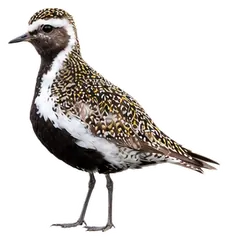 European Golden PloverPluvialis apricaria
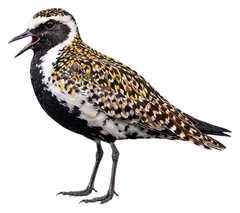 Pacific Golden PloverPluvialis fulva
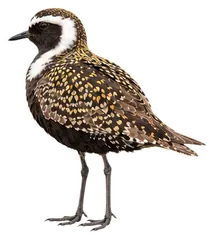 American Golden PloverPluvialis dominica
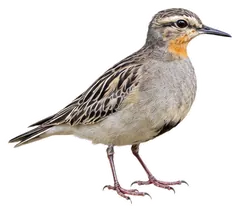 Tawny-throated DotterelOreopholus ruficollis
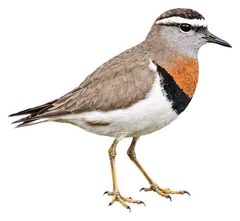 Rufous-chested DotterelZonibyx modestus
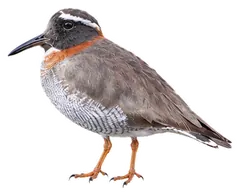 Diademed Sandpiper-PloverPhegornis mitchellii
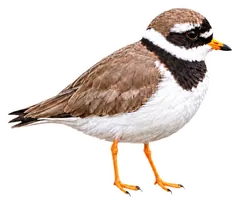
Download illustration
Free to use with credit: “Illustration: Bird Album (birdalbum.com)”. Drawn by AI from a reference photo by Ryan Shaw. ↗
Heard it but can't see it? Mingji identifies birds by sound and photo, on your phone.
In other languages
- EnglishCommon Ringed Plover
- 简体中文剑鸻
- 繁體中文環頸鴴
- 日本語ハジロコチドリ
- 한국어흰죽지꼬마물떼새
- DeutschSandregenpfeifer
- FrançaisPluvier grand-gravelot
- EspañolChorlitejo grande
- Portuguêsborrelho-grande-de-coleira
- ItalianoCorriere grosso
- NederlandsBontbekplevier
- РусскийГалстучник
- Svenskastörre strandpipare
- DanskStor Præstekrave
- Polskisieweczka obrożna