 Bird Album
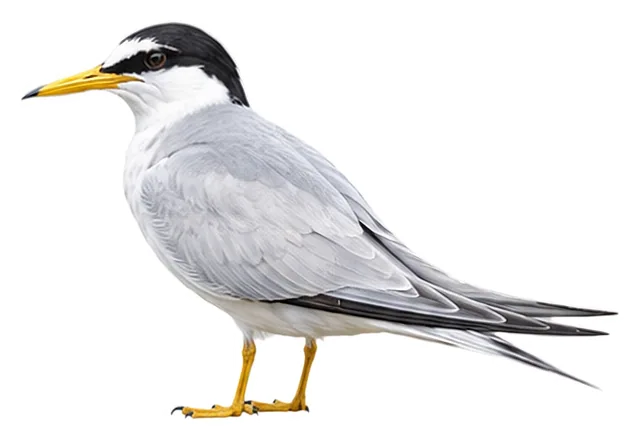
Little Tern
Sternula albifrons (Pallas, 1764)
≈26 cmLength52 cmWingspan57 gWeight
It is a small tern with a white forehead, black-tipped yellow bill and yellow legs in the breeding season.
Busiest months: May · Most records: China, United Kingdom, Australia
How to identify
Field marks
- White forehead in the breeding season
- Bill slender, pointed and yellow with a black tip
- Legs yellow
- Forehead whiter, bill black and legs darker in winter
Voice
Loud, distinctive quacking calls.
Where and when it's recorded
Busiest months: May · Most records: China, United Kingdom, Australia

Little Tern has been recorded at 1,543 of the 8,276 birding hotspots we track, in 116 countries and regions.
Records by month Northern Hemisphere
Where it's recorded most
- Western Treatment PlantAustralia2,088 records
- Pak Thale Nature ReserveThailand1,863 records
- Minsmere RSPB ReserveUnited Kingdom1,707 records
More places
- Cairns EsplanadeAustralia1,681 records
- Titchwell Marsh RSPB ReserveUnited Kingdom1,358 records
- Lake WollumboolaAustralia1,226 records
- Hualien River Estuary IBATaiwan (China)1,223 records
- Spurn Bird Observatory Recording AreaUnited Kingdom1,124 records
- Eilat north beachIsrael1,051 records
- Nanpu MudflatChina877 records
Countries and regions with the most records
eBird records via GBIF up to 2024-12-31. A record means someone listed it; more records partly mean more birders, not more birds.
About
The little tern (Sternula albifrons) is a small seabird of the family Laridae. It is widely distributed breeding on the coasts and inland waterways of Europe, Asia, north and west Africa, and eastern Australia. It winters in the subtropical and tropical oceans as far south as South Africa and Australia.
Excerpt from Wikipedia, CC BY-SA 4.0 · authors · Read more on Wikipedia
Questions
How big is the Little Tern?
The Little Tern is about ≈26 cm long, with a wingspan of 52 cm and weighs around 57 g.
Where does the Little Tern live?
Its breeding range: Africa, Palearctic, Oriental, Australasia: western Europe, southwestern Russia, Central Asia, Mongolia to southeastern Russia, Japan, eastern China, Taiwan (China) and Vietnam; northern, western Africa; Persian Gulf and Iraq to Indus Valley (Pakistan) and Gangetic Plain (north-central India); Sri Lanka; Gulf of Thailand, Malay Peninsula, Singapore, and islands off Greater Sundas; off New Britain (southeastern Bismarck Archipelago), Bougainville (northern Solomon Islands); coastal northwestern, northern, eastern, southeastern Australia and Tasmania; and Saipan (southern Northern Mariana Islands, northwestern Micronesia). It is most often recorded in China, United Kingdom and Australia.
When is the best time to see the Little Tern?
At the hotspots we track, it is recorded most in May (Northern Hemisphere).
Is the Little Tern endangered?
The IUCN Red List classifies the Little Tern as Least Concern.
What does the Little Tern eat?
Main food: Fish, shrimp & shellfish.
What family is the Little Tern in?
It belongs to the family Gulls, Terns, Skimmers (Laridae), order Charadriiformes.
At a glance
- Length
- ≈26 cm
- Wingspan
- 52 cm
- Weight
- 57 g
- Habitat
- Coast & tidal flats
- Diet
- Fish, shrimp & shellfish
- Lifestyle
- Feeds in the air
- Migration
- Migratory
- Conservation
- Least Concern
More measurements
- Wing
- 170 mm
- Tail
- 80 mm
- Bill
- 34 mm
- Tarsus
- 15 mm
Averages from the AVONET dataset; length from field guides where available.
Range
Africa, Palearctic, Oriental, Australasia: western Europe, southwestern Russia, Central Asia, Mongolia to southeastern Russia, Japan, eastern China, Taiwan (China) and Vietnam; northern, western Africa; Persian Gulf and Iraq to Indus Valley (Pakistan) and Gangetic Plain (north-central India); Sri Lanka; Gulf of Thailand, Malay Peninsula, Singapore, and islands off Greater Sundas; off New Britain (southeastern Bismarck Archipelago), Bougainville (northern Solomon Islands); coastal northwestern, northern, eastern, southeastern Australia and Tasmania; and Saipan (southern Northern Mariana Islands, northwestern Micronesia)
Breeding range, IOC World Bird List 15.2
Subspecies · 1
- Sternula albifrons sinensis Indus River basin (Pakistan), Gangetic Plain (nc India); Sri Lanka; se Russia through Japan, Korean Pen., e China, Taiwan (China), Vietnam and Mindanao (s Philippines); Gulf of Thailand, Malay Pen., Singapore, and islands off Greater Sundas; off New Britain (se Bismarck Arch.), Bougainville (n Solomon Is.); coastal nw, n, Australia; and Saipan (s Northern Mariana Is., nw Micronesia) | non-breeding: Philippines, Malaysia, Indonesia, coastal New Guinea, Australia, New Zealand and w Micronesia
Classification
- Order
- Charadriiformes
- Family
- Gulls, Terns, Skimmers Laridae
- Genus
- Sternula
Other birds in the genus Sternula
 Saunders's TernSternula saundersi
 Least TernSternula antillarum
 Yellow-billed TernSternula superciliaris
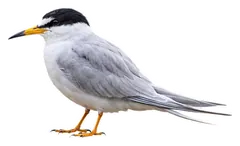 Peruvian TernSternula lorata
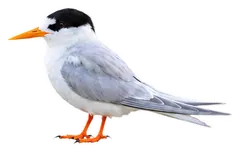 Fairy TernSternula nereis
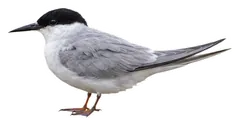 Damara TernSternula balaenarum
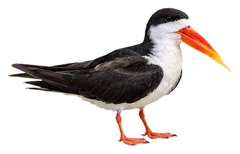 African SkimmerRynchops flavirostris
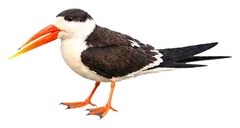 Indian SkimmerRynchops albicollis
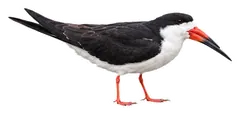 Black SkimmerRynchops niger
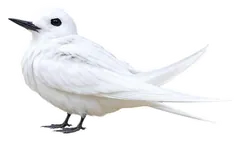 Atlantic White TernGygis alba
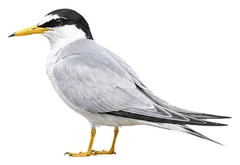
Download illustration
Free to use with credit: “Illustration: Bird Album (birdalbum.com)”. Drawn by AI from a reference photo by PetroKaterynych. ↗

Heard it but can't see it? Mingji identifies birds by sound and photo, on your phone.