 Bird Album
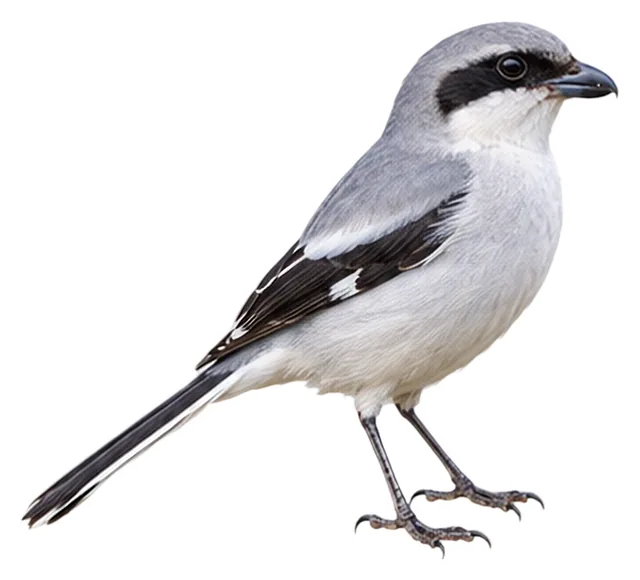
Loggerhead Shrike
Lanius ludovicianus Linnaeus, 1766
52 gWeight
The loggerhead shrike (Lanius ludovicianus) is a passerine bird in the family Laniidae.
Busiest months: January, April and November · Most records: United States, Mexico, Canada
Where and when it's recorded

Loggerhead Shrike has been recorded at 401 of the 8,171 birding hotspots we track, in 5 countries and regions.
Records by month Northern Hemisphere
Where it's recorded most
- Fort De Soto ParkUnited States14,819 records
- The Celery FieldsUnited States10,107 records
- Mitchell Lake Audubon CenterUnited States7,017 records
More places
- San Jacinto Wildlife AreaUnited States6,899 records
- Piute PondsUnited States6,736 records
- Willcox – Lake Cochise and Twin Lakes Golf CourseUnited States6,323 records
- Jocelyn Nungaray NWR (Anahuac)United States5,264 records
- Whitewater Draw Wildlife AreaUnited States5,203 records
- Hagerman NWRUnited States4,743 records
- Hornsby BendUnited States4,512 records
Countries and regions with the most records
eBird records via GBIF up to 2024-12-31. A record means someone listed it; more records partly mean more birders, not more birds.
About
The loggerhead shrike (Lanius ludovicianus) is a passerine bird in the family Laniidae. It is the only member of the shrike family endemic to North America; the related northern shrike (L. borealis) occurs north of its range; however, it is also found in Siberia. It is nicknamed the butcherbird after its carnivorous tendencies, as it consumes prey such as insects, amphibians, lizards, small mammals and small birds, and some prey end up displayed and stored at a site, for example in a tree.
Excerpt from Wikipedia, CC BY-SA 4.0 · authors · Read more on Wikipedia
Questions
How big is the Loggerhead Shrike?
The Loggerhead Shrike weighs around 52 g.
Where does the Loggerhead Shrike live?
Its breeding range: North America, Middle America: widespread. It is most often recorded in United States, Mexico and Canada.
When is the best time to see the Loggerhead Shrike?
At the hotspots we track, it is recorded most in January, April and November (Northern Hemisphere).
Is the Loggerhead Shrike endangered?
The IUCN Red List classifies the Loggerhead Shrike as Near Threatened.
What does the Loggerhead Shrike eat?
Main food: Insects & other invertebrates.
What family is the Loggerhead Shrike in?
It belongs to the family Shrikes (Laniidae), order Passerines (Passeriformes).
At a glance
- Weight
- 52 g
- Habitat
- Shrubland
- Diet
- Insects & other invertebrates
- Lifestyle
- Perches in trees
- Migration
- Migratory
- Conservation
- Near Threatened
More measurements
- Wing
- 96 mm
- Tail
- 97 mm
- Bill
- 21 mm
- Tarsus
- 28 mm
Averages from the AVONET dataset; length from field guides where available.
Range
North America, Middle America: widespread
Breeding range, IOC World Bird List 15.2
Classification
- Order
- Passerines Passeriformes
- Family
- Shrikes Laniidae
- Genus
- Lanius
Other birds in the genus Lanius
 Long-tailed FiscalLanius cabanisi
 Grey-backed FiscalLanius excubitoroides
 Taita FiscalLanius dorsalis
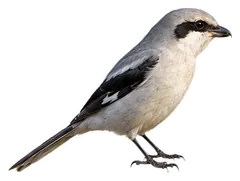 Great Grey ShrikeLanius excubitor
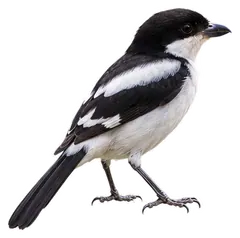 Somali FiscalLanius somalicus
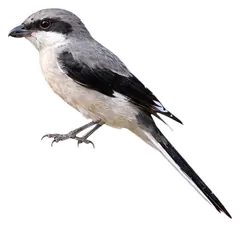 Giant Grey ShrikeLanius giganteus
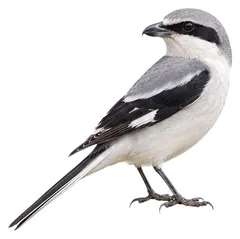 Chinese Grey ShrikeLanius sphenocercus
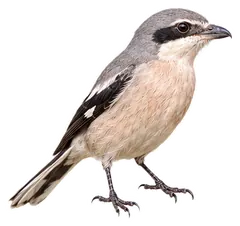 Iberian Grey ShrikeLanius meridionalis
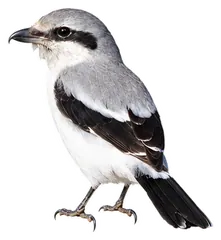 Northern ShrikeLanius borealis
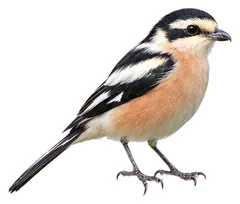 Masked ShrikeLanius nubicus
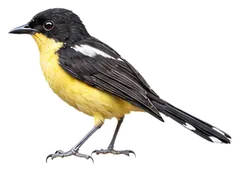 Sao Tome FiscalLanius newtoni
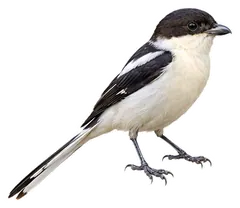 Northern FiscalLanius humeralis
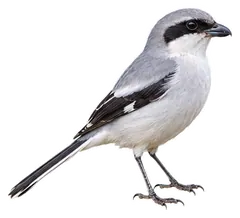
Download illustration
Free to use with credit: “Illustration: Bird Album (birdalbum.com)”. Drawn by AI from a reference photo by MarvalPhotography19. ↗
Heard it but can't see it? Mingji identifies birds by sound and photo, on your phone.
In other languages
- EnglishLoggerhead Shrike
- 简体中文呆头伯劳
- 繁體中文呆頭伯勞
- 日本語アメリカオオモズ
- DeutschLouisianawürger
- FrançaisPie-grièche migratrice
- EspañolAlcaudón americano
- Portuguêspicanço-americano
- ItalianoAverla stolida
- NederlandsAmerikaanse Klapekster
- РусскийАмериканский сорокопут
- Svenskaamerikansk törnskata
- DanskAmerikansk Tornskade
- Polskidzierzba siwa