 Bird Album
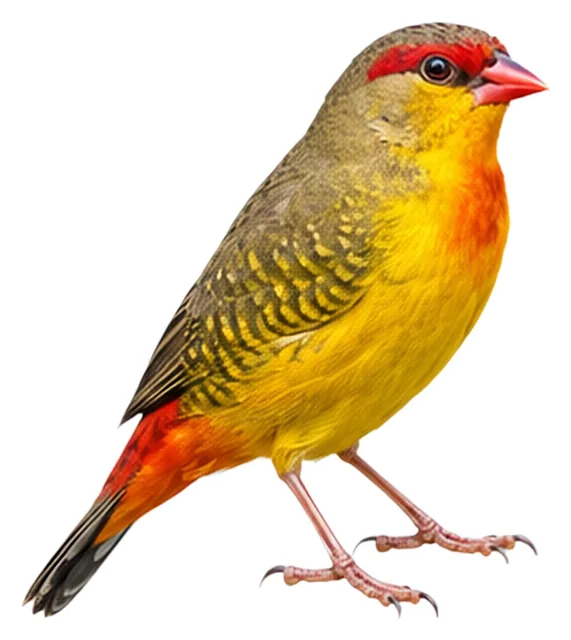
Orange-breasted Waxbill
Amandava subflava (Vieillot, 1819)
≈9.1 cmLength7.4 gWeight
It has an orange breast and red bill, and the male also has a single red supercilium.
Busiest months: March, May and November · Most records: South Africa, Senegal, Zimbabwe
How to identify
Field marks
- Breast orange, bill red
- Plumage dark olive
- Male: supercilium and rump red
- Male: dark barring on the pale flanks
Male, female and young
The female is smaller and duller than the male and lacks his red supercilium.
Where and when it's recorded

Orange-breasted Waxbill has been recorded at 161 of the 8,171 birding hotspots we track, in 26 countries and regions.
Records by month Southern Hemisphere
Where it's recorded most
- Marievale Bird SanctuarySouth Africa307 records
- Nairobi NPKenya128 records
- Suikerbosrand NRSouth Africa119 records
More places
- PN des Oiseaux du DjoudjSenegal104 records
- Midmar Dam – South ShoreSouth Africa89 records
- Rietvlei NRSouth Africa82 records
- Monavale MarshZimbabwe63 records
- Plaine de (dé)crue du fleuve SénégalSenegal48 records
- Zaagkuildrift RdSouth Africa48 records
- Cleveland Dam/Haka Game ParkZimbabwe47 records
Countries and regions with the most records
eBird records via GBIF up to 2024-12-31. A record means someone listed it; more records partly mean more birders, not more birds.
About
The orange-breasted waxbill (Amandava subflava), also known as the zebra waxbill, is a small (approximately 9 cm long) sparrow-like bird with a reddish iris, orange breast, red bill and dark olive-green plumage. The male has a red rump, dark bars on the whitish flank and a scarlet eyebrow stripe. The female is duller and smaller than male; it also lacks the male's red eyebrow.
Excerpt from Wikipedia, CC BY-SA 4.0 · authors · Read more on Wikipedia
Questions
How big is the Orange-breasted Waxbill?
The Orange-breasted Waxbill is about ≈9.1 cm long and weighs around 7.4 g.
Where does the Orange-breasted Waxbill live?
Its breeding range: Africa, Palearctic: western, central, eastern, southern Africa, southwestern Arabian Peninsula. It is most often recorded in South Africa, Senegal and Zimbabwe.
When is the best time to see the Orange-breasted Waxbill?
At the hotspots we track, it is recorded most in March, May and November (Southern Hemisphere).
Is the Orange-breasted Waxbill endangered?
The IUCN Red List classifies the Orange-breasted Waxbill as Least Concern.
What does the Orange-breasted Waxbill eat?
Main food: Seeds.
What family is the Orange-breasted Waxbill in?
It belongs to the family Waxbills, Munias & Allies (Estrildidae), order Passerines (Passeriformes).
At a glance
- Length
- ≈9.1 cm
- Weight
- 7.4 g
- Habitat
- Grassland
- Diet
- Seeds
- Lifestyle
- Varied
- Migration
- Resident (barely migrates)
- Conservation
- Least Concern
More measurements
- Wing
- 43 mm
- Tail
- 34 mm
- Bill
- 9 mm
- Tarsus
- 12 mm
Averages from the AVONET dataset; length from field guides where available.
Range
Africa, Palearctic: western, central, eastern, southern Africa, southwestern Arabian Peninsula
Breeding range, IOC World Bird List 15.2
Classification
- Order
- Passerines Passeriformes
- Family
- Waxbills, Munias & Allies Estrildidae
- Genus
- Amandava
Other birds in the genus Amandava
 Green AvadavatAmandava formosa
 Red AvadavatAmandava amandava
 Pictorella MannikinHeteromunia pectoralis
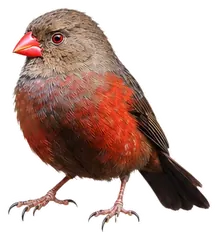 Mountain FiretailOreostruthus fuliginosus
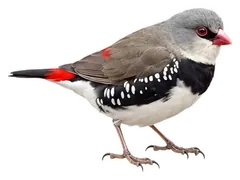 Diamond FiretailStagonopleura guttata
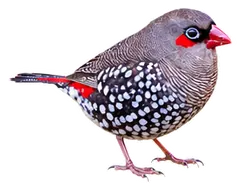 Red-eared FiretailStagonopleura oculata
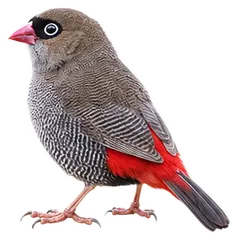 Beautiful FiretailStagonopleura bella
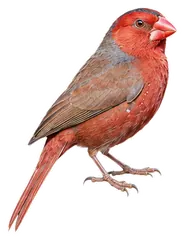 Crimson FinchNeochmia phaeton
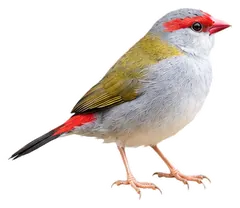 Red-browed FinchNeochmia temporalis
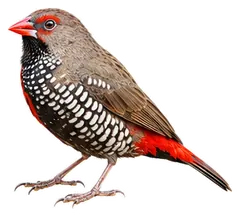 Painted FinchEmblema pictum
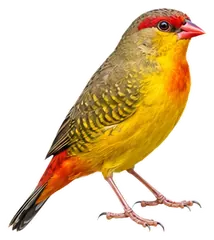
Download illustration
Free to use with credit: “Illustration: Bird Album (birdalbum.com)”. Drawn by AI from a reference photo by Heinrich Human. ↗
Heard it but can't see it? Mingji identifies birds by sound and photo, on your phone.
In other languages
- EnglishOrange-breasted Waxbill
- 简体中文橙胸梅花雀
- 繁體中文橙腹梅花雀
- 日本語シマベニスズメ
- DeutschGoldbrustastrild
- FrançaisBengali zébré
- EspañolBengalí cebra
- Portuguêsbico-de-lacre-de-peito-laranja
- ItalianoBengalino zebrato
- NederlandsGoudbuikje
- РусскийЗолотистогрудый астрильд
- Svenskaguldbröstad tigerfink
- DanskGuldbrystet Astrild
- Polskibengalik złotobrzuchy