 Bird Album
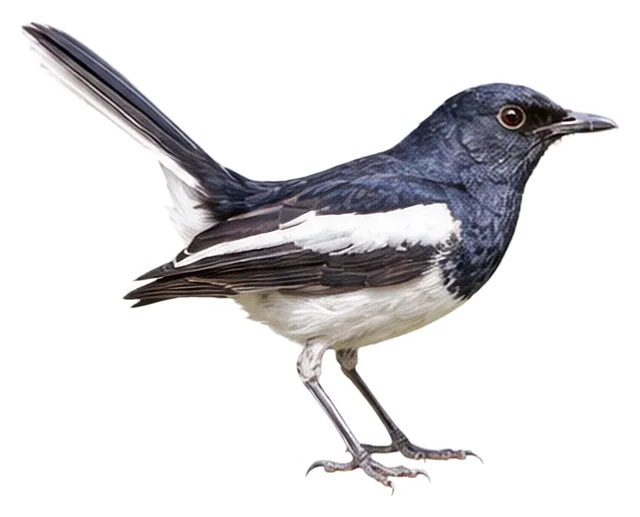
Oriental Magpie-Robin
Copsychus saularis (Linnaeus, 1758)
19–21 cmLength36 gWeight
This black-and-white bird often raises its long tail and has a melodious song.
Busiest months: February · Most records: India, China, Thailand
Looks like Oriental Magpie
How to identify
Field marks
- Male has black upperparts with a blue metallic gloss
- White patches on both wings
- White belly in the nominate subspecies; white tail sides
- Longish tail feathers, often held upright when on the ground
Male, female and young
Male has black upperparts, female gray; juvenile has brown upperparts and head with scaling.
Voice
The typical call when mobbing predators is a rough hiss, “krshhh”; song may include mimicry of other birds.
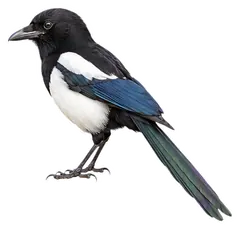
Similar species
Where and when it's recorded

Oriental Magpie-Robin has been recorded at 1,675 of the 8,171 birding hotspots we track, in 15 countries and regions.
Records by month Northern Hemisphere
Where it's recorded most
- GKVK CampusIndia8,701 records
- Kanha NP – Mukki ZoneIndia5,086 records
- Fergusson College CampusIndia4,234 records
More places
- Bharatpur – Keoladeo Ghana NPIndia4,124 records
- Taipei – National Taiwan University Main CampusTaiwan (China)3,990 records
- IIT BombayIndia3,748 records
- Mai Po Nature ReserveHong Kong (China)3,483 records
- Kerala Agricultural UniversityIndia3,213 records
- Singapore Botanic GardensSingapore3,114 records
- Salim Ali Centre for Ornithology and Natural HistoryIndia3,054 records
Countries and regions with the most records
eBird records via GBIF up to 2024-12-31. A record means someone listed it; more records partly mean more birders, not more birds.
About
The Oriental magpie-robin (Copsychus saularis) is a small passerine bird that was formerly classed as a member of the thrush family Turdidae, but now considered an Old World flycatcher. Occurring across most of the Indian subcontinent and parts of Southeast Asia, they are common birds in urban gardens as well as forests. They are particularly well known for their songs and are popular as cagebirds.
Excerpt from Wikipedia, CC BY-SA 4.0 · authors · Read more on Wikipedia
Questions
How big is the Oriental Magpie-Robin?
The Oriental Magpie-Robin is about 19–21 cm long and weighs around 36 g.
Where does the Oriental Magpie-Robin live?
Its breeding range: Oriental: widespread. It is most often recorded in India, China and Thailand.
When is the best time to see the Oriental Magpie-Robin?
At the hotspots we track, it is recorded most in February (Northern Hemisphere).
Is the Oriental Magpie-Robin endangered?
The IUCN Red List classifies the Oriental Magpie-Robin as Least Concern.
What does the Oriental Magpie-Robin eat?
Main food: Insects & other invertebrates.
What family is the Oriental Magpie-Robin in?
It belongs to the family Chats, Old World Flycatchers (Muscicapidae), order Passerines (Passeriformes).
At a glance
- Length
- 19–21 cm
- Weight
- 36 g
- Habitat
- Woodland
- Diet
- Insects & other invertebrates
- Lifestyle
- Active on the ground
- Migration
- Resident (barely migrates)
- Conservation
- Least Concern
More measurements
- Wing
- 98 mm
- Tail
- 84 mm
- Bill
- 23 mm
- Tarsus
- 30 mm
Averages from the AVONET dataset; length from field guides where available.
Range
Oriental: widespread
Breeding range, IOC World Bird List 15.2
Subspecies · 1
- Copsychus saularis saularis ne Pakistan and India to s, e China, Hainan I. (off se China), Thailand and Indochina
Classification
- Order
- Passerines Passeriformes
- Family
- Chats, Old World Flycatchers Muscicapidae
- Genus
- Copsychus
Other birds in the genus Copsychus
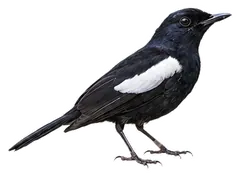 Seychelles Magpie-RobinCopsychus sechellarum
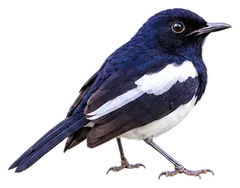 Philippine Magpie-RobinCopsychus mindanensis
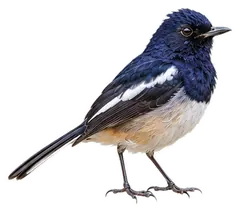 Madagascar Magpie-RobinCopsychus albospecularis
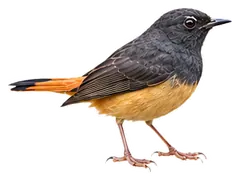 Rufous-tailed ShamaCopsychus pyrropygus
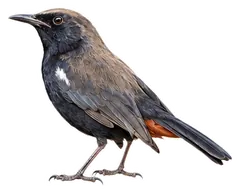 Indian RobinCopsychus fulicatus
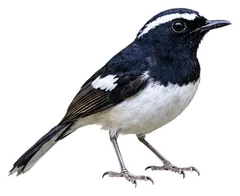 White-browed ShamaCopsychus luzoniensis
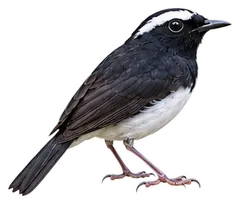 Visayan ShamaCopsychus superciliaris
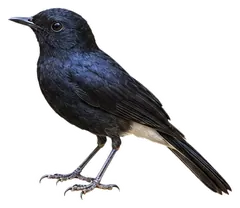 White-vented ShamaCopsychus niger
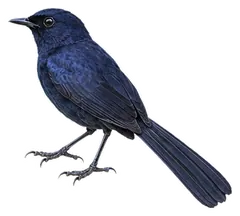 Black ShamaCopsychus cebuensis
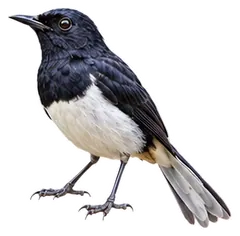 Andaman ShamaCopsychus albiventris
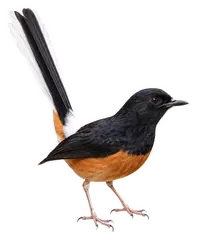 Larwo ShamaCopsychus omissus
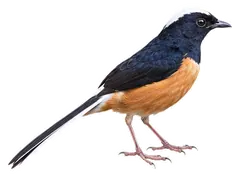 White-crowned ShamaCopsychus stricklandii
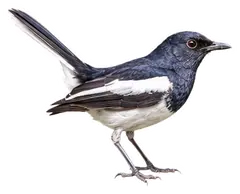
Download illustration
Free to use with credit: “Illustration: Bird Album (birdalbum.com)”. Drawn by AI from a reference photo by Charles J. Sharp. ↗

Heard it but can't see it? Mingji identifies birds by sound and photo, on your phone.