 Bird Album
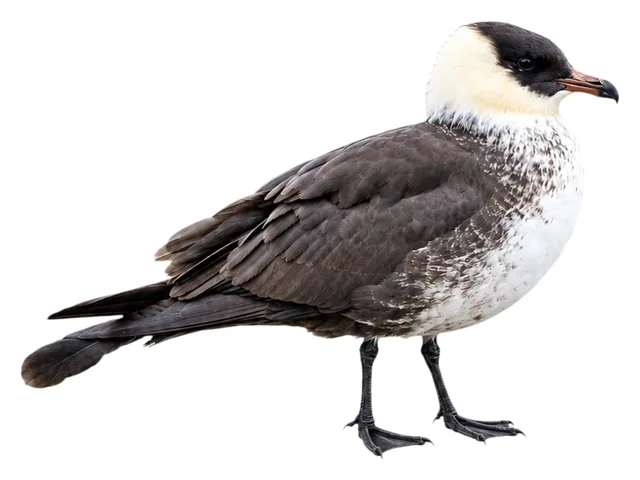
Pomarine Jaeger
Stercorarius pomarinus (Temminck, 1815)
45 cmLength118 cmWingspan692 gWeight
An adult in the breeding season has two long, twisted, spoon-shaped central tail feathers.
Busiest months: September · Most records: United States, Spain, United Kingdom
How to identify
Field marks
- Breeding adult has long, spoon-shaped central tail feathers
- White patches on the underwing form a double flash
- Pale-morph adult has a black crown and yellowish-white head and neck
- Dark-morph adult has dark brown body feathers
Male, female and young
Juvenile is harder to identify than adult.
Voice
Grating clucking, also a call like “which-yew”.
Where and when it's recorded

Pomarine Jaeger has been recorded at 511 of the 8,171 birding hotspots we track, in 86 countries and regions.
Records by month Northern Hemisphere
Where it's recorded most
- GambellUnited States2,711 records
- Pt. Pinos – seawatch onlyUnited States2,175 records
- Southeast Farallon IslandUnited States1,695 records
More places
- Estaca de Bares – Observatorio de aves y entornoSpain1,477 records
- St. Paul IslandUnited States625 records
- Bridges of RossIreland421 records
- Dungeness Bird Observatory Recording AreaUnited Kingdom385 records
- Ngor – Hotel Le CalaoSenegal349 records
- Eilat north beachIsrael319 records
- PN Sintra-Cascais – Cabo RasoPortugal304 records
Countries and regions with the most records
eBird records via GBIF up to 2024-12-31. A record means someone listed it; more records partly mean more birders, not more birds.
About
The pomarine jaeger (Stercorarius pomarinus), pomarine skua, or pomatorhine skua, is a seabird in the skua family Stercorariidae. It is a migrant, wintering at sea in the tropical oceans.
Excerpt from Wikipedia, CC BY-SA 4.0 · authors · Read more on Wikipedia
Questions
How big is the Pomarine Jaeger?
The Pomarine Jaeger is about 45 cm long, with a wingspan of 118 cm and weighs around 692 g.
Where does the Pomarine Jaeger live?
Its breeding range: North America, Palearctic: Holarctic high Arctic tundra: erratically off southwestern Greenland, Svalbard (nesting unconfirmed; north of Norway), northwest to northeastern Arctic Russia (including many high Arctic islands), high Arctic northern Alaska and southwestern Alaska mainland, and Arctic Canada to Baffin Island (northeastern Canada). It is most often recorded in United States, Spain and United Kingdom.
When is the best time to see the Pomarine Jaeger?
At the hotspots we track, it is recorded most in September (Northern Hemisphere).
Is the Pomarine Jaeger endangered?
The IUCN Red List classifies the Pomarine Jaeger as Least Concern.
What does the Pomarine Jaeger eat?
Main food: Fish, shrimp & shellfish.
What family is the Pomarine Jaeger in?
It belongs to the family Skuas (Stercorariidae), order Charadriiformes.
At a glance
- Length
- 45 cm
- Wingspan
- 118 cm
- Weight
- 692 g
- Habitat
- Ocean
- Diet
- Fish, shrimp & shellfish
- Lifestyle
- Feeds in the air
- Migration
- Migratory
- Conservation
- Least Concern
More measurements
- Wing
- 351 mm
- Tail
- 176 mm
- Bill
- 46 mm
- Tarsus
- 52 mm
Averages from the AVONET dataset; length from field guides where available.
Range
North America, Palearctic: Holarctic high Arctic tundra: erratically off southwestern Greenland, Svalbard (nesting unconfirmed; north of Norway), northwest to northeastern Arctic Russia (including many high Arctic islands), high Arctic northern Alaska and southwestern Alaska mainland, and Arctic Canada to Baffin Island (northeastern Canada)
Breeding range, IOC World Bird List 15.2
Classification
- Order
- Charadriiformes
- Family
- Skuas Stercorariidae
- Genus
- Stercorarius
Other birds in the genus Stercorarius
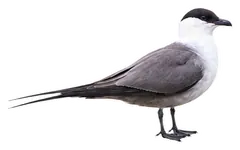 Long-tailed JaegerStercorarius longicaudus
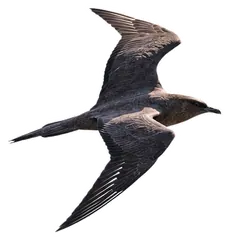 Parasitic JaegerStercorarius parasiticus
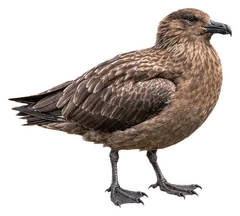 Great SkuaStercorarius skua
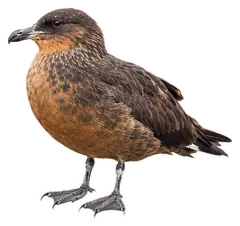 Chilean SkuaStercorarius chilensis
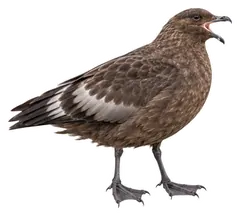 Brown SkuaStercorarius antarcticus
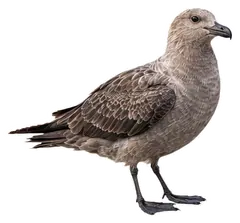 South Polar SkuaStercorarius maccormicki
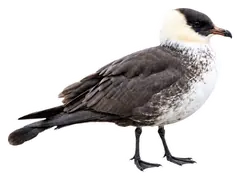
Download illustration
Free to use with credit: “Illustration: Bird Album (birdalbum.com)”. Drawn by AI from a reference photo by Nigel Voaden. ↗
Heard it but can't see it? Mingji identifies birds by sound and photo, on your phone.