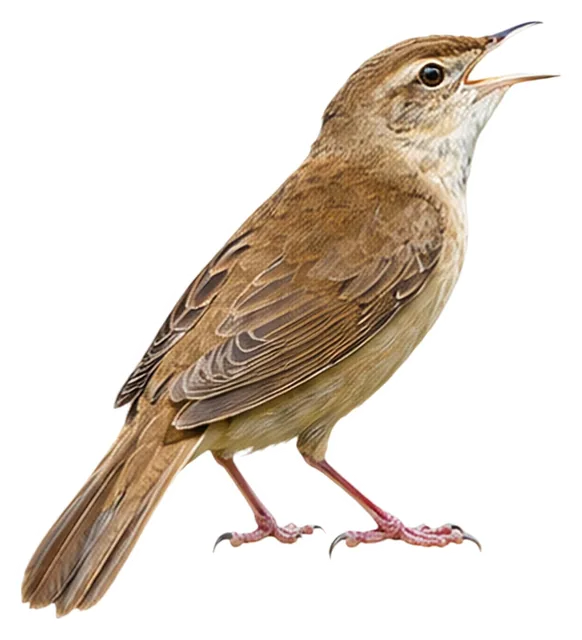
Savi's Warbler
Locustella luscinioides (Savi, 1824)
14 cmLength20 cmWingspan14 gWeight
It has a plain reddish-brown back and climbs to reed tops to sing.
Busiest months: April–May · Most records: Israel, Spain, Germany
How to identify
Field marks
- Upperparts plain dark reddish-brown
- Supercilium pale yellowish-brown and indistinct
- Throat without streaks; belly pale yellowish-white
- Bill thin and brown; legs and feet also brown
Male, female and young
Sexes alike; juvenile has yellower underparts.
Voice
A monotonous, mechanical insect-like continuous song, often given at dusk and preceded by a series of low beeps.
Where and when it's recorded
Busiest months: April–May · Most records: Israel, Spain, Germany

Savi's Warbler has been recorded at 624 of the 8,276 birding hotspots we track, in 68 countries and regions.
Records by month Northern Hemisphere
Where it's recorded most
- International Birding and Research Center Eilat (IBRCE)Israel2,066 records
- Poleg MarshIsrael878 records
- Ria de Aveiro – SalreuPortugal784 records
More places
- Sureste PNat – Miralrío, Velilla de San AntonioSpain716 records
- Embalse de Arrocampo – Observatorio 2Spain611 records
- Aras Kuş Halkalama İstasyonuTürkiye479 records
- Marjal dels Moros – ÁreaSpain455 records
- Laguna de la Nava ENat – ÁreaSpain431 records
- Yeruham LakeIsrael424 records
- Spytkowice FishpondsPoland420 records
Countries and regions with the most records
eBird records via GBIF up to 2024-12-31. A record means someone listed it; more records partly mean more birders, not more birds.
About
Savi's warbler (Locustella luscinioides) is a species of Old World warbler in the genus Locustella. It breeds in Europe and the western Palearctic. It is migratory, wintering in northern and sub-Saharan Africa.
Excerpt from Wikipedia, CC BY-SA 4.0 · authors · Read more on Wikipedia
Questions
How big is the Savi's Warbler?
The Savi's Warbler is about 14 cm long, with a wingspan of 20 cm and weighs around 14 g.
Where does the Savi's Warbler live?
Its breeding range: Palearctic: central, western, southwestern, also northwestern Africa. It is most often recorded in Israel, Spain and Germany.
When is the best time to see the Savi's Warbler?
At the hotspots we track, it is recorded most in April and May (Northern Hemisphere).
Is the Savi's Warbler endangered?
The IUCN Red List classifies the Savi's Warbler as Least Concern.
What does the Savi's Warbler eat?
Main food: Insects & other invertebrates.
What family is the Savi's Warbler in?
It belongs to the family Grassbirds & Allies (Locustellidae), order Passerines (Passeriformes).
At a glance
- Length
- 14 cm
- Wingspan
- 20 cm
- Weight
- 14 g
- Habitat
- Wetland
- Diet
- Insects & other invertebrates
- Lifestyle
- Varied
- Migration
- Migratory
- Conservation
- Least Concern
More measurements
- Wing
- 70 mm
- Tail
- 54 mm
- Bill
- 16 mm
- Tarsus
- 21 mm
Averages from the AVONET dataset; length from field guides where available.
Range
Palearctic: central, western, southwestern, also northwestern Africa
Breeding range, IOC World Bird List 15.2
Classification
- Order
- Passerines Passeriformes
- Family
- Grassbirds & Allies Locustellidae
- Genus
- Locustella
Other birds in the genus Locustella
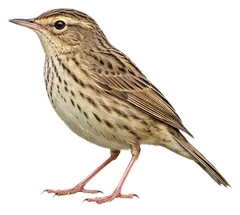 Lanceolated WarblerLocustella lanceolata
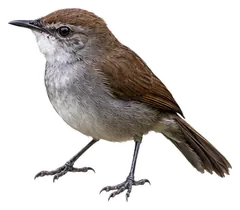 Bamboo WarblerLocustella alfredi
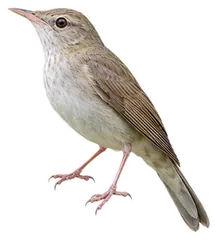 River WarblerLocustella fluviatilis
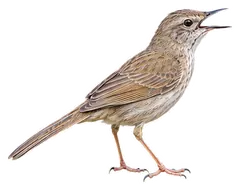 Long-billed Bush WarblerLocustella major
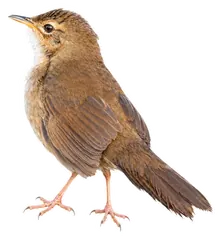 Brown Bush WarblerLocustella luteoventris
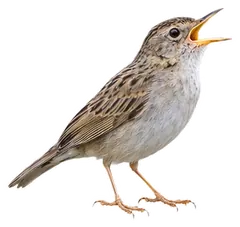 Common Grasshopper WarblerLocustella naevia
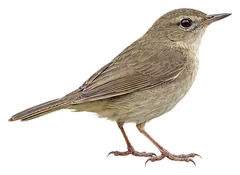 Chinese Bush WarblerLocustella tacsanowskia
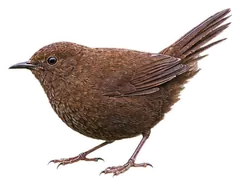 Friendly Bush WarblerLocustella accentor
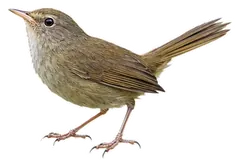 Long-tailed Bush WarblerLocustella caudata
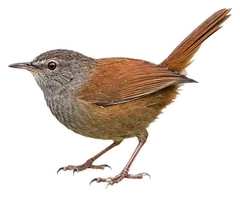 Sulawesi Bush WarblerLocustella castanea
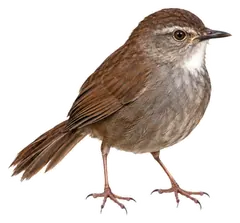 Seram Bush WarblerLocustella musculus
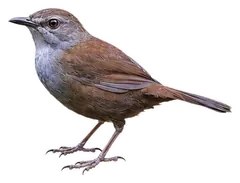 Taliabu Bush WarblerLocustella portenta
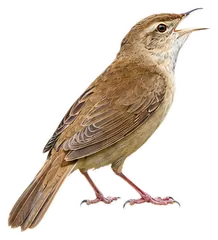
Download illustration
Free to use with credit: “Illustration: Bird Album (birdalbum.com)”. Drawn by AI from a reference photo by Светлана Медведева. ↗
Heard it but can't see it? Mingji identifies birds by sound and photo, on your phone.