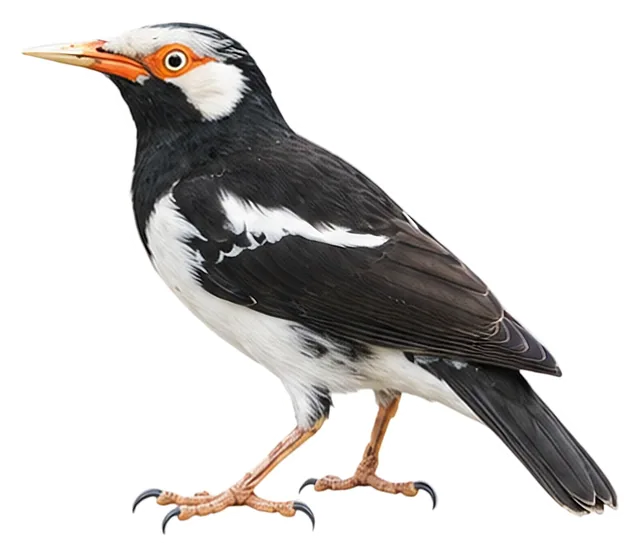
Siamese Pied Myna
Gracupica floweri (Sharpe, 1897)
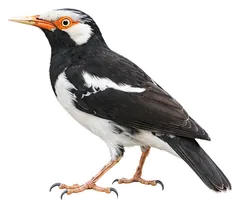
It has black-and-white plumage with a black collar around the neck.
Busiest months: January–February · Most records: Thailand, Cambodia, Malaysia
How to identify
Field marks
- Black collar around the neck
- White stripes on the forehead
- Red-orange bare skin around the eye
Where and when it's recorded
Busiest months: January–February · Most records: Thailand, Cambodia, Malaysia

Siamese Pied Myna has been recorded at 137 of the 8,276 birding hotspots we track, in 5 countries and regions.
Records by month Northern Hemisphere
Where it's recorded most
- Benjakiti ParkThailand960 records
- Rot Fai ParkThailand937 records
- Lat Krabang – Thap Yao paddies & aquaculture pondsThailand925 records
More places
- Lumphini ParkThailand639 records
- Chulalongkorn UniversityThailand608 records
- H.M. Queen Sirikit ParkThailand495 records
- Pak Thale Nature ReserveThailand462 records
- Pathum Thani Rice Research CenterThailand459 records
- Doi Lo paddiesThailand396 records
- Kaeng Krachan NP – Baan Maka Nature LodgeThailand396 records
Countries and regions with the most records
eBird records via GBIF up to 2024-12-31. A record means someone listed it; more records partly mean more birders, not more birds.
About
The Siamese pied myna (Gracupica floweri) is a species of starling in the family Sturnidae. Its plumage is black and white, with a black collar. It is found in southern Myanmar to Thailand and Laos.
Excerpt from Wikipedia, CC BY-SA 4.0 · authors · Read more on Wikipedia
Questions
Where does the Siamese Pied Myna live?
Its breeding range: Oriental: southern, eastern Myanmar and southern China to Thailand, Laos and Cambodia. It is most often recorded in Thailand, Cambodia and Malaysia.
When is the best time to see the Siamese Pied Myna?
At the hotspots we track, it is recorded most in January and February (Northern Hemisphere).
Is the Siamese Pied Myna endangered?
The IUCN Red List classifies the Siamese Pied Myna as Least Concern.
What family is the Siamese Pied Myna in?
It belongs to the family Starlings, Rhabdornises (Sturnidae), order Passerines (Passeriformes).
At a glance
- Conservation
- Least Concern
Range
Oriental: southern, eastern Myanmar and southern China to Thailand, Laos and Cambodia
Breeding range, IOC World Bird List 15.2
Classification
- Order
- Passerines Passeriformes
- Family
- Starlings, Rhabdornises Sturnidae
- Genus
- Gracupica
Other birds in the genus Gracupica
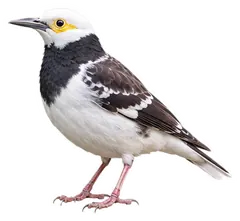 Black-collared StarlingGracupica nigricollis
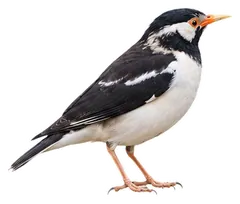 Indian Pied MynaGracupica contra
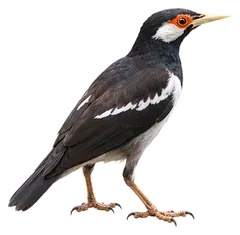 Javan Pied MynaGracupica jalla
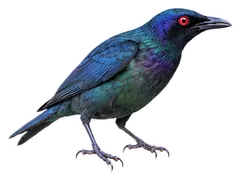 Metallic StarlingAplonis metallica
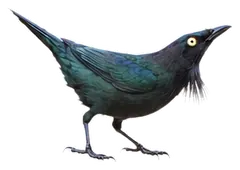 Yellow-eyed StarlingAplonis mystacea
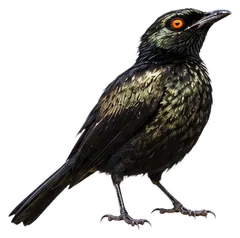 Singing StarlingAplonis cantoroides
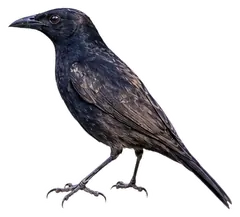 Tanimbar StarlingAplonis crassa
 Atoll StarlingAplonis feadensis
 Rennell StarlingAplonis insularis
 Long-tailed StarlingAplonis magna
Download illustration
Free to use with credit: “Illustration: Bird Album (birdalbum.com)”. Drawn by AI from a reference photo by yichang. ↗
Heard it but can't see it? Mingji identifies birds by sound and photo, on your phone.