Snowy Owl
Bubo scandiacus (Linnaeus, 1758)
52–64 cmLength2 kgWeight
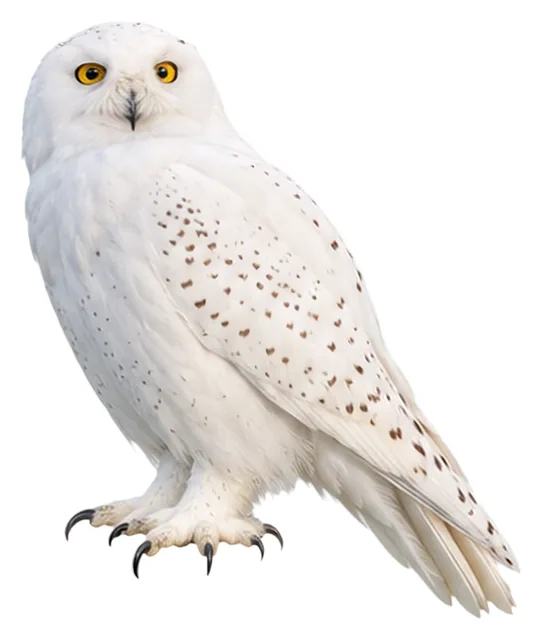
This large, snow-white owl is also active by day and has a round head without ear tufts.
Busiest months: December–January · Most records: United States, Canada, Spain
How to identify
Field marks
- Almost pure white, with black fan-shaped spots
- Head rounded and snow-white, without ear tufts
- Eyes yellow, bill black
- Toes densely covered in white feathers, claws black
Male, female and young
Male distinctly smaller and whiter than female; female and juvenile have more black markings.
Voice
Usually very quiet; a common call is a repeated, low “gawh”; in the breeding season the male gives repeated hoots during courtship.
Where and when it's recorded
Busiest months: December–January · Most records: United States, Canada, Spain

Snowy Owl has been recorded at 320 of the 8,276 birding hotspots we track, in 15 countries and regions.
Records by month Northern Hemisphere
To protect this bird from disturbance, we don't list exact sites.
Countries and regions with the most records
eBird records via GBIF up to 2024-12-31. A record means someone listed it; more records partly mean more birders, not more birds.
About
The snowy owl (Bubo scandiacus), also known as the polar owl, the white owl and the Arctic owl, is a large, white owl of the true owl family. Snowy owls are native to the Arctic regions of both North America and the Palearctic, breeding mostly on the tundra. It has a number of unique adaptations to its habitat and lifestyle, which are quite distinct from other extant owls.
Excerpt from Wikipedia, CC BY-SA 4.0 · authors · Read more on Wikipedia
Questions
How big is the Snowy Owl?
The Snowy Owl is about 52–64 cm long and weighs around 2 kg.
Where does the Snowy Owl live?
Its breeding range: North America, Palearctic: widespread in the northern. It is most often recorded in United States, Canada and Spain.
When is the best time to see the Snowy Owl?
At the hotspots we track, it is recorded most in January and December (Northern Hemisphere).
Is the Snowy Owl endangered?
The IUCN Red List classifies the Snowy Owl as Vulnerable.
What does the Snowy Owl eat?
Main food: Vertebrate prey.
What family is the Snowy Owl in?
It belongs to the family Owls (Strigidae), order Strigiformes.
At a glance
- Length
- 52–64 cm
- Weight
- 2 kg
- Habitat
- Grassland
- Diet
- Vertebrate prey
- Lifestyle
- Perches in trees
- Migration
- Migratory
- Conservation
- Vulnerable
More measurements
- Wing
- 419 mm
- Tail
- 215 mm
- Bill
- 44 mm
- Tarsus
- 62 mm
Averages from the AVONET dataset; length from field guides where available.
Range
North America, Palearctic: widespread in the northern
Breeding range, IOC World Bird List 15.2
Classification
- Order
- Strigiformes
- Family
- Owls Strigidae
- Genus
- Bubo
Other birds in the genus Bubo
 Great Horned OwlBubo virginianus
 Lesser Horned OwlBubo magellanicus
 Eurasian Eagle-OwlBubo bubo
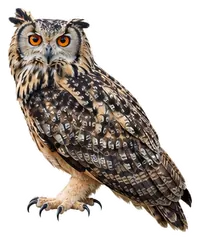 Indian Eagle-OwlBubo bengalensis
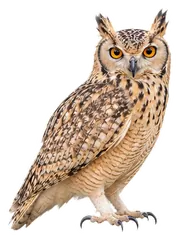 Pharaoh Eagle-OwlBubo ascalaphus
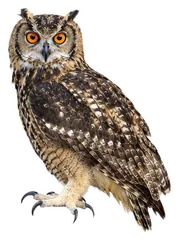 Cape Eagle-OwlBubo capensis
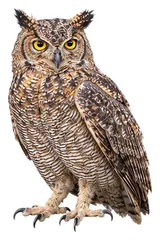 Arabian Eagle-OwlBubo milesi
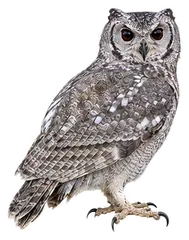 Greyish Eagle-OwlBubo cinerascens
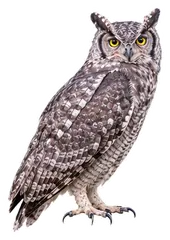 Spotted Eagle-OwlBubo africanus
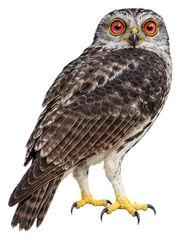 Papuan Hawk-OwlUroglaux dimorpha
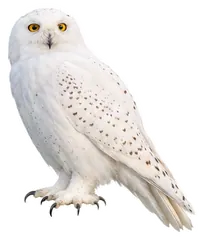
Download illustration
Free to use with credit: “Illustration: Bird Album (birdalbum.com)”. Drawn by AI from a reference photo by Александр Кочетков. ↗
Heard it but can't see it? Mingji identifies birds by sound and photo, on your phone.