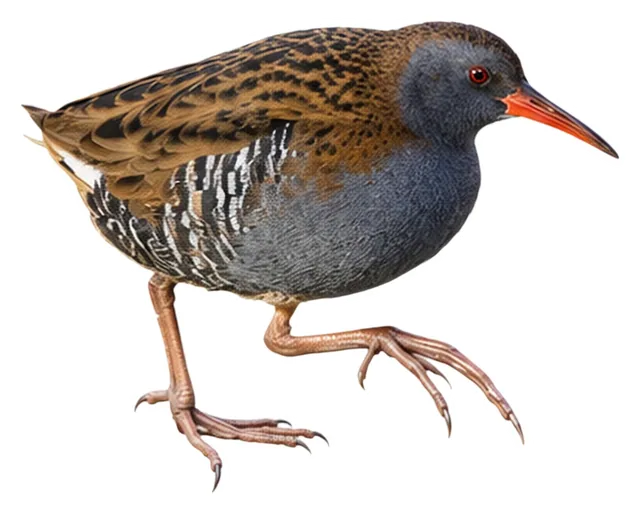
Water Rail
Rallus aquaticus Linnaeus, 1758
23–28 cmLength42 cmWingspan111 gWeight
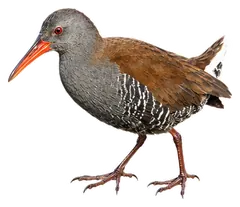
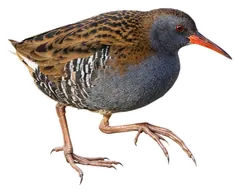
It has a long red bill and a flattened body that helps it move through dense reeds.
Busiest months: October · Most records: United Kingdom, Spain, Portugal
How to identify
Field marks
- Long red bill, slightly decurved
- Adult of the nominate subspecies has black-and-white barring on the flanks
- Adult of the nominate subspecies has a dark blue-gray upper belly
- Adult of the nominate subspecies has an olive-brown back with black streaks
Male, female and young
Sexes similar in the nominate subspecies; female averages slightly smaller, with a more slender bill; juvenile has pale rufous or white underparts with dark barring.
Voice
Begins with a few grunts, followed by piglet-like squeals, then returns to grunts.
Where and when it's recorded
Busiest months: October · Most records: United Kingdom, Spain, Portugal

Water Rail has been recorded at 1,079 of the 8,276 birding hotspots we track, in 76 countries and regions.
Records by month Northern Hemisphere
Where it's recorded most
- Urdaibai RB – bird center y laguna de OruetaSpain2,980 records
- International Birding and Research Center Eilat (IBRCE)Israel2,799 records
- Titchwell Marsh RSPB ReserveUnited Kingdom2,153 records
More places
- Amwell HMWT NRUnited Kingdom1,972 records
- Aras Kuş Halkalama İstasyonuTürkiye1,927 records
- Txingudi – PlaiaundiSpain1,888 records
- Minsmere RSPB ReserveUnited Kingdom1,502 records
- Barrinha de EsmorizPortugal1,325 records
- Marjal dels Moros – ÁreaSpain1,276 records
- Ria de Aveiro – SalreuPortugal1,229 records
Countries and regions with the most records
eBird records via GBIF up to 2024-12-31. A record means someone listed it; more records partly mean more birders, not more birds.
About
The water rail, western water rail or European water rail (Rallus aquaticus) is a bird of the rail family which breeds in well-vegetated wetlands across Europe, Asia and North Africa. Northern and eastern populations are migratory, but this species is a permanent resident in the warmer parts of its breeding range. The adult is 23–28 cm (9–11 in) long, and, like other rails, has a body that is flattened laterally, allowing it easier passage through the reed beds it inhabits.
Excerpt from Wikipedia, CC BY-SA 4.0 · authors · Read more on Wikipedia
Questions
How big is the Water Rail?
The Water Rail is about 23–28 cm long, with a wingspan of 42 cm and weighs around 111 g.
Where does the Water Rail live?
Its breeding range: Palearctic: western Europe to Central Asia. It is most often recorded in United Kingdom, Spain and Portugal.
When is the best time to see the Water Rail?
At the hotspots we track, it is recorded most in October (Northern Hemisphere).
Is the Water Rail endangered?
The IUCN Red List classifies the Water Rail as Least Concern.
What does the Water Rail eat?
Main food: Fish, shrimp & shellfish.
What family is the Water Rail in?
It belongs to the family Rails, Crakes & Coots (Rallidae), order Gruiformes.
At a glance
- Length
- 23–28 cm
- Wingspan
- 42 cm
- Weight
- 111 g
- Habitat
- Wetland
- Diet
- Fish, shrimp & shellfish
- Lifestyle
- Active on the ground
- Migration
- Partial migrant
- Conservation
- Least Concern
More measurements
- Wing
- 114 mm
- Tail
- 51 mm
- Bill
- 42 mm
- Tarsus
- 38 mm
Averages from the AVONET dataset; length from field guides where available.
Range
Palearctic: western Europe to Central Asia
Breeding range, IOC World Bird List 15.2
Subspecies · 1
- Rallus aquaticus korejewi Aral Sea and Iran to nw China and Kashmir | non-breeding: India and s China
Classification
- Order
- Gruiformes
- Family
- Rails, Crakes & Coots Rallidae
- Genus
- Rallus
Other birds in the genus Rallus
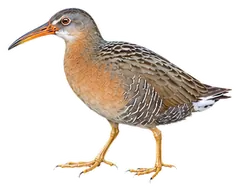 Ridgway's RailRallus obsoletus
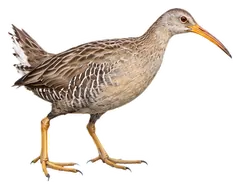 Clapper RailRallus crepitans
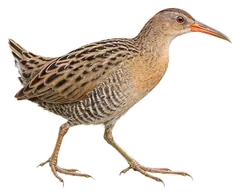 Aztec RailRallus tenuirostris
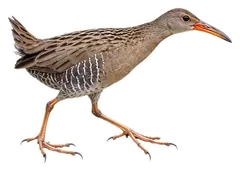 Mangrove RailRallus longirostris
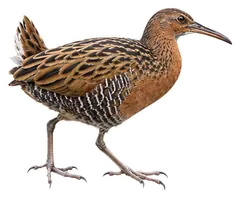 King RailRallus elegans
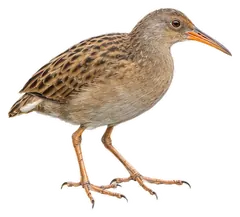 Plain-flanked RailRallus wetmorei
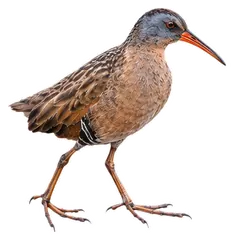 Virginia RailRallus limicola
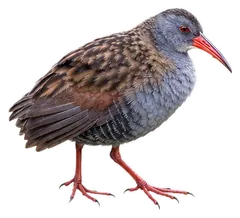 Bogota RailRallus semiplumbeus
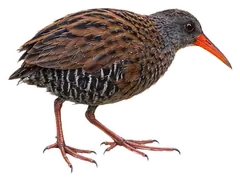 Ecuadorian RailRallus aequatorialis
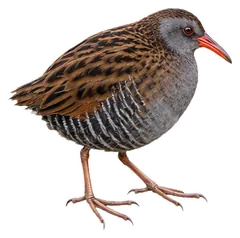 Austral RailRallus antarcticus
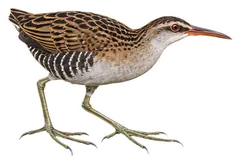 Brown-cheeked RailRallus indicus
 African RailRallus caerulescens
Download illustration
Free to use with credit: “Illustration: Bird Album (birdalbum.com)”. Drawn by AI from a reference photo by Torben Mathiasen. ↗
Heard it but can't see it? Mingji identifies birds by sound and photo, on your phone.