 Bird Album
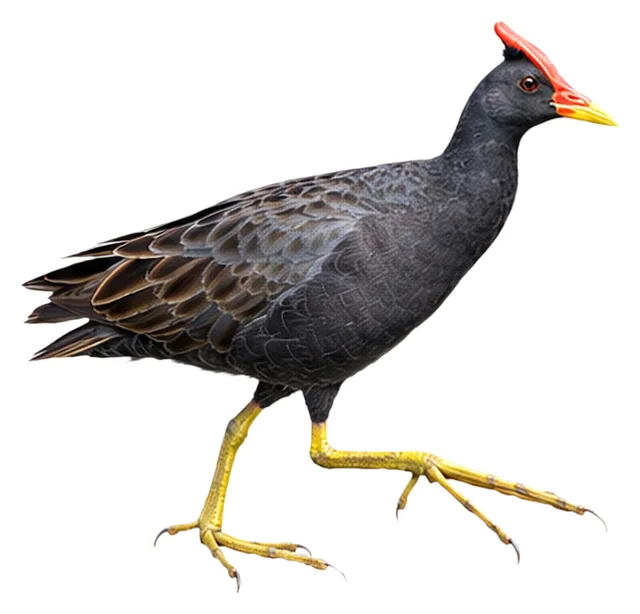
Watercock
Gallicrex cinerea (Gmelin, JF, 1789)
43 cmLength77 cmWingspan390 gWeight
The adult male is mainly blackish-gray with a red bill and legs and feet, and a red frontal shield and horn.
Busiest months: January–March and June · Most records: India, Sri Lanka, Cambodia
How to identify
Field marks
- Adult male's feathers mainly blackish-gray
- Male has a red-and-yellow bill and red frontal shield and horn
- Toes long, tail short
Male, female and young
Female smaller, with dark brown upperparts and paler underparts, dark stripes and spots on the feathers, a yellow bill and green legs and feet; young male pale brown, with a yellow bill and green legs and feet.
Voice
Very noisy, especially at dawn and dusk, with loud calls resembling gulping.
Where and when it's recorded

Watercock has been recorded at 380 of the 8,171 birding hotspots we track, in 22 countries and regions.
Records by month Northern Hemisphere
Where it's recorded most
- Krishnampathi Lake, SeeranaickenpalayamIndia584 records
- Matara – Kirala Kele SanctuarySri Lanka385 records
- Changaram Wetlands – EzhupunnaIndia331 records
More places
- Bundala NPSri Lanka293 records
- Baruipur MarshesIndia255 records
- Vellayani – Punchakkari WetlandsIndia222 records
- Phnom Krom – rice fieldsCambodia217 records
- EzhomeIndia212 records
- Viva Wetlands, VirarIndia200 records
- Ang Trapeang ThmorCambodia187 records
Countries and regions with the most records
eBird records via GBIF up to 2024-12-31. A record means someone listed it; more records partly mean more birders, not more birds.
About
The watercock (Gallicrex cinerea) is a waterbird in the rail and crake family, Rallidae that is widely distributed across Southeast Asia. It is the only member of the genus Gallicrex.
Excerpt from Wikipedia, CC BY-SA 4.0 · authors · Read more on Wikipedia
Questions
How big is the Watercock?
The Watercock is about 43 cm long, with a wingspan of 77 cm and weighs around 390 g.
Where does the Watercock live?
Its breeding range: Oriental: Pakistan and Maldives through northeastern China, Korean Peninsula, Ryukyu Islands (Japan) through Philippines and Greater Sundas. It is most often recorded in India, Sri Lanka and Cambodia.
When is the best time to see the Watercock?
At the hotspots we track, it is recorded most in January, February, March and June (Northern Hemisphere).
Is the Watercock endangered?
The IUCN Red List classifies the Watercock as Least Concern.
What does the Watercock eat?
Main food: Omnivore.
What family is the Watercock in?
It belongs to the family Rails, Crakes & Coots (Rallidae), order Gruiformes.
At a glance
- Length
- 43 cm
- Wingspan
- 77 cm
- Weight
- 390 g
- Habitat
- Wetland
- Diet
- Omnivore
- Lifestyle
- Active on the ground
- Migration
- Partial migrant
- Conservation
- Least Concern
More measurements
- Wing
- 186 mm
- Tail
- 73 mm
- Bill
- 43 mm
- Tarsus
- 64 mm
Averages from the AVONET dataset; length from field guides where available.
Range
Oriental: Pakistan and Maldives through northeastern China, Korean Peninsula, Ryukyu Islands (Japan) through Philippines and Greater Sundas
Breeding range, IOC World Bird List 15.2
Classification
- Order
- Gruiformes
- Family
- Rails, Crakes & Coots Rallidae
- Genus
- Gallicrex
More from the family Rails, Crakes & Coots
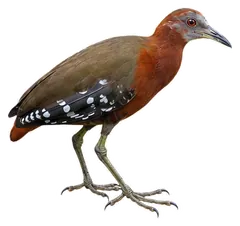 Grey-throated RailCanirallus oculeus
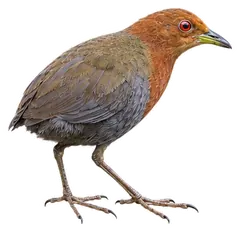 Chestnut-headed CrakeAnurolimnas castaneiceps
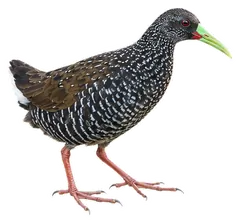 Spotted RailPardirallus maculatus
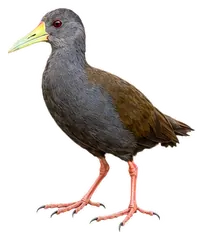 Blackish RailPardirallus nigricans
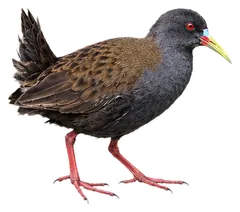 Plumbeous RailPardirallus sanguinolentus
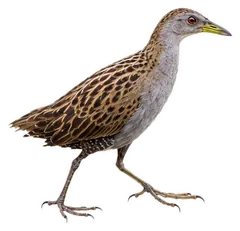 Ash-throated CrakeMustelirallus albicollis
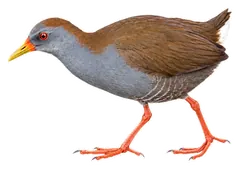 Zapata RailMustelirallus cerverai
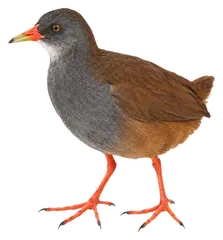 Colombian CrakeMustelirallus colombianus
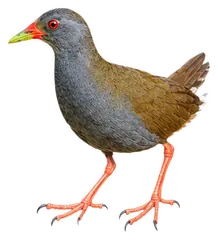 Paint-billed CrakeMustelirallus erythrops
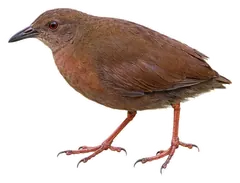 Uniform CrakeAmaurolimnas concolor
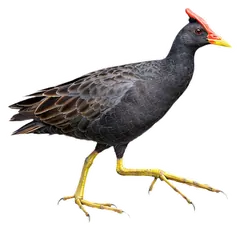
Download illustration
Free to use with credit: “Illustration: Bird Album (birdalbum.com)”. Drawn by AI from a reference photo by Koshy Koshy. ↗

Heard it but can't see it? Mingji identifies birds by sound and photo, on your phone.