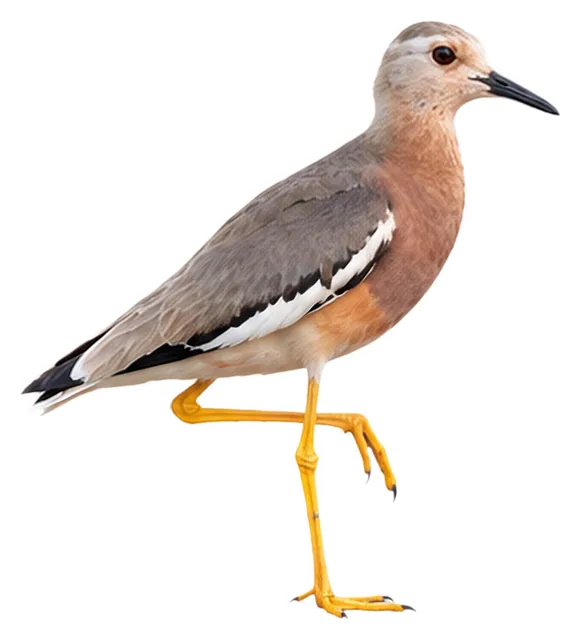
White-tailed Lapwing
Vanellus leucurus (Lichtenstein, MHC, 1823)
≈29 cmLength63 cmWingspan132 gWeight
This slender, upright lapwing has yellow legs and feet and an entirely white tail as an adult.
Busiest months: January–February · Most records: India, United Arab Emirates, Kuwait
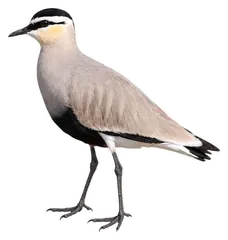
Looks like Sociable Lapwing
How to identify
Field marks
- Adults have an entirely white tail
- Long-legged; legs and feet yellow
- Adults have a brown back and foreneck, pale face and gray breast
- Upperwing patterned in brown, white and black
Male, female and young
Juveniles have a scaled back and may have some brown on the tail.
Voice
A “peewit” call in the breeding season.
Similar species
Where and when it's recorded
Busiest months: January–February · Most records: India, United Arab Emirates, Kuwait

White-tailed Lapwing has been recorded at 153 of the 8,276 birding hotspots we track, in 40 countries and regions.
Records by month Northern Hemisphere
Where it's recorded most
- Bharatpur – Keoladeo Ghana NPIndia1,908 records
- Dubai Pivot FieldsUnited Arab Emirates1,366 records
- Al Jahra Reserve (Restricted access)Kuwait1,051 records
More places
- Sultanpur National ParkIndia975 records
- Al Wathba Wetland ReserveUnited Arab Emirates971 records
- Al Marmoom DCR – Al Qudra PivotsUnited Arab Emirates445 records
- Basai WetlandIndia412 records
- Blacktoft Sands RSPB ReserveUnited Kingdom403 records
- Okhla Bird SanctuaryIndia393 records
- Dhanauri Wetlands – Dhanauri Kalan EastIndia363 records
Countries and regions with the most records
eBird records via GBIF up to 2024-12-31. A record means someone listed it; more records partly mean more birders, not more birds.
About
The white-tailed lapwing or white-tailed plover (Vanellus leucurus) is a wader in the lapwing genus. The genus name Vanellus is Medieval Latin for a lapwing and derives from vannus, which refers to a winnowing fan. The specific leucurus is from Ancient Greek leukouros, "white-tailed".
Excerpt from Wikipedia, CC BY-SA 4.0 · authors · Read more on Wikipedia
Questions
How big is the White-tailed Lapwing?
The White-tailed Lapwing is about ≈29 cm long, with a wingspan of 63 cm and weighs around 132 g.
Where does the White-tailed Lapwing live?
Its breeding range: Palearctic: inland central Turkey and eastern Azerbaijan to northern Caspian Sea, southern Kazakhstan, Uzbekistan and Turkmenistan and northwestern Afghanistan; southern to northern Jordan and Persian Gulf to southwestern Pakistan. It is most often recorded in India, United Arab Emirates and Kuwait.
When is the best time to see the White-tailed Lapwing?
At the hotspots we track, it is recorded most in January and February (Northern Hemisphere).
Is the White-tailed Lapwing endangered?
The IUCN Red List classifies the White-tailed Lapwing as Least Concern.
What does the White-tailed Lapwing eat?
Main food: Fish, shrimp & shellfish.
What family is the White-tailed Lapwing in?
It belongs to the family Plovers (Charadriidae), order Charadriiformes.
At a glance
- Length
- ≈29 cm
- Wingspan
- 63 cm
- Weight
- 132 g
- Habitat
- Wetland
- Diet
- Fish, shrimp & shellfish
- Lifestyle
- Active on the ground
- Migration
- Migratory
- Conservation
- Least Concern
More measurements
- Wing
- 171 mm
- Tail
- 74 mm
- Bill
- 34 mm
- Tarsus
- 70 mm
Averages from the AVONET dataset; length from field guides where available.
Range
Palearctic: inland central Turkey and eastern Azerbaijan to northern Caspian Sea, southern Kazakhstan, Uzbekistan and Turkmenistan and northwestern Afghanistan; southern to northern Jordan and Persian Gulf to southwestern Pakistan
Breeding range, IOC World Bird List 15.2
Classification
- Order
- Charadriiformes
- Family
- Plovers Charadriidae
- Genus
- Vanellus
Other birds in the genus Vanellus
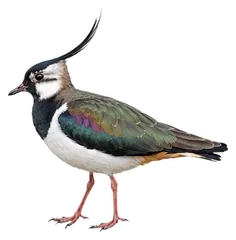 Northern LapwingVanellus vanellus
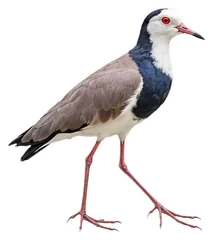 Long-toed LapwingVanellus crassirostris
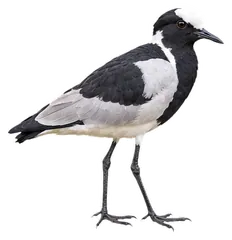 Blacksmith LapwingVanellus armatus
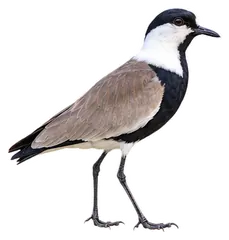 Spur-winged LapwingVanellus spinosus
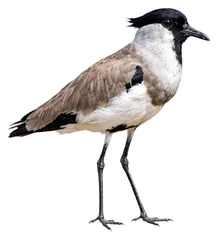 River LapwingVanellus duvaucelii
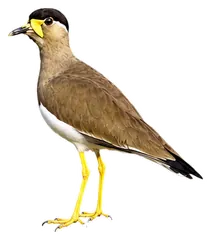 Yellow-wattled LapwingVanellus malabaricus
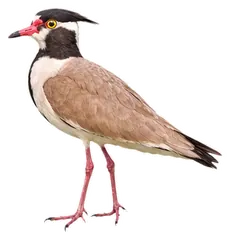 Black-headed LapwingVanellus tectus
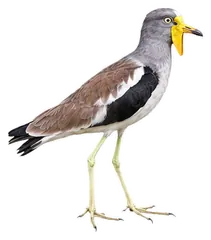 White-crowned LapwingVanellus albiceps
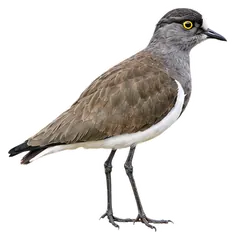 Senegal LapwingVanellus lugubris
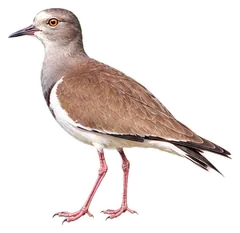 Black-winged LapwingVanellus melanopterus
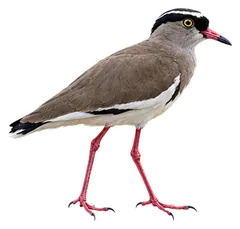 Crowned LapwingVanellus coronatus
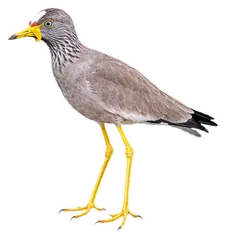 African Wattled LapwingVanellus senegallus
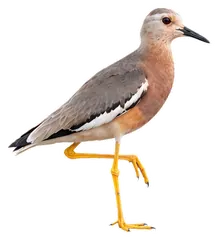
Download illustration
Free to use with credit: “Illustration: Bird Album (birdalbum.com)”. Drawn by AI from a reference photo by photokeen. ↗
Heard it but can't see it? Mingji identifies birds by sound and photo, on your phone.