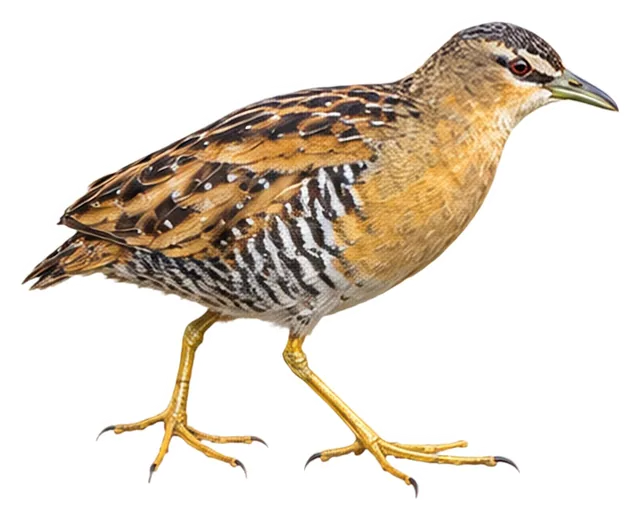
Yellow-breasted Crake
Laterallus flaviventer (Boddaert, 1783)
12–14 cmLength25 gWeight
Busiest months: February · Most records: Costa Rica, Puerto Rico, Brazil
Where and when it's recorded
Busiest months: February · Most records: Costa Rica, Puerto Rico, Brazil

Yellow-breasted Crake has been recorded at 94 of the 8,276 birding hotspots we track, in 21 countries and regions.
Records by month Northern Hemisphere
Where it's recorded most
- Medio Queso wetlandCosta Rica854 records
- Refugio mixto Caño NegroCosta Rica688 records
- Laguna Cartagena - West EndPuerto Rico228 records
More places
- Piracicaba – TanquãBrazil174 records
- Ammo Dump PondsPanama102 records
- Reserva Natural Laguna CartagenaPuerto Rico94 records
- Crooked Tree Wildlife Sanctuary – Northern LagoonBelize70 records
- Coto 47 – Las PangasCosta Rica63 records
- Lago de Yojoa – Sendero Acuático El CanalHonduras49 records
- Lago de Yojoa – Sector Cortijo del LagoHonduras43 records
Countries and regions with the most records
eBird records via GBIF up to 2024-12-31. A record means someone listed it; more records partly mean more birders, not more birds.
Questions
How big is the Yellow-breasted Crake?
The Yellow-breasted Crake is about 12–14 cm long and weighs around 25 g.
Where does the Yellow-breasted Crake live?
Its breeding range: North America, Middle America, South America: Caribbean and southern Mexico to southeastern South America. It is most often recorded in Costa Rica, Puerto Rico and Brazil.
When is the best time to see the Yellow-breasted Crake?
At the hotspots we track, it is recorded most in February (Northern Hemisphere).
Is the Yellow-breasted Crake endangered?
The IUCN Red List classifies the Yellow-breasted Crake as Least Concern.
What does the Yellow-breasted Crake eat?
Main food: Fish, shrimp & shellfish.
What family is the Yellow-breasted Crake in?
It belongs to the family Rails, Crakes & Coots (Rallidae), order Gruiformes.
At a glance
- Length
- 12–14 cm
- Weight
- 25 g
- Habitat
- Wetland
- Diet
- Fish, shrimp & shellfish
- Lifestyle
- Active on the ground
- Migration
- Partial migrant
- Conservation
- Least Concern
More measurements
- Wing
- 66 mm
- Tail
- 28 mm
- Bill
- 17 mm
- Tarsus
- 22 mm
Averages from the AVONET dataset; length from field guides where available.
Range
North America, Middle America, South America: Caribbean and southern Mexico to southeastern South America
Breeding range, IOC World Bird List 15.2
Classification
- Order
- Gruiformes
- Family
- Rails, Crakes & Coots Rallidae
- Genus
- Laterallus
Other birds in the genus Laterallus
 Speckled RailLaterallus notatus
 Dot-winged CrakeLaterallus spiloptera
 Inaccessible Island RailLaterallus rogersi
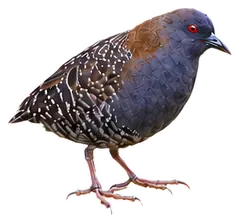 Black RailLaterallus jamaicensis
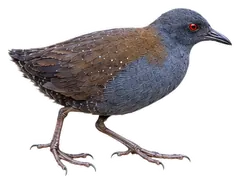 Galapagos CrakeLaterallus spilonota
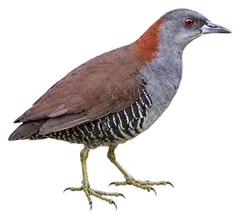 Grey-breasted CrakeLaterallus exilis
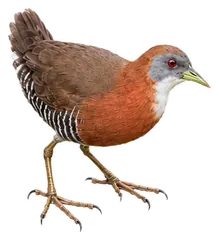 White-throated CrakeLaterallus albigularis
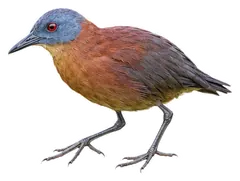 Ruddy CrakeLaterallus ruber
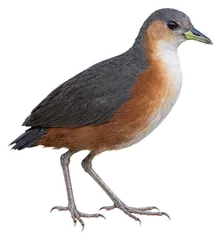 Rusty-flanked CrakeLaterallus levraudi
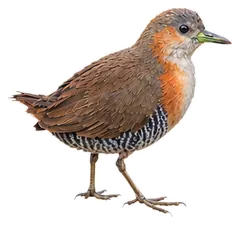 Rufous-sided CrakeLaterallus melanophaius
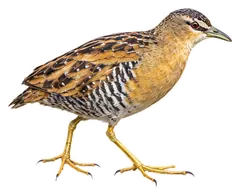
Download illustration
Free to use with credit: “Illustration: Bird Album (birdalbum.com)”. Drawn by AI from a reference photo by Eduardo Borges. ↗
Heard it but can't see it? Mingji identifies birds by sound and photo, on your phone.
In other languages
- EnglishYellow-breasted Crake
- 简体中文黄胸田鸡
- 繁體中文黃胸田雞
- 日本語キムネヒメクイナ
- DeutschGelbbrust-Sumpfhuhn
- FrançaisRâle à sourcils blancs
- EspañolPolluela pálida
- Portuguêssanã-amarela
- ItalianoSchiribilla pettogiallo
- NederlandsGeelbuikporseleinhoen
- РусскийЖелтогрудый погоныш
- Svenskagulbröstad dvärgrall
- DanskGulbrystet Rørvagtel
- Polskiderkaczyk żółtawy