 Bird Album
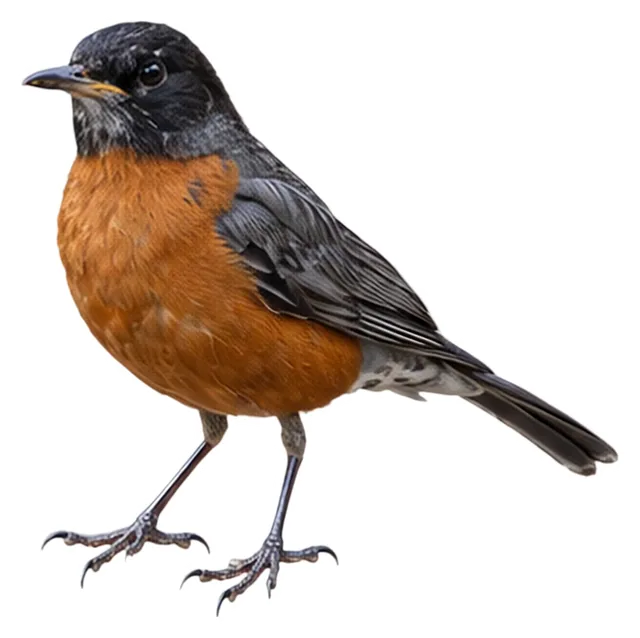
American Robin
Turdus migratorius Linnaeus, 1766
23–28 cmLength31–41 cmWingspan78 gWeight
This thrush has an orange-red breast and a yellow bill, and begins singing at dawn.
Busiest months: May · Most records: United States, Canada, Mexico
How to identify
Field marks
- Adult has a reddish-brown to orange-red breast
- Bill mainly yellow with a dark tip
- Head ink-black to gray, with white eye arcs and a white supercilium
- White throat with black stripes
Male, female and young
Female is usually darker than male, with brown on the head and upperparts; juvenile is paler than adult male, with dark breast spots.
Voice
Male sings a cheerful series of short phrases, often repeated with brief pauses between them, usually from high branches.
Where and when it's recorded
Busiest months: May · Most records: United States, Canada, Mexico

American Robin has been recorded at 797 of the 8,276 birding hotspots we track, in 8 countries and regions.
Records by month Northern Hemisphere
Where it's recorded most
- Montrose Point Bird Sanctuary, Lincoln Park, ChicagoUnited States41,201 records
- Prospect ParkUnited States38,384 records
- Central ParkUnited States38,163 records
More places
- Magee Marsh – BoardwalkUnited States31,313 records
- Parker River NWRUnited States30,709 records
- John Heinz NWR – impoundmentUnited States24,207 records
- Point Pelee National ParkCanada23,193 records
- Mount Auburn CemeteryUnited States21,813 records
- Union Bay Natural Area/Montlake FillUnited States21,366 records
- Central Park – The RambleUnited States18,852 records
Countries and regions with the most records
eBird records via GBIF up to 2024-12-31. A record means someone listed it; more records partly mean more birders, not more birds.
About
The American robin (Turdus migratorius) is a migratory bird of the true thrush genus and Turdidae, the wider thrush family. It is named after the European robin because of its reddish-orange breast, though the two species are not closely related, with the European robin belonging to the Old World flycatcher family. The American robin is widely distributed throughout North America, wintering from southern Canada to central Mexico and along the Pacific coast.
Excerpt from Wikipedia, CC BY-SA 4.0 · authors · Read more on Wikipedia
Questions
How big is the American Robin?
The American Robin is about 23–28 cm long, with a wingspan of 31–41 cm and weighs around 78 g.
Where does the American Robin live?
Its breeding range: North America, Middle America: Alaska and Canada to Guatemala. It is most often recorded in United States, Canada and Mexico.
When is the best time to see the American Robin?
At the hotspots we track, it is recorded most in May (Northern Hemisphere).
Is the American Robin endangered?
The IUCN Red List classifies the American Robin as Least Concern.
What does the American Robin eat?
Main food: Insects & other invertebrates.
What family is the American Robin in?
It belongs to the family Thrushes (Turdidae), order Passerines (Passeriformes).
At a glance
- Length
- 23–28 cm
- Wingspan
- 31–41 cm
- Weight
- 78 g
- Habitat
- Forest
- Diet
- Insects & other invertebrates
- Lifestyle
- Varied
- Migration
- Migratory
- Conservation
- Least Concern
More measurements
- Wing
- 127 mm
- Tail
- 96 mm
- Bill
- 23 mm
- Tarsus
- 33 mm
Averages from the AVONET dataset; length from field guides where available.
Range
North America, Middle America: Alaska and Canada to Guatemala
Breeding range, IOC World Bird List 15.2
Classification
- Order
- Passerines Passeriformes
- Family
- Thrushes Turdidae
- Genus
- Turdus
Other birds in the genus Turdus
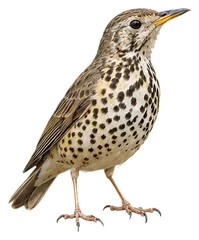 Ethiopian ThrushTurdus simensis
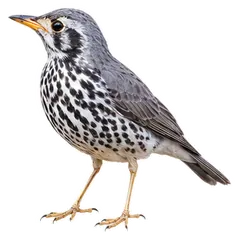 Groundscraper ThrushTurdus litsitsirupa
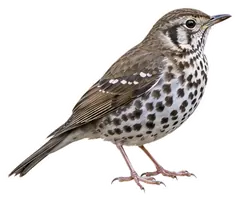 Chinese ThrushTurdus mupinensis
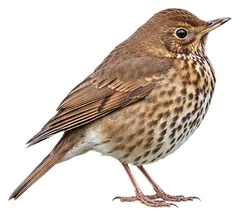 Song ThrushTurdus philomelos
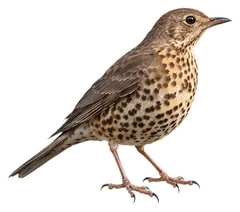 Mistle ThrushTurdus viscivorus
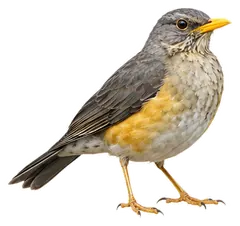 African ThrushTurdus pelios
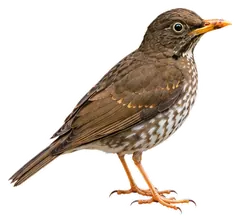 Principe ThrushTurdus xanthorhynchus
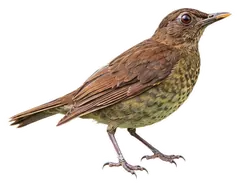 Sao Tome ThrushTurdus olivaceofuscus
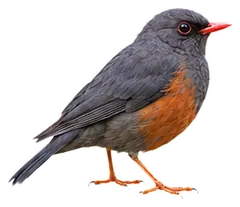 Abyssinian ThrushTurdus abyssinicus
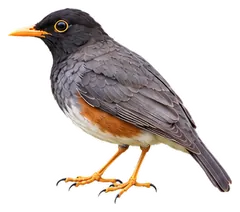 Taita ThrushTurdus helleri
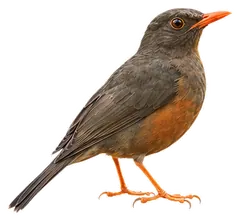 Usambara ThrushTurdus roehli
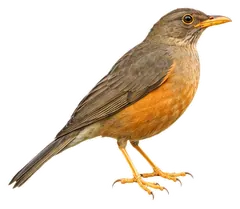 Olive ThrushTurdus olivaceus
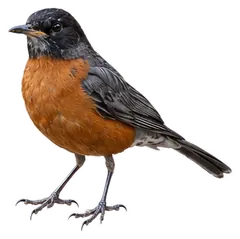
Download illustration
Free to use with credit: “Illustration: Bird Album (birdalbum.com)”. Drawn by AI from a reference photo by J Hilliard. ↗
Heard it but can't see it? Mingji identifies birds by sound and photo, on your phone.