 Bird Album
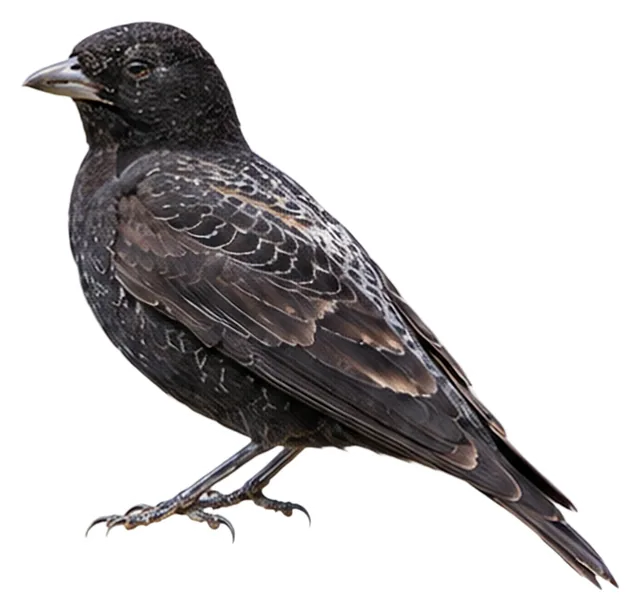
Black Lark
Melanocorypha yeltoniensis (Forster, JR, 1768)
18–20 cmLength60 gWeight
The male is entirely black, with a pale yellow or pink bill.
Busiest months: May · Most records: Kazakhstan, China, Azerbaijan
How to identify
Field marks
- Male all black, with pale edges to the back feathers
- Male has a pale yellow or pink bill
- Female has a gray back with dark patches
- Female has black legs and feet and black underwings
Male, female and young
Male black overall; female has gray upperparts with dark patches and paler underparts.
Voice
Song resembles that of Eurasian Skylark, but with a more rapid rhythm.
Where and when it's recorded

Black Lark has been recorded at 10 of the 8,276 birding hotspots we track, in 3 countries and regions.
Records by month Northern Hemisphere
Where it's recorded most
- Korgalzhyn Village – General Area;Kazakhstan73 records
- Maishukur Village – Lake 1Kazakhstan55 records
- Korgalzhyn NWRKazakhstan43 records
More places
- KiziltamaqChina22 records
- Besh Barmag bottleneckAzerbaijan3 records
- Karasu River – From P-2Kazakhstan2 records
- Tengiz – South Evaporation PondsKazakhstan2 records
- Shirvan NPAzerbaijan1 record
- KanshengelKazakhstan1 record
- Kulustay GrasslandChina1 record
Countries and regions with the most records
eBird records via GBIF up to 2024-12-31. A record means someone listed it; more records partly mean more birders, not more birds.
About
The black lark (Melanocorypha yeltoniensis) is a species of lark in the family Alaudidae found in south-eastern Russia and Kazakhstan.
Excerpt from Wikipedia, CC BY-SA 4.0 · authors · Read more on Wikipedia
Questions
How big is the Black Lark?
The Black Lark is about 18–20 cm long and weighs around 60 g.
Where does the Black Lark live?
Its breeding range: Palearctic: southern Russia and Kazakhstan. It is most often recorded in Kazakhstan, China and Azerbaijan.
When is the best time to see the Black Lark?
At the hotspots we track, it is recorded most in May (Northern Hemisphere).
Is the Black Lark endangered?
The IUCN Red List classifies the Black Lark as Least Concern.
What does the Black Lark eat?
Main food: Omnivore.
What family is the Black Lark in?
It belongs to the family Larks (Alaudidae), order Passerines (Passeriformes).
At a glance
- Length
- 18–20 cm
- Weight
- 60 g
- Habitat
- Grassland
- Diet
- Omnivore
- Lifestyle
- Active on the ground
- Migration
- Partial migrant
- Conservation
- Least Concern
More measurements
- Wing
- 126 mm
- Tail
- 71 mm
- Bill
- 18 mm
- Tarsus
- 24 mm
Averages from the AVONET dataset; length from field guides where available.
Range
Palearctic: southern Russia and Kazakhstan
Breeding range, IOC World Bird List 15.2
Classification
- Order
- Passerines Passeriformes
- Family
- Larks Alaudidae
- Genus
- Melanocorypha
Other birds in the genus Melanocorypha
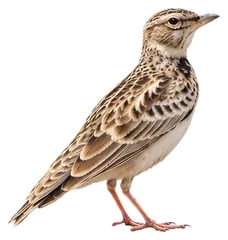 Bimaculated LarkMelanocorypha bimaculata
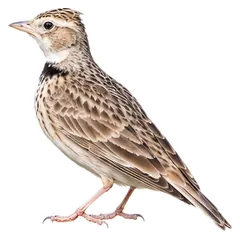 Calandra LarkMelanocorypha calandra
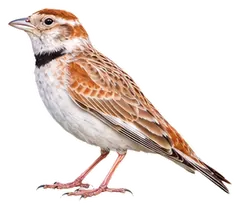 Mongolian LarkMelanocorypha mongolica
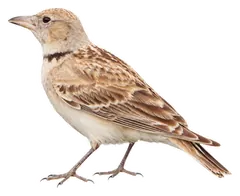 Tibetan LarkMelanocorypha maxima
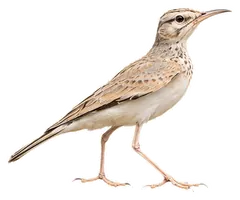 Greater Hoopoe-LarkAlaemon alaudipes
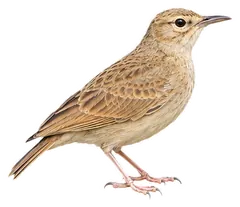 Lesser Hoopoe-LarkAlaemon hamertoni
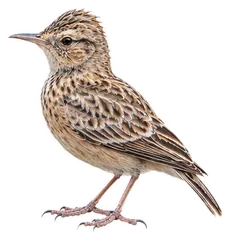 Beesley's LarkChersomanes beesleyi
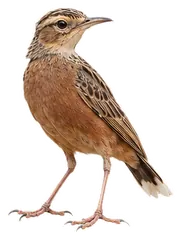 Spike-heeled LarkChersomanes albofasciata
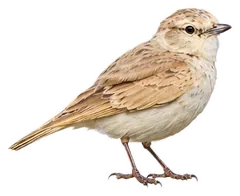 Gray's LarkAmmomanopsis grayi
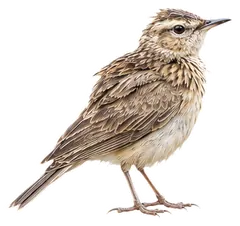 Short-clawed LarkCerthilauda chuana
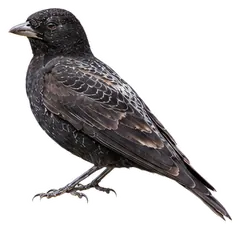
Download illustration
Free to use with credit: “Illustration: Bird Album (birdalbum.com)”. Drawn by AI from a reference photo by Sergey Alexeyev. ↗
Heard it but can't see it? Mingji identifies birds by sound and photo, on your phone.