 Bird Album
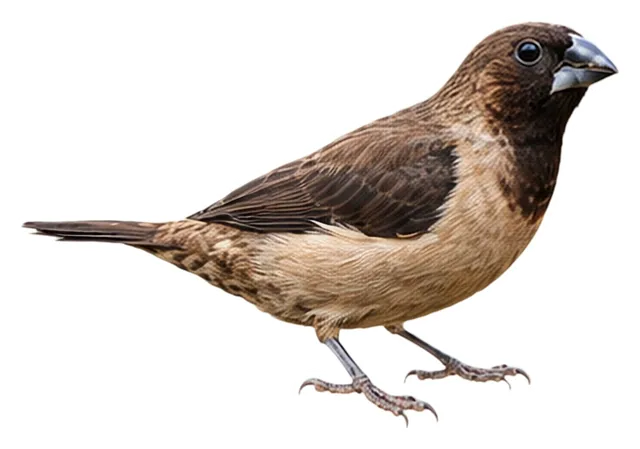
Black-throated Munia
Lonchura kelaarti (Jerdon, 1863)
14 gWeight
The black-throated munia or Jerdon's mannikin (Lonchura kelaarti) is a small passerine bird.
Busiest months: November–February · Most records: India, Sri Lanka
Where and when it's recorded

Black-throated Munia has been recorded at 44 of the 8,171 birding hotspots we track, in 2 countries and regions.
Records by month Northern Hemisphere
Where it's recorded most
- College of Veterinary and Animal Sciences, PookodeIndia418 records
- Thattekkad Bird SanctuaryIndia238 records
- Thattekad Bird Sanctuary – UrulanthanniIndia174 records
More places
- Sinharaja Forest ReserveSri Lanka150 records
- Bondla Wildlife SanctuaryIndia107 records
- Horton Plains National ParkSri Lanka76 records
- Sinharaja – Kudawa Village areaSri Lanka69 records
- Sinharaja NP – Kudawa accessSri Lanka69 records
- KitulgalaSri Lanka36 records
- Kitulgala – Kelani Valley/Makandawa Forest ReserveSri Lanka29 records
Countries and regions with the most records
eBird records via GBIF up to 2024-12-31. A record means someone listed it; more records partly mean more birders, not more birds.
About
The black-throated munia or Jerdon's mannikin (Lonchura kelaarti) is a small passerine bird. This estrildid finch is a resident breeding bird in the hills of southwest India, the Western Ghats, Eastern Ghats and Sri Lanka.
Excerpt from Wikipedia, CC BY-SA 4.0 · authors · Read more on Wikipedia
Questions
How big is the Black-throated Munia?
The Black-throated Munia weighs around 14 g.
Where does the Black-throated Munia live?
Its breeding range: Oriental: India and Sri Lanka. It is most often recorded in India and Sri Lanka.
When is the best time to see the Black-throated Munia?
At the hotspots we track, it is recorded most in January, February, November and December (Northern Hemisphere).
Is the Black-throated Munia endangered?
The IUCN Red List classifies the Black-throated Munia as Least Concern.
What does the Black-throated Munia eat?
Main food: Seeds.
What family is the Black-throated Munia in?
It belongs to the family Waxbills, Munias & Allies (Estrildidae), order Passerines (Passeriformes).
At a glance
- Weight
- 14 g
- Habitat
- Shrubland
- Diet
- Seeds
- Lifestyle
- Perches in trees
- Migration
- Resident (barely migrates)
- Conservation
- Least Concern
More measurements
- Wing
- 54 mm
- Tail
- 39 mm
- Bill
- 14 mm
- Tarsus
- 14 mm
Averages from the AVONET dataset; length from field guides where available.
Range
Oriental: India and Sri Lanka
Breeding range, IOC World Bird List 15.2
Classification
- Order
- Passerines Passeriformes
- Family
- Waxbills, Munias & Allies Estrildidae
- Genus
- Lonchura
Other birds in the genus Lonchura
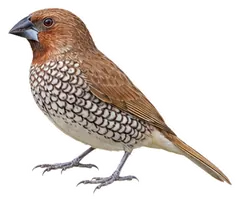 Scaly-breasted MuniaLonchura punctulata
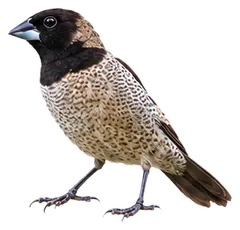 Black-faced MuniaLonchura molucca
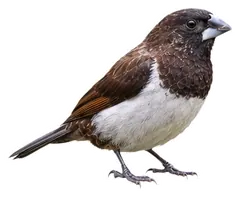 White-rumped MuniaLonchura striata
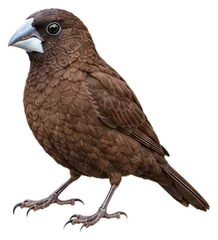 Dusky MuniaLonchura fuscans
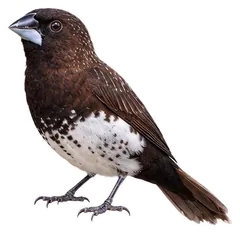 White-bellied MuniaLonchura leucogastra
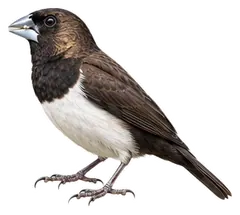 Javan MuniaLonchura leucogastroides
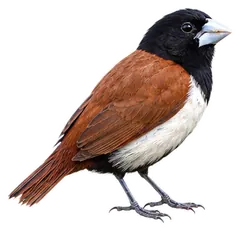 Tricolored MuniaLonchura malacca
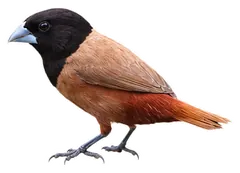 Chestnut MuniaLonchura atricapilla
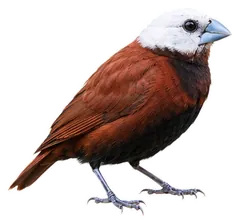 White-capped MuniaLonchura ferruginosa
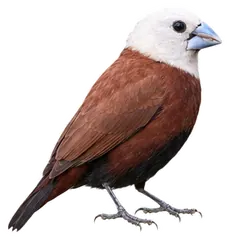 White-headed MuniaLonchura maja
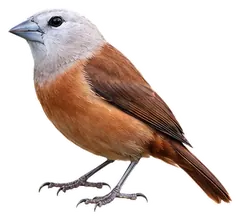 Pale-headed MuniaLonchura pallida
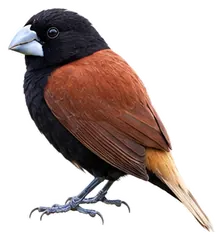 Great-billed MannikinLonchura grandis
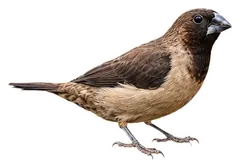
Download illustration
Free to use with credit: “Illustration: Bird Album (birdalbum.com)”. Drawn by AI from a reference photo by Melvin Jaison. ↗
Heard it but can't see it? Mingji identifies birds by sound and photo, on your phone.
In other languages
- EnglishBlack-throated Munia
- 简体中文红胸文鸟
- 繁體中文紅腹文鳥
- 日本語チャイロキンパラ
- DeutschBergbronzemännchen
- FrançaisCapucin à ventre roux
- EspañolCapuchino golinegro
- Portuguêscapuchinho-de-garganta-preta
- ItalianoMunia golanera
- NederlandsZwartkeelbronzemannetje
- РусскийЧернозобая муния
- Svenskasvartstrupig munia
- DanskJerdon´ Bronzefinke
- Polskimniszka marmurkowa