 Bird Album
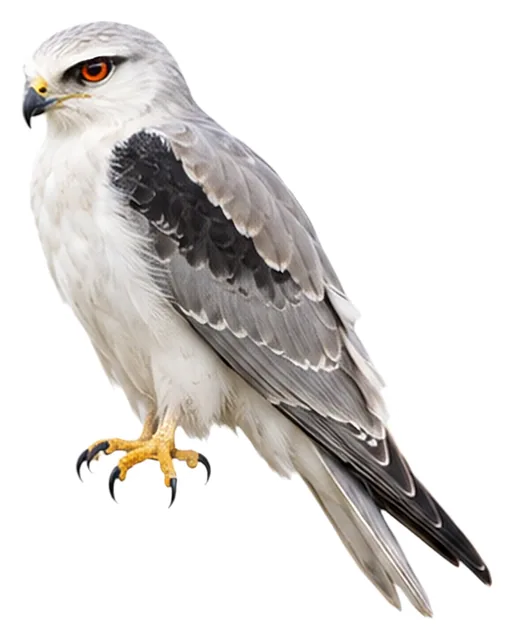
Black-winged Kite
Elanus caeruleus (Desfontaines, 1789)
≈40 cmLength83 cmWingspan260 gWeight
It has a grayish-white body, black scapulars and wingtips, forward-facing red eyes, and often hovers.
Busiest months: October–January · Most records: India, China, Portugal
How to identify
Field marks
- Body grayish-white, with black patches on scapulars and wingtips
- Black eyestripe; eyes face forward, iris red
- Wingtips extend beyond tail when perched
- Tail short and square, not forked
Male, female and young
Sexes alike in plumage; immature has rufous tones.
Voice
Vocalizations are high and thin.
Where and when it's recorded
Busiest months: October–January · Most records: India, China, Portugal

Black-winged Kite has been recorded at 1,965 of the 8,276 birding hotspots we track, in 93 countries and regions.
Records by month Northern Hemisphere
Where it's recorded most
- Lezíria Grande de Vila Franca de Xira – área geralPortugal2,899 records
- Bharatpur – Keoladeo Ghana NPIndia1,545 records
- Poleg MarshIsrael1,418 records
More places
- Strandfontein WTPSouth Africa1,406 records
- Nairobi NPKenya1,403 records
- Hama'apil FishpondsIsrael1,374 records
- Aogu Wetland IBATaiwan (China)1,283 records
- La Janda – ÁreaSpain1,203 records
- Taipei – Beitou Guizikeng Drainage CanalTaiwan (China)1,080 records
- Hoskote / Hosakote KereIndia1,061 records
Countries and regions with the most records
eBird records via GBIF up to 2024-12-31. A record means someone listed it; more records partly mean more birders, not more birds.
About
The black-winged kite (Elanus caeruleus), also known as the black-shouldered kite (not to be confused with the closely related Australian species of the same name), is a small diurnal bird of prey in the family Accipitridae best known for its habit of hovering over open grasslands in the manner of the much smaller kestrels. This Palearctic and Afrotropical species was sometimes combined with the Australian black-shouldered kite (Elanus axillaris) and the white-tailed kite (Elanus leucurus) of North and South America which together form a superspecies.
Excerpt from Wikipedia, CC BY-SA 4.0 · authors · Read more on Wikipedia
Questions
How big is the Black-winged Kite?
The Black-winged Kite is about ≈40 cm long, with a wingspan of 83 cm and weighs around 260 g.
Where does the Black-winged Kite live?
Its breeding range: Palearctic, Africa, Oriental, Australasia: widespread. It is most often recorded in India, China and Portugal.
When is the best time to see the Black-winged Kite?
At the hotspots we track, it is recorded most in January, October, November and December (Northern Hemisphere).
Is the Black-winged Kite endangered?
The IUCN Red List classifies the Black-winged Kite as Least Concern.
What does the Black-winged Kite eat?
Main food: Vertebrate prey.
What family is the Black-winged Kite in?
It belongs to the family Kites, Hawks, Eagles (Accipitridae), order Accipitriformes.
At a glance
- Length
- ≈40 cm
- Wingspan
- 83 cm
- Weight
- 260 g
- Habitat
- Grassland
- Diet
- Vertebrate prey
- Lifestyle
- Feeds in the air
- Migration
- Partial migrant
- Conservation
- Least Concern
More measurements
- Wing
- 286 mm
- Tail
- 128 mm
- Bill
- 31 mm
- Tarsus
- 32 mm
Averages from the AVONET dataset; length from field guides where available.
Range
Palearctic, Africa, Oriental, Australasia: widespread
Breeding range, IOC World Bird List 15.2
Subspecies · 1
- Elanus caeruleus vociferus Pakistan to e China, Malay Pen. and Indochina
Classification
- Order
- Accipitriformes
- Family
- Kites, Hawks, Eagles Accipitridae
- Genus
- Elanus
Other birds in the genus Elanus
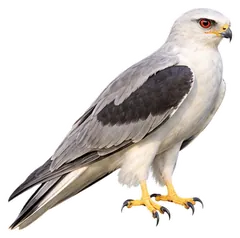 White-tailed KiteElanus leucurus
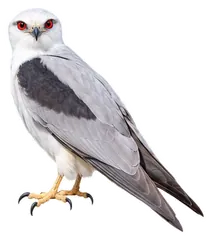 Black-shouldered KiteElanus axillaris
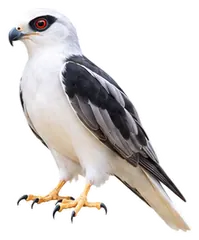 Letter-winged KiteElanus scriptus
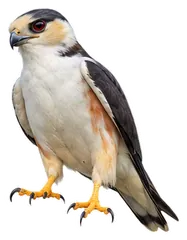 Pearl KiteGampsonyx swainsonii
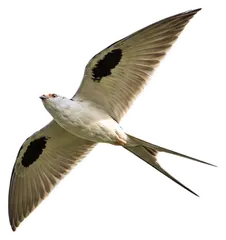 Scissor-tailed KiteChelictinia riocourii
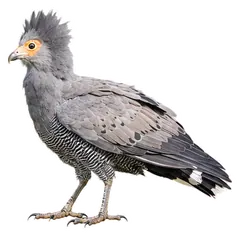 African Harrier-HawkPolyboroides typus
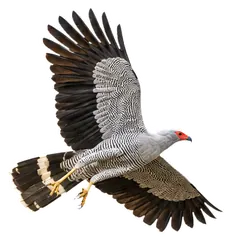 Madagascar Harrier-HawkPolyboroides radiatus
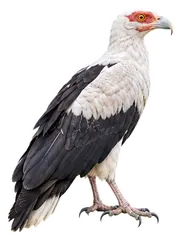 Palm-nut VultureGypohierax angolensis
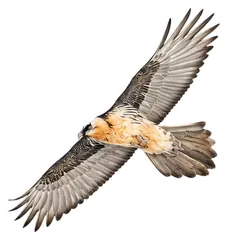 Bearded VultureGypaetus barbatus
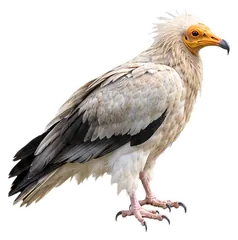 Egyptian VultureNeophron percnopterus
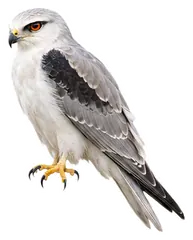
Download illustration
Free to use with credit: “Illustration: Bird Album (birdalbum.com)”. Drawn by AI from a reference photo by Tisha Mukherjee. ↗

Heard it but can't see it? Mingji identifies birds by sound and photo, on your phone.