 Bird Album
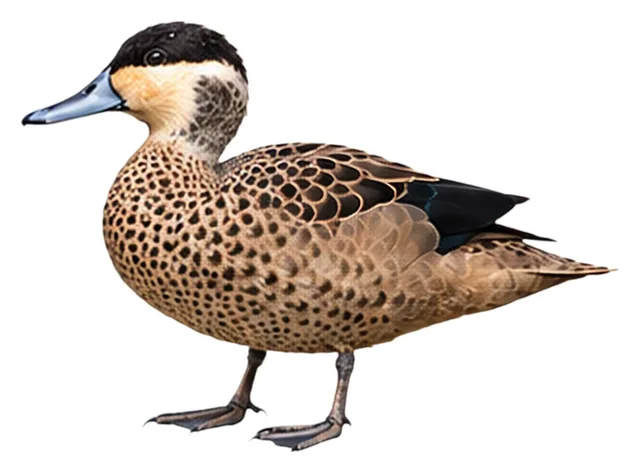
Blue-billed Teal
Spatula hottentota (Eyton, 1838)
276 gWeight
The blue-billed teal (Spatula hottentota), also sometimes called spotted teal and formerly Hottentot teal, is a species of dabbling duck of the genus Spatula.
Busiest months: October–November · Most records: South Africa, Kenya, Tanzania
Where and when it's recorded
Busiest months: October–November · Most records: South Africa, Kenya, Tanzania

Blue-billed Teal has been recorded at 244 of the 8,276 birding hotspots we track, in 22 countries and regions.
Records by month Southern Hemisphere
Where it's recorded most
- Marievale Bird SanctuarySouth Africa1,050 records
- Parc de TsarasaotraMadagascar903 records
- Strandfontein WTPSouth Africa821 records
More places
- Ngorongoro Conservation Area – Ngorongoro CraterTanzania763 records
- Amboseli NPKenya590 records
- Lake Nakuru NPKenya562 records
- Macaneta – Wetland, dune forests and coastMozambique312 records
- Manguo SwampKenya298 records
- Lake NaivashaKenya263 records
- Pietermaritzburg – Darvill Resources ParkSouth Africa253 records
Countries and regions with the most records
eBird records via GBIF up to 2024-12-31. A record means someone listed it; more records partly mean more birders, not more birds.
About
The blue-billed teal (Spatula hottentota), also sometimes called spotted teal and formerly Hottentot teal, is a species of dabbling duck of the genus Spatula. It is resident in eastern, southern, and western Africa, from Sudan and Ethiopia west to Niger and Nigeria, and south to South Africa and Namibia, and also in Madagascar. It is generally sedentary, but shows nomadic behaviour in response to water requirements, moving away if drought causes wetlands to dry out.
Excerpt from Wikipedia, CC BY-SA 4.0 · authors · Read more on Wikipedia
Questions
How big is the Blue-billed Teal?
The Blue-billed Teal weighs around 276 g.
Where does the Blue-billed Teal live?
Its breeding range: Africa: Nigeria to Ethiopia and south to South Africa, Madagascar. It is most often recorded in South Africa, Kenya and Tanzania.
When is the best time to see the Blue-billed Teal?
At the hotspots we track, it is recorded most in October and November (Southern Hemisphere).
Is the Blue-billed Teal endangered?
The IUCN Red List classifies the Blue-billed Teal as Least Concern.
What does the Blue-billed Teal eat?
Main food: Omnivore.
What family is the Blue-billed Teal in?
It belongs to the family Ducks, Geese, Swans (Anatidae), order Anseriformes.
At a glance
- Weight
- 276 g
- Habitat
- Wetland
- Diet
- Omnivore
- Lifestyle
- Varied
- Migration
- Resident (barely migrates)
- Conservation
- Least Concern
More measurements
- Wing
- 147 mm
- Tail
- 62 mm
- Bill
- 36 mm
- Tarsus
- 23 mm
Averages from the AVONET dataset; length from field guides where available.
Range
Africa: Nigeria to Ethiopia and south to South Africa, Madagascar
Breeding range, IOC World Bird List 15.2
Classification
- Order
- Anseriformes
- Family
- Ducks, Geese, Swans Anatidae
- Genus
- Spatula
Other birds in the genus Spatula
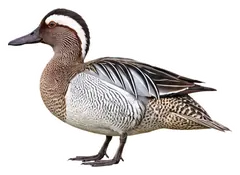 GarganeySpatula querquedula
 Puna TealSpatula puna
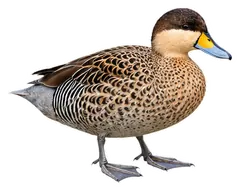 Silver TealSpatula versicolor
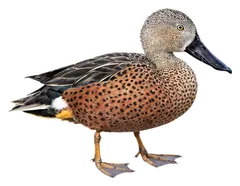 Red ShovelerSpatula platalea
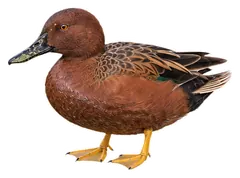 Cinnamon TealSpatula cyanoptera
 Blue-winged TealSpatula discors
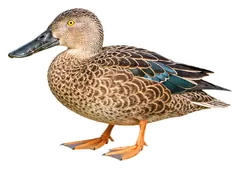 Cape ShovelerSpatula smithii
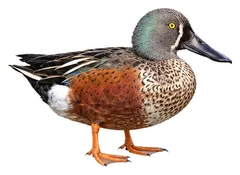 Australasian ShovelerSpatula rhynchotis
 Northern ShovelerSpatula clypeata
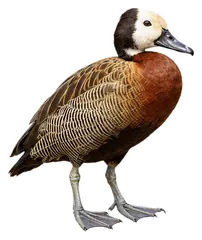 White-faced Whistling DuckDendrocygna viduata
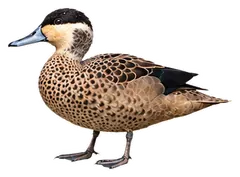
Download illustration
Free to use with credit: “Illustration: Bird Album (birdalbum.com)”. Drawn by AI from a reference photo by Roy Holtzkampf. ↗
Heard it but can't see it? Mingji identifies birds by sound and photo, on your phone.