 Bird Album
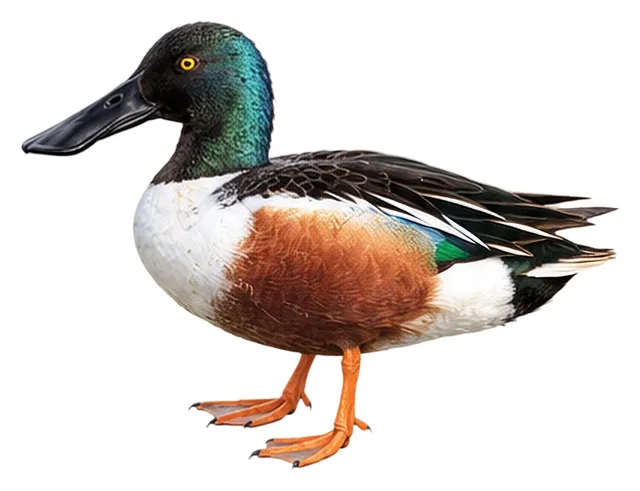
Northern Shoveler
Spatula clypeata (Linnaeus, 1758)
≈45 cmLength613 gWeight
It has a long, broad, shovel-like bill, and the male has a green head, white breast and chestnut belly.
Busiest months: January and March–April · Most records: United States, Canada, United Kingdom
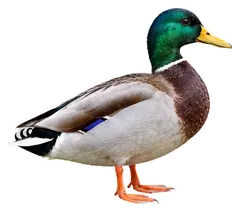
Looks like Mallard
How to identify
Field marks
- Bill large and long, with a broad, shovel-like tip
- Male has a dark green head and neck with a metallic gloss
- Male has a white breast and chestnut belly and flanks
- Male shows pale gray-blue wing coverts contrasting with a green speculum in flight
Male, female and young
Female mottled brown with a whitish tail and dark eyestripe.
Voice
Male gives a muffled “clunk”-like sound; female gives quacking calls like Mallard.
Similar species
Where and when it's recorded
Busiest months: January and March–April · Most records: United States, Canada, United Kingdom

Northern Shoveler has been recorded at 3,201 of the 8,276 birding hotspots we track, in 154 countries and regions.
Records by month Northern Hemisphere
Where it's recorded most
- Estero Llano Grande SP WBCUnited States24,553 records
- Sweetwater WetlandsUnited States21,294 records
- Riparian Preserve at Gilbert Water RanchUnited States20,718 records
More places
- Union Bay Natural Area/Montlake FillUnited States17,532 records
- Hornsby BendUnited States16,465 records
- Reifel Bird SanctuaryCanada15,875 records
- Billy Frank Jr. Nisqually NWRUnited States13,435 records
- Prospect ParkUnited States13,332 records
- Leonabelle Turnbull Birding Ctr.United States13,174 records
- Santa Ana NWRUnited States12,637 records
Countries and regions with the most records
eBird records via GBIF up to 2024-12-31. A record means someone listed it; more records partly mean more birders, not more birds.
About
The northern shoveler (Spatula clypeata), often known simply as the shoveler where other related species do not occur, is a common and widespread duck. It breeds in northern areas of Europe and throughout the Palearctic and across most of North America, and winters in southern Europe, the Indian subcontinent, Southeast Asia, Central America, the Caribbean, and northern South America. It is a rare vagrant to Australia.
Excerpt from Wikipedia, CC BY-SA 4.0 · authors · Read more on Wikipedia
Questions
How big is the Northern Shoveler?
The Northern Shoveler is about ≈45 cm long and weighs around 613 g.
Where does the Northern Shoveler live?
Its breeding range: North America, Palearctic: widespread. It is most often recorded in United States, Canada and United Kingdom.
When is the best time to see the Northern Shoveler?
At the hotspots we track, it is recorded most in January, March and April (Northern Hemisphere).
Is the Northern Shoveler endangered?
The IUCN Red List classifies the Northern Shoveler as Least Concern.
What does the Northern Shoveler eat?
Main food: Fish, shrimp & shellfish.
What family is the Northern Shoveler in?
It belongs to the family Ducks, Geese, Swans (Anatidae), order Anseriformes.
At a glance
- Length
- ≈45 cm
- Weight
- 613 g
- Habitat
- Wetland
- Diet
- Fish, shrimp & shellfish
- Lifestyle
- On the water surface
- Migration
- Migratory
- Conservation
- Least Concern
More measurements
- Wing
- 226 mm
- Tail
- 75 mm
- Bill
- 69 mm
- Tarsus
- 34 mm
Averages from the AVONET dataset; length from field guides where available.
Range
North America, Palearctic: widespread
Breeding range, IOC World Bird List 15.2
Classification
- Order
- Anseriformes
- Family
- Ducks, Geese, Swans Anatidae
- Genus
- Spatula
Other birds in the genus Spatula
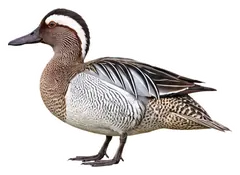 GarganeySpatula querquedula
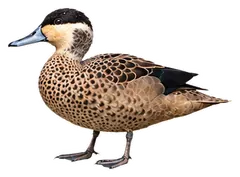 Blue-billed TealSpatula hottentota
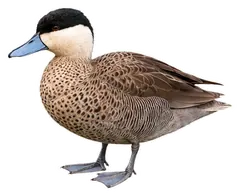 Puna TealSpatula puna
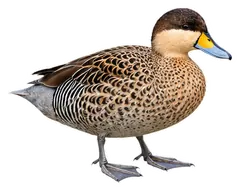 Silver TealSpatula versicolor
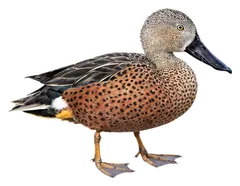 Red ShovelerSpatula platalea
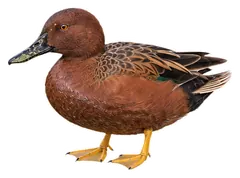 Cinnamon TealSpatula cyanoptera
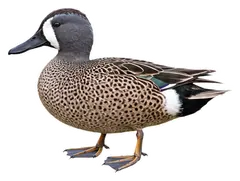 Blue-winged TealSpatula discors
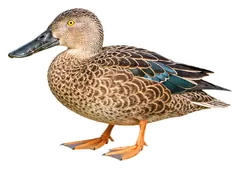 Cape ShovelerSpatula smithii
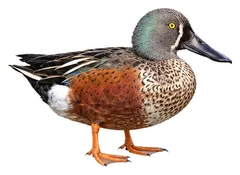 Australasian ShovelerSpatula rhynchotis
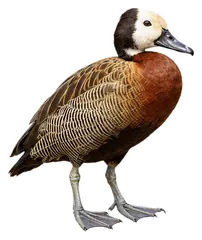 White-faced Whistling DuckDendrocygna viduata
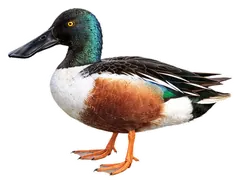
Download illustration
Free to use with credit: “Illustration: Bird Album (birdalbum.com)”. Drawn by AI from a reference photo by Luiz Lapa. ↗

Heard it but can't see it? Mingji identifies birds by sound and photo, on your phone.