 Bird Album
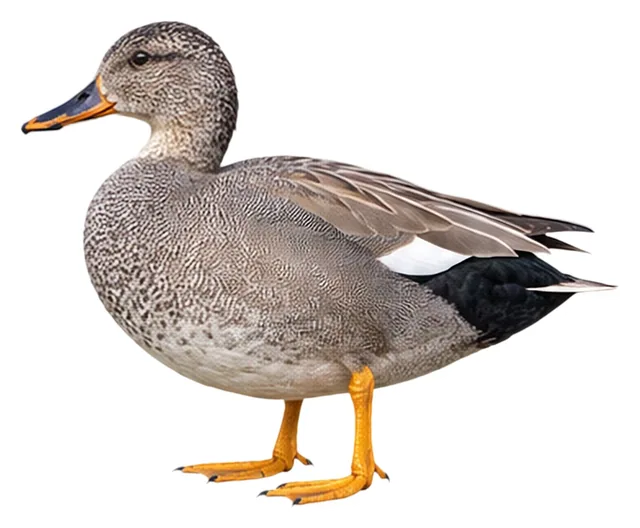
Gadwall
Mareca strepera (Linnaeus, 1758)
47–58 cmLength78–90 cmWingspan916 gWeight
In the breeding season, the male is gray with a black rear, and its white speculum is conspicuous even at rest.
Busiest months: March–May · Most records: United States, Canada, United Kingdom
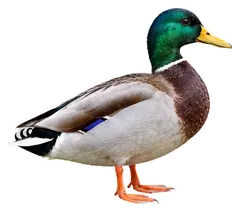
Looks like Mallard
How to identify
Field marks
- Male in the breeding season has a patterned gray body
- Male in the breeding season has a black tail area
- Male has pale chestnut wings and a conspicuous white speculum
Male, female and young
Female pale brown with deep orange bill edges; male in the non-breeding season resembles female.
Voice
Usually quiet; female’s quacking is sharper than female Mallard’s; male gives a low humming “mep” and whistles.
Similar species
Where and when it's recorded

Gadwall has been recorded at 2,752 of the 8,171 birding hotspots we track, in 110 countries and regions.
Records by month Northern Hemisphere
Where it's recorded most
- Union Bay Natural Area/Montlake FillUnited States22,993 records
- Parker River NWRUnited States20,443 records
- Tommy Thompson ParkCanada16,077 records
More places
- Reifel Bird SanctuaryCanada15,223 records
- Estero Llano Grande SP WBCUnited States15,170 records
- Sweetwater WetlandsUnited States15,101 records
- IRWD San Joaquin Marsh & Wildlife Sanctuary, IrvineUnited States14,016 records
- Cape Island – South Cape May MeadowsUnited States13,971 records
- Cape Island – Cape May Point SPUnited States12,930 records
- Toronto – Colonel Samuel Smith ParkCanada10,536 records
Countries and regions with the most records
eBird records via GBIF up to 2024-12-31. A record means someone listed it; more records partly mean more birders, not more birds.
Questions
How big is the Gadwall?
The Gadwall is about 47–58 cm long, with a wingspan of 78–90 cm and weighs around 916 g.
Where does the Gadwall live?
Its breeding range: North America, Palearctic: widespread. It is most often recorded in United States, Canada and United Kingdom.
When is the best time to see the Gadwall?
At the hotspots we track, it is recorded most in March, April and May (Northern Hemisphere).
Is the Gadwall endangered?
The IUCN Red List classifies the Gadwall as Least Concern.
What does the Gadwall eat?
Main food: Aquatic plants.
What family is the Gadwall in?
It belongs to the family Ducks, Geese, Swans (Anatidae), order Anseriformes.
At a glance
- Length
- 47–58 cm
- Wingspan
- 78–90 cm
- Weight
- 916 g
- Habitat
- Wetland
- Diet
- Aquatic plants
- Lifestyle
- On the water surface
- Migration
- Partial migrant
- Conservation
- Least Concern
More measurements
- Wing
- 251 mm
- Tail
- 83 mm
- Bill
- 49 mm
- Tarsus
- 36 mm
Averages from the AVONET dataset; length from field guides where available.
Range
North America, Palearctic: widespread
Breeding range, IOC World Bird List 15.2
Classification
- Order
- Anseriformes
- Family
- Ducks, Geese, Swans Anatidae
- Genus
- Mareca
Other birds in the genus Mareca
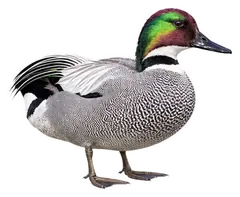 Falcated DuckMareca falcata
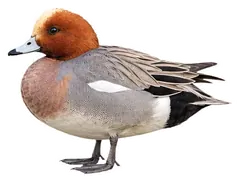 Eurasian WigeonMareca penelope
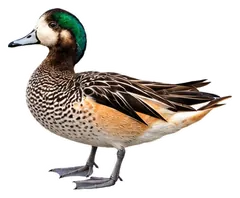 Chiloe WigeonMareca sibilatrix
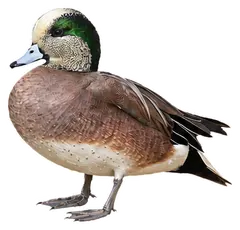 American WigeonMareca americana
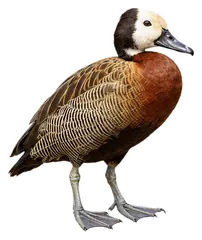 White-faced Whistling DuckDendrocygna viduata
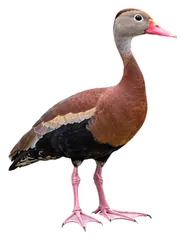 Black-bellied Whistling DuckDendrocygna autumnalis
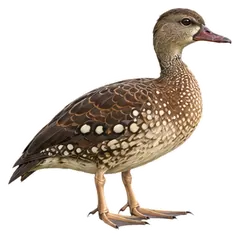 Spotted Whistling DuckDendrocygna guttata
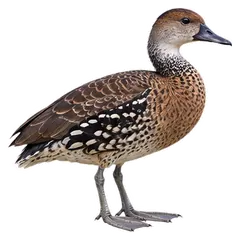 West Indian Whistling DuckDendrocygna arborea
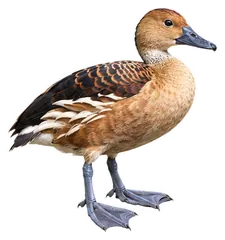 Fulvous Whistling DuckDendrocygna bicolor
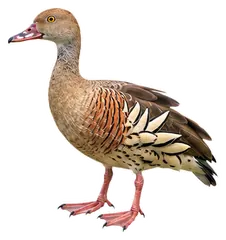 Plumed Whistling DuckDendrocygna eytoni
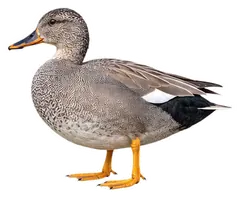
Download illustration
Free to use with credit: “Illustration: Bird Album (birdalbum.com)”. Drawn by AI from a reference photo by Andreas Trepte. ↗

Heard it but can't see it? Mingji identifies birds by sound and photo, on your phone.