 Bird Album
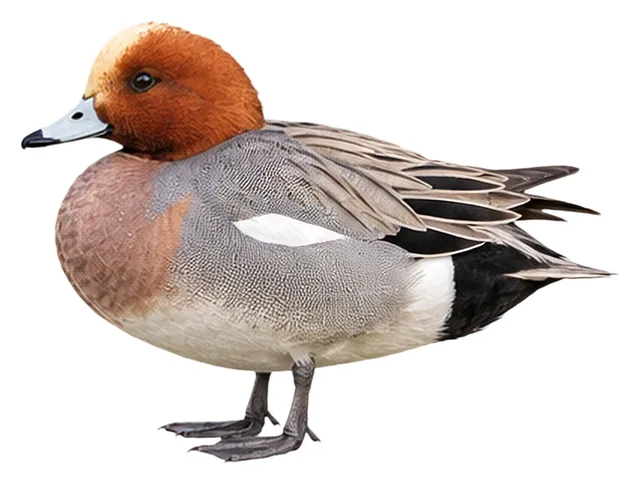
Eurasian Wigeon
Mareca penelope (Linnaeus, 1758)
42–52 cmLength770 gWeight
The male is conspicuous with a chestnut head and a creamy-yellow patch on the forehead and crown.
Busiest months: October–January · Most records: United Kingdom, United States, China
Looks like American Wigeon
How to identify
Field marks
- Male has a rufous head and neck, with a creamy-yellow forehead and crown
- Male has grayish-white upperparts densely covered with fine dark brown wavy markings
- Male has black uppertail-coverts and undertail-coverts
- Male has an emerald-green speculum edged with black, and white secondary coverts
Male, female and young
Female rufous-brown overall with a pure white belly; male in eclipse plumage in the non-breeding season resembles female more closely.
Voice
Male gives a whistle-like “pjiew pjiew”; female gives a low howl, “rawr”.
Similar species
Where and when it's recorded
Busiest months: October–January · Most records: United Kingdom, United States, China

Eurasian Wigeon has been recorded at 2,515 of the 8,276 birding hotspots we track, in 111 countries and regions.
Records by month Northern Hemisphere
Where it's recorded most
- KaldbakstjarnirIceland6,457 records
- Titchwell Marsh RSPB ReserveUnited Kingdom5,094 records
- Billy Frank Jr. Nisqually NWRUnited States4,212 records
More places
- Cape Island – Cape May Point SPUnited States3,803 records
- Minsmere RSPB ReserveUnited Kingdom3,745 records
- Amwell HMWT NRUnited Kingdom3,513 records
- Cley & Salthouse Marshes NWT NR – Cley Marshes including Hides and Visitor CentreUnited Kingdom3,343 records
- Rutland WaterUnited Kingdom3,057 records
- Blackie SpitCanada2,937 records
- Mai Po Nature ReserveHong Kong (China)2,923 records
Countries and regions with the most records
eBird records via GBIF up to 2024-12-31. A record means someone listed it; more records partly mean more birders, not more birds.
About
The Eurasian wigeon or European wigeon (Mareca penelope), also known as the widgeon or wigeon, is one of three extant species of wigeon in the dabbling duck genus Mareca. It is common and widespread within its Palearctic range.
Excerpt from Wikipedia, CC BY-SA 4.0 · authors · Read more on Wikipedia
Questions
How big is the Eurasian Wigeon?
The Eurasian Wigeon is about 42–52 cm long and weighs around 770 g.
Where does the Eurasian Wigeon live?
Its breeding range: Palearctic: northern Eurasia. It is most often recorded in United Kingdom, United States and China.
When is the best time to see the Eurasian Wigeon?
At the hotspots we track, it is recorded most in January, October, November and December (Northern Hemisphere).
Is the Eurasian Wigeon endangered?
The IUCN Red List classifies the Eurasian Wigeon as Least Concern.
What does the Eurasian Wigeon eat?
Main food: Omnivore.
What family is the Eurasian Wigeon in?
It belongs to the family Ducks, Geese, Swans (Anatidae), order Anseriformes.
At a glance
- Length
- 42–52 cm
- Weight
- 770 g
- Habitat
- Wetland
- Diet
- Omnivore
- Lifestyle
- Active on the ground
- Migration
- Migratory
- Conservation
- Least Concern
More measurements
- Wing
- 251 mm
- Tail
- 90 mm
- Bill
- 38 mm
- Tarsus
- 36 mm
Averages from the AVONET dataset; length from field guides where available.
Range
Palearctic: northern Eurasia
Breeding range, IOC World Bird List 15.2
Classification
- Order
- Anseriformes
- Family
- Ducks, Geese, Swans Anatidae
- Genus
- Mareca
Other birds in the genus Mareca
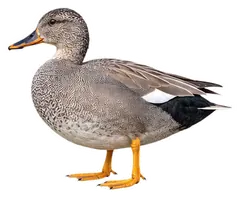 GadwallMareca strepera
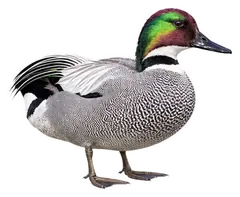 Falcated DuckMareca falcata
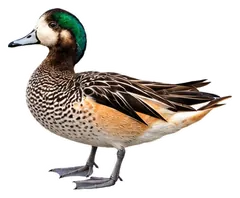 Chiloe WigeonMareca sibilatrix
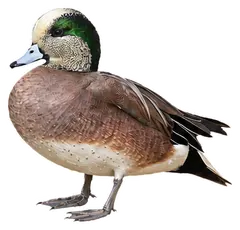 American WigeonMareca americana
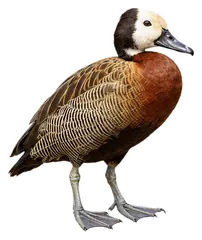 White-faced Whistling DuckDendrocygna viduata
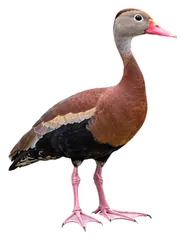 Black-bellied Whistling DuckDendrocygna autumnalis
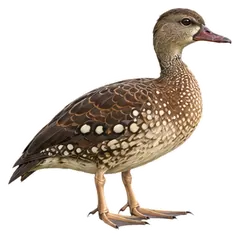 Spotted Whistling DuckDendrocygna guttata
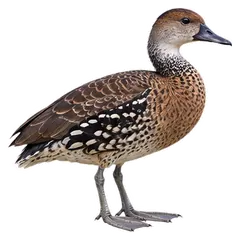 West Indian Whistling DuckDendrocygna arborea
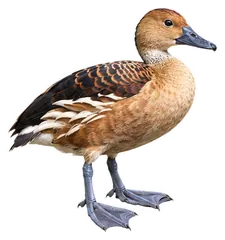 Fulvous Whistling DuckDendrocygna bicolor
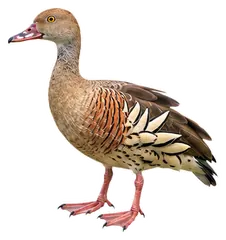 Plumed Whistling DuckDendrocygna eytoni
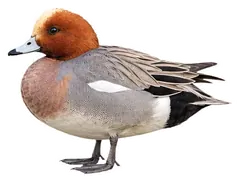
Download illustration
Free to use with credit: “Illustration: Bird Album (birdalbum.com)”. Drawn by AI from a reference photo by Laitche. ↗

Heard it but can't see it? Mingji identifies birds by sound and photo, on your phone.