 Bird Album
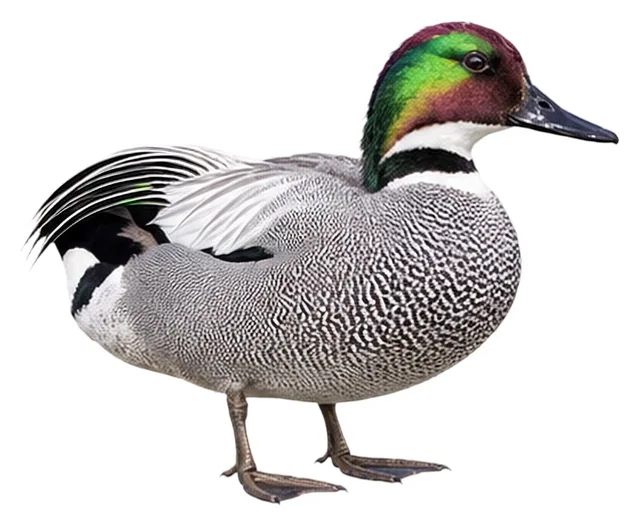
Falcated Duck
Mareca falcata (Georgi, 1775)
50 cmLength646 gWeight
In the breeding season, the male has a bronze crown, slightly elongated green nape feathers and sickle-shaped tertials drooping behind the back.
Busiest months: December–January · Most records: China, Japan, South Korea
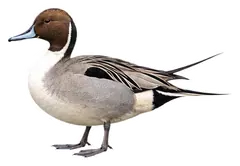
Looks like Northern Pintail
How to identify
Field marks
- Elongated, sickle-shaped tertials trail in the water
- Male in the breeding season has a bronze crown and slightly elongated green nape feathers
- Crescent-shaped white patch on the jaw, with a thin dark green collar below
- Breeding male has wavy markings on the breast and flanks, with creamy-yellow areas on either side below the tail
Male, female and young
Female mainly dark brown and black, without sickle-shaped tertials; tail feathers somewhat long and pointed.
Voice
Male gives a sharp, bright whistle, “tyu-tyu-vit”; female has a harsh voice; usually quiet.
Similar species
Where and when it's recorded
Busiest months: December–January · Most records: China, Japan, South Korea

Falcated Duck has been recorded at 711 of the 8,276 birding hotspots we track, in 25 countries and regions.
Records by month Northern Hemisphere
Where it's recorded most
- Mai Po Nature ReserveHong Kong (China)886 records
- Nanhui DongtanChina633 records
- Shahe ReservoirChina386 records
More places
- Gajoldoba Barrage JGIndia373 records
- Wild Duck LakeChina330 records
- Chiyoda Ward – Imperial Palace – Sakurada MoatJapan324 records
- South Lake, YuhangChina286 records
- Yilan – WuweigangTaiwan (China)284 records
- Muravyevka ParkRussia245 records
- Aogu Wetland IBATaiwan (China)238 records
Countries and regions with the most records
eBird records via GBIF up to 2024-12-31. A record means someone listed it; more records partly mean more birders, not more birds.
About
The falcated duck or falcated teal (Mareca falcata) is a gadwall-sized dabbling duck from the east Palearctic (East Siberia and Mongolia to North Japan; wintering to India).
Excerpt from Wikipedia, CC BY-SA 4.0 · authors · Read more on Wikipedia
Questions
How big is the Falcated Duck?
The Falcated Duck is about 50 cm long and weighs around 646 g.
Where does the Falcated Duck live?
Its breeding range: Palearctic: Mongolia, eastern Siberia and northeastern China. It is most often recorded in China, Japan and South Korea.
When is the best time to see the Falcated Duck?
At the hotspots we track, it is recorded most in January and December (Northern Hemisphere).
Is the Falcated Duck endangered?
The IUCN Red List classifies the Falcated Duck as Least Concern.
What does the Falcated Duck eat?
Main food: Aquatic plants.
What family is the Falcated Duck in?
It belongs to the family Ducks, Geese, Swans (Anatidae), order Anseriformes.
At a glance
- Length
- 50 cm
- Weight
- 646 g
- Habitat
- Wetland
- Diet
- Aquatic plants
- Lifestyle
- On the water surface
- Migration
- Migratory
- Conservation
- Least Concern
More measurements
- Wing
- 238 mm
- Tail
- 64 mm
- Bill
- 46 mm
- Tarsus
- 36 mm
Averages from the AVONET dataset; length from field guides where available.
Range
Palearctic: Mongolia, eastern Siberia and northeastern China
Breeding range, IOC World Bird List 15.2
Classification
- Order
- Anseriformes
- Family
- Ducks, Geese, Swans Anatidae
- Genus
- Mareca
Other birds in the genus Mareca
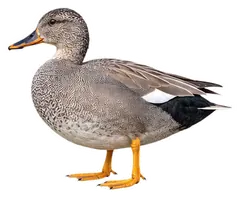 GadwallMareca strepera
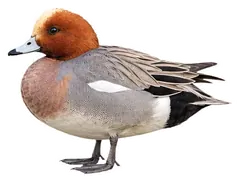 Eurasian WigeonMareca penelope
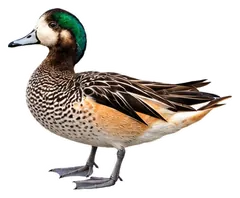 Chiloe WigeonMareca sibilatrix
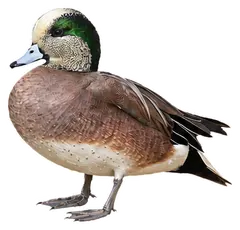 American WigeonMareca americana
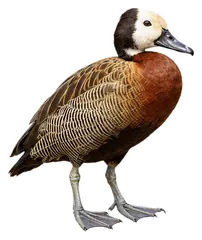 White-faced Whistling DuckDendrocygna viduata
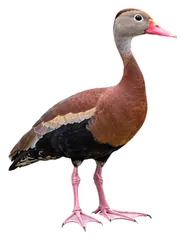 Black-bellied Whistling DuckDendrocygna autumnalis
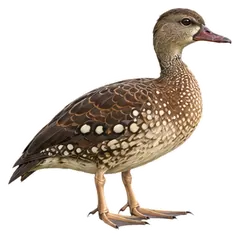 Spotted Whistling DuckDendrocygna guttata
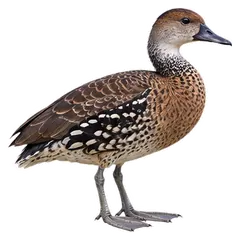 West Indian Whistling DuckDendrocygna arborea
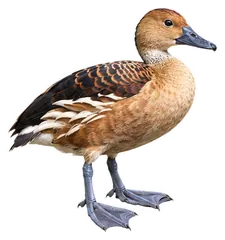 Fulvous Whistling DuckDendrocygna bicolor
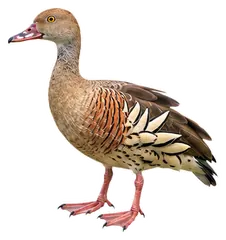 Plumed Whistling DuckDendrocygna eytoni
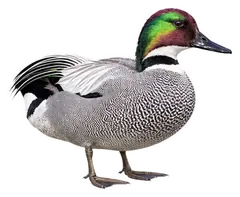
Download illustration
Free to use with credit: “Illustration: Bird Album (birdalbum.com)”. Drawn by AI from a reference photo by Francis C. Franklin. ↗

Heard it but can't see it? Mingji identifies birds by sound and photo, on your phone.