 Bird Album
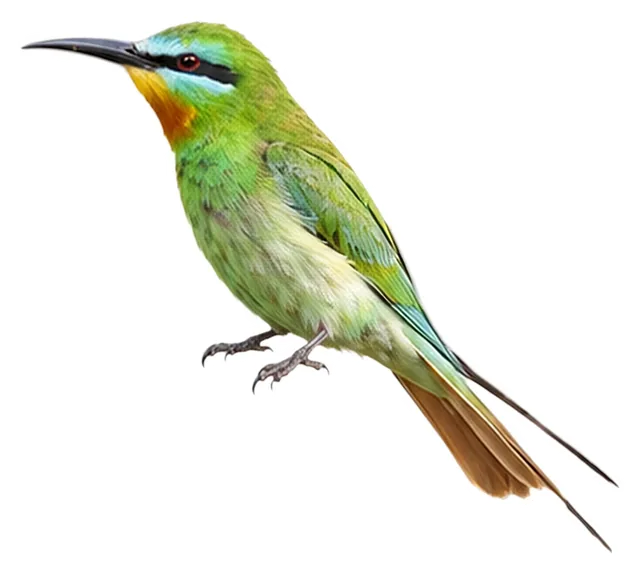
Blue-cheeked Bee-eater
Merops persicus Pallas, 1773
30 cmLength49 gWeight
It has a mostly green body and a black eyestripe across the blue sides of the face.
Busiest months: September · Most records: India, United Arab Emirates, Israel
How to identify
Field marks
- Sides of face blue; eyestripe black
- Body mostly green
- Throat two-toned yellow and brown
- Two central tail feathers elongated
Male, female and young
Sexes broadly similar; female has shorter elongated tail feathers.
Voice
Calls are flatter and less flute-like than those of Blue-tailed Bee-eater.
Where and when it's recorded

Blue-cheeked Bee-eater has been recorded at 548 of the 8,171 birding hotspots we track, in 67 countries and regions.
Records by month Northern Hemisphere
Where it's recorded most
- Changaram Wetlands – EzhupunnaIndia1,127 records
- Al Jahra Reserve (Restricted access)Kuwait825 records
- International Birding and Research Center Eilat (IBRCE)Israel803 records
More places
- Private estate near Green MubazzarahUnited Arab Emirates629 records
- Wamm FarmsUnited Arab Emirates542 records
- Dubai Pivot FieldsUnited Arab Emirates504 records
- Besh Barmag bottleneckAzerbaijan399 records
- Mushrif Palace GardensUnited Arab Emirates399 records
- Kfar Ruppin fishpondsIsrael338 records
- Bardena – Galugah Raptor Count SiteIran335 records
Countries and regions with the most records
eBird records via GBIF up to 2024-12-31. A record means someone listed it; more records partly mean more birders, not more birds.
About
The blue-cheeked bee-eater (Merops persicus) is a species of bee-eater that breeds in Northern Africa and the Middle East from eastern Turkey to Kazakhstan and India. It is generally strongly migratory, wintering in tropical Africa, although some populations are resident year-round in the Sahel. This species occurs as a rare vagrant north of its breeding range, with most vagrants occurring in Italy and Greece.
Excerpt from Wikipedia, CC BY-SA 4.0 · authors · Read more on Wikipedia
Questions
How big is the Blue-cheeked Bee-eater?
The Blue-cheeked Bee-eater is about 30 cm long and weighs around 49 g.
Where does the Blue-cheeked Bee-eater live?
Its breeding range: Palearctic: southwestern, northwestern Africa. It is most often recorded in India, United Arab Emirates and Israel.
When is the best time to see the Blue-cheeked Bee-eater?
At the hotspots we track, it is recorded most in September (Northern Hemisphere).
Is the Blue-cheeked Bee-eater endangered?
The IUCN Red List classifies the Blue-cheeked Bee-eater as Least Concern.
What does the Blue-cheeked Bee-eater eat?
Main food: Insects & other invertebrates.
What family is the Blue-cheeked Bee-eater in?
It belongs to the family Bee-eaters (Meropidae), order Coraciiformes.
At a glance
- Length
- 30 cm
- Weight
- 49 g
- Habitat
- Desert
- Diet
- Insects & other invertebrates
- Lifestyle
- Perches in trees
- Migration
- Migratory
- Conservation
- Least Concern
More measurements
- Wing
- 154 mm
- Tail
- 89 mm
- Bill
- 47 mm
- Tarsus
- 14 mm
Averages from the AVONET dataset; length from field guides where available.
Range
Palearctic: southwestern, northwestern Africa
Breeding range, IOC World Bird List 15.2
Classification
- Order
- Coraciiformes
- Family
- Bee-eaters Meropidae
- Genus
- Merops
Other birds in the genus Merops
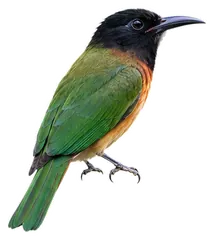 Black-headed Bee-eaterMerops breweri
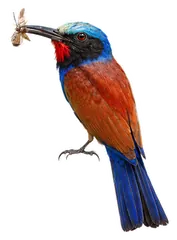 Blue-headed Bee-eaterMerops muelleri
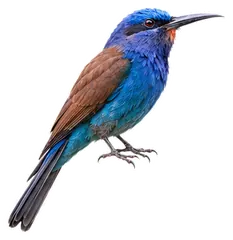 Blue-moustached Bee-eaterMerops mentalis
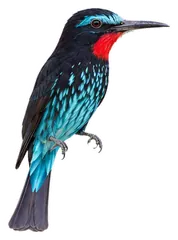 Black Bee-eaterMerops gularis
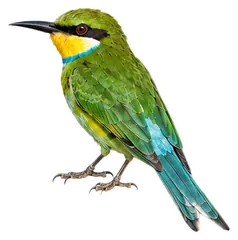 Swallow-tailed Bee-eaterMerops hirundineus
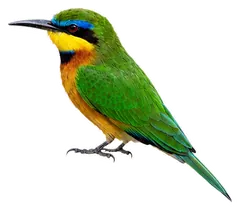 Little Bee-eaterMerops pusillus
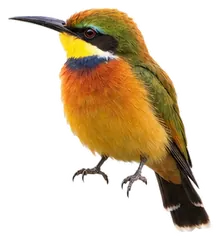 Blue-breasted Bee-eaterMerops variegatus
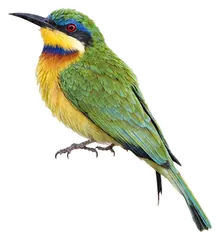 Ethiopian Bee-eaterMerops lafresnayii
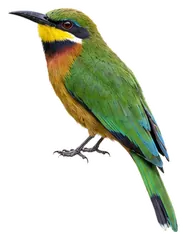 Cinnamon-chested Bee-eaterMerops oreobates
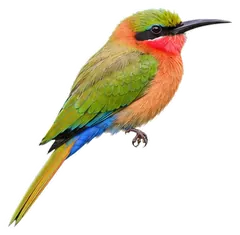 Red-throated Bee-eaterMerops bulocki
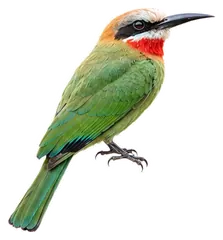 White-fronted Bee-eaterMerops bullockoides
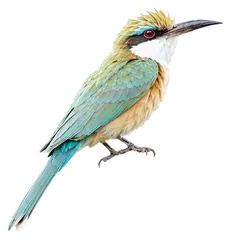 Somali Bee-eaterMerops revoilii
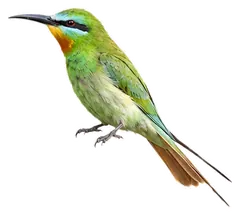
Download illustration
Free to use with credit: “Illustration: Bird Album (birdalbum.com)”. Drawn by AI from a reference photo by 洪廷維. ↗
Heard it but can't see it? Mingji identifies birds by sound and photo, on your phone.